

What Is a Tech Pack in Plush Toy Manufacturing?
Last reviewed: August 2026 | Audience: Brand owners, promotional product buyers, corporate gifting buyers, retail buyers, IP/licensing managers, e-commerce sellers sourcing custom plush | Reading time: ~11 min
Quick Answer
A tech pack (technical package) is the master document a buyer sends a plush toy factory before development starts — it translates a design concept into buildable manufacturing instructions covering shape, materials, construction, color, safety compliance, and packaging.
What trips up most first-time buyers is that “tech pack” and “spec sheet” are not always the same document across the industry — one competitor treats them as synonyms, while the broader manufacturing convention treats “spec sheet” as just the measurements section nested inside a larger tech pack.
Rather than trusting the label, the safer approach is to verify what a document actually covers against a fixed checklist of sections, regardless of what your factory calls it.
What this article covers:
• What a tech pack is, and where it fits in the plush development timeline
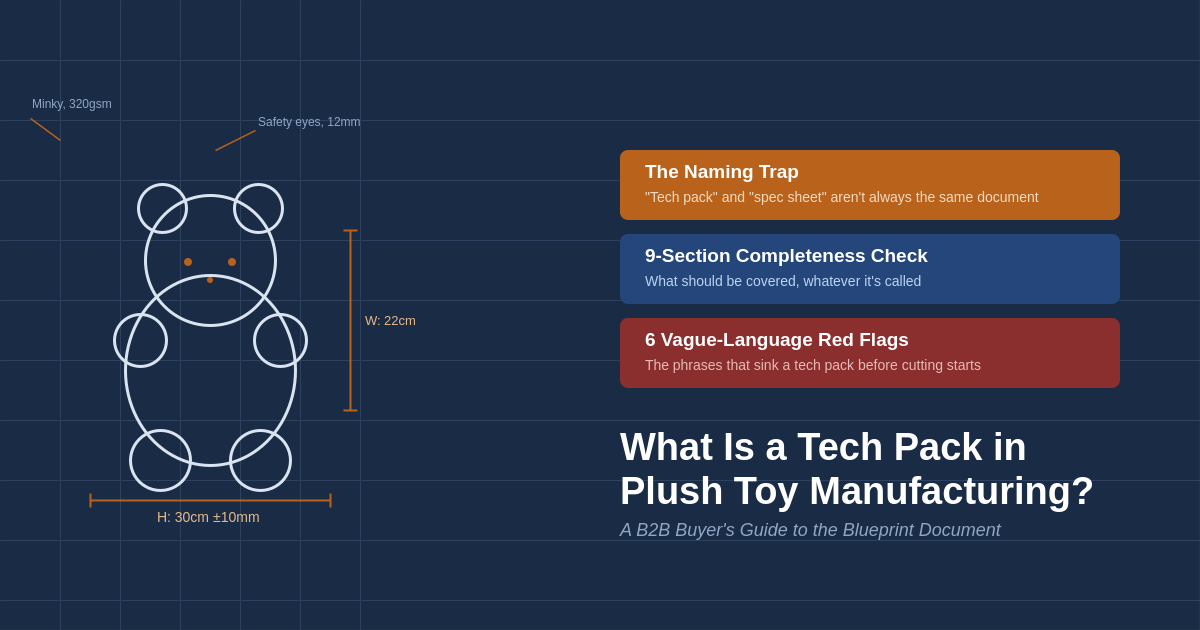
• The Naming Trap — why “tech pack” and “spec sheet” don’t reliably mean the same thing
• The Nine-Section Completeness Check — what should be covered, whatever it’s called
• The vague-language red flags that cause the most costly production mistakes
• Real benchmark numbers (tolerances, stitch density, AQL) across three product tiers
• A buyer’s checklist of what to prepare before requesting a quote or sample
• How to choose a factory based on how they actually handle your tech pack

What Is a Tech Pack? — Definition and Purpose
A tech pack is the document that turns a plush toy concept into something a factory can actually build. Before a factory cuts a single piece of fabric, it needs an unambiguous answer to a long list of questions: What does the character look like from every angle? What fabric, in what weight and pile height? What color, matched to what standard? How is it sewn together, and where does it need reinforcement? What filling, and how much? What safety standards does it need to pass? How is it packaged? A tech pack is where a buyer answers all of that in one place, instead of leaving the factory to guess or assume.
In a typical plush development timeline, the tech pack comes first — reviewed by the factory for feasibility before pattern-making and the first physical prototype begins. (If you’ve read our guide to the prototype/sculpt stage, the tech pack is the document that stage is built from — the prototype is the factory’s physical answer to what the tech pack specified.) A detailed tech pack shortens that first sampling cycle, because the factory isn’t spending revision rounds guessing at details you could have specified upfront.
The purpose of a tech pack is narrower than it sounds: it isn’t meant to describe the *brand story* behind a character, or aspirational language about “premium quality.” It’s meant to remove every ambiguity a factory would otherwise have to resolve on its own — because every ambiguity a factory resolves on its own is a guess, and every guess is a chance the result doesn’t match what you had in mind.

The Naming Trap — Why “Tech Pack” and “Spec Sheet” Aren’t Always the Same Document
Here’s a genuine inconsistency worth knowing about before you ask a factory for either document: the plush toy industry does not use “tech pack” and “spec sheet” consistently.
One documented plush-factory resource treats the two terms as interchangeable, referring to the same document throughout as “a plush toy specification sheet — usually called a ‘spec sheet’ or ‘tech pack.'” A second plush-industry source uses “tech pack” exclusively, never once mentioning “spec sheet” as a term. Meanwhile, the broader apparel and soft-goods manufacturing convention — where the tech pack concept originated — draws a narrower line: the spec sheet (short for “specification sheet”) is one section inside a tech pack, specifically the page of exact measurements, not the whole document. Industry glossaries in that space explicitly flag this as a common point of confusion, noting that a tech pack “gets confused with a garment spec sheet” by buyers who assume the terms are equivalent.
Why this matters for you as a buyer: if you ask two different factories for “a spec sheet,” you may get two very different documents back — one factory’s complete, contract-grade production document, and another factory’s narrower measurement-only page. Neither factory is wrong; they’re just using the term differently. The mistake is assuming the name tells you the scope.
The practical fix: don’t rely on what a document is called. Rely on what it actually contains. That’s what the next section gives you — a fixed checklist of sections that should be covered somewhere in your development paperwork, whether your factory hands you one document called a “tech pack” or splits it into a design brief plus a separate spec sheet.

The Nine-Section Completeness Check — What Should Be In It, Whatever It’s Called
Regardless of naming, a complete plush tech pack needs to cover nine functional areas. This list reconciles two independently documented plush-factory frameworks — one organized around design/material/construction/color/safety/packaging, the other around a more granular nine-section production and commercial structure — into a single checklist you can use to audit any document a factory sends you, or any brief you’re preparing to send out.
# | Section | What It Should Answer | Commonly Missing |
|---|---|---|---|
1 | Product ID | Product name, SKU, factory reference code, version number, sign-off date | Version number |
2 | Drawings & dimensions | Front/side/back views, key measurements, tolerances for each | Tolerances |
3 | Fabric & materials | Fiber type, pile height, GSM, color reference, dye-lot control | Materials named only by category |
4 | Construction & stitching | Stitch type per seam, stitch density, seam allowance, reinforcement points | Reinforcement at stress points |
5 | Accessories & trims | Eyes/nose/embroidery specs, attachment method, safety certification | Certification for safety eyes |
6 | Stuffing | Fill material, fill weight with tolerance, density anchored to reference sample | Physical reference sample |
7 | Packaging | Package type, dimensions, materials, barcode placement, case-pack config | Case-pack / master carton specs |
8 | Safety & compliance | Standards by market (ASTM F963, CPSIA, EN71), test reports, labeling | Standard code + version number |
9 | Quantity, pricing & terms | Order quantity, lead time, Incoterms, AQL standard, defect remedy | AQL standard definition |
A tech pack this thorough typically runs several pages for a standard character plush — a one-page brief for a retail-bound product is a sign that at least some of these nine areas were left undefined, not that the product is simple.

The Vague-Language Red Flags That Sink a Tech Pack
Most tech pack problems don’t come from missing sections — they come from sections that are present but too vague to actually constrain what the factory produces. Six patterns show up repeatedly as the source of costly misunderstandings:
— Qualitative language standing in for a number. “High quality,” “premium,” “industry standard,” or “appropriate” fill in for material weight, stitch density, or fill firmness — and none of those phrases can be enforced, because none of them mean the same thing to a buyer and a production line.
— Dimensions with no tolerance. A measurement without a stated acceptable variance leaves the factory to apply whatever tolerance it considers normal, which may be looser than what your retail packaging or brand expectations assume.
— Materials named only by category. “Minky” or “velboa” alone, without pile height, GSM, or a color reference, leaves room for the factory to substitute any fabric that fits the category — not necessarily the one you had in mind.
— No physical reference sample for subjective qualities. Firmness, color, and “feel” are subjective; without a physical swatch or approved sample both sides hold, there’s nothing to measure a disputed batch against.
— No certification requirement stated upfront. If a safety standard, material certification (like GRS or OEKO-TEX for eco materials), or test report isn’t specified as a requirement in the document itself, it typically doesn’t get produced — compliance has to be requested, not assumed.
— No version control. Tech packs get revised during sampling. Without a version number on the document, there’s no reliable way to confirm both sides are looking at the same version when a dispute comes up later.
A real practice from the factory floor: rather than assuming a tech pack is complete, our production team reviews every client tech pack before quoting or scheduling development. Wherever something reads as ambiguous — a color without a reference, a material named only by category — we go back to the client and get it confirmed in writing before any cutting starts. The goal is to catch the gap on paper, not in a finished batch.

Tech Pack Benchmarks by Product Tier — Tolerances, Stitch Density, and AQL
Numbers help more than adjectives, but “what’s normal” genuinely varies by product tier. The table below reflects one documented factory’s real tiered examples — treat it as a directional benchmark to calibrate your own expectations against, not a universal standard every factory follows exactly.
Spec | Budget (e.g., keychain) | Mid-Market (character plush) | Premium (designer/collector) |
|---|---|---|---|
Dimensional tolerance | ±5mm | ±10mm | ±8mm (tighter, larger piece) |
Fabric | Velboa, ~240gsm, 3mm pile | Premium minky, ~320gsm, 8mm pile, single dye lot | Wool/mohair blend, ~480gsm, 12mm pile, reserved bolt |
Stuffing | Virgin polyester fiberfill | GRS-certified recycled fiberfill, sample-anchored density | Organic cotton + polyester blend, weighted pellet pouches |
Stitch density | 8 SPI | 10 SPI body, 12 SPI at joints | 12 SPI machine, hand-stitching at head/limb |
Safety eyes | Plastic snap-fit, basic cert | Snap-fit, metal backing washer, pull-test cert | Hand-attached custom eyes, heritage-grade |
AQL standard | 2.5–4.0 | 2.5 | 1.5 |
What this tells you as a buyer: the jump from budget to premium isn’t just fabric cost — it’s the tightness of every tolerance, the certification level of every material, and the AQL standard the whole batch is inspected against. If your tech pack specifies premium-tier language (“hand-finished,” “heritage quality”) but a budget-tier AQL and no dye-lot control, the document is internally inconsistent, and that inconsistency is exactly what a factory will end up resolving by guesswork.

Buyer’s Checklist — What to Send Before You Request a Quote or Sample
This is the practical minimum a factory needs from you before development can start — organized the way a production team actually reviews an incoming brief.
Design and appearance
☐ Clear design sketches or drawings — ideally with dimensions, proportions, and part-level detail (eyes, ears, mouth, and other features called out specifically)
☐ 3D design files or a model, if you have them — these help the factory understand structure and form faster than 2D alone
☐ Color requirements clearly stated, with a color card or reference image if there’s anything brand-specific or non-standard
☐ Fabric preference — ask what plush fabric options the factory offers and choose a texture that fits the product (short pile, long pile, ultra-soft, etc.)
☐ Decoration details — eyes, nose, mouth, clothing, and whether they’re embroidered, sewn, or attached as separate accessories
☐ Size specification — height, width, and thickness clearly stated, matched to the product’s intended use
Materials and filling
☐ Fabric type and quality confirmed with the factory against your softness, safety, and durability expectations
☐ Filling material specified — PP cotton is the common baseline; confirm the filling meets safety standards and isn’t a substandard substitute
☐ Safety and environmental standards named explicitly for your target market (for example, EU EN71 or US ASTM F963), if your target market requires them
Before you approve anything, ask your factory directly: “If anything in what I’ve sent is ambiguous, will you flag it and confirm with me before starting, or will you make a reasonable assumption and proceed?” The answer to that question tells you more about how the relationship will go than the tech pack template itself.

How to Choose a Factory Based on How They Handle Your Tech Pack
A factory’s response to an imperfect tech pack — and virtually every buyer’s first tech pack is imperfect — is one of the clearest signals of how the rest of the relationship will go.
1. Do they review before they quote or schedule, not after? A factory that reads your tech pack for gaps before committing to a price or timeline is trying to prevent problems; a factory that quotes instantly off an incomplete brief is pricing in guesswork you won’t see until the sample arrives.
2. Do they flag ambiguity and confirm it with you in writing, rather than assuming? This is the single biggest differentiator described in this guide — a factory that stops and asks about a vague color or material reference, rather than proceeding on an internal assumption, is the one catching problems on paper instead of in a finished batch.
3. Do they have their own minimum-requirement checklist they share upfront? A factory that can hand you a clear list of what they need — design detail, material preference, size, safety standard — before you even finish your first draft is signaling they’ve done this many times and know exactly where gaps usually occur.
4. Do they name specific standards, not just “compliant”? Listen for ASTM F963-23 or EN71 named by code and version, not a vague “we meet all safety standards” — the same distinction that separates a real tech pack from a vague one applies to how a factory talks about compliance.
5. Do they push back on internal inconsistency? A tech pack that mixes premium-tier language with budget-tier numbers should prompt a question from your factory, not a silent quote at whichever tier is cheaper for them to produce.
6. Do they version-control revisions? If your tech pack changes during sampling, does the factory track which version is currently approved, or does “the latest WhatsApp message” become the de facto spec?
Frequently Asked Questions
What is a tech pack in plush toy manufacturing?
A tech pack (technical package) is the master document a buyer provides before development begins, specifying a plush toy’s design, materials, construction, color standards, safety compliance, and packaging in enough detail for a factory to build it without guessing.
Is a tech pack the same thing as a spec sheet?
Not always — this is a genuine point of inconsistency across the industry. Some plush factories use the terms interchangeably to mean the same complete document. In the broader apparel/soft-goods convention the tech pack concept comes from, “spec sheet” more narrowly refers to just the measurements section nested inside a larger tech pack. Don’t assume based on the name — verify what the document actually covers.
What should be included in a plush toy tech pack?
At minimum: design drawings/3D files, color references, fabric type and quality, filling material and safety standard, construction and stitching details, and applicable safety compliance requirements (such as ASTM F963 or EN71). More complete tech packs also specify dimensional tolerances, AQL inspection standards, and packaging specifications.
What happens if my tech pack is incomplete or vague?
It depends on the factory. Some factories will proceed on their own reasonable assumptions, which may not match what you intended. A better practice — and the one to look for when choosing a factory — is one that reviews your tech pack for ambiguity and confirms unclear points with you in writing before development starts.
Do I need a full tech pack for a small or simple plush order?
Yes, though it can be shorter. Even simple products like a plush keychain benefit from covering the same core sections — design, material, construction, safety — just with fewer pages than a complex character plush with multiple accessories.
How is a tech pack different from a prototype?
They’re sequential, not interchangeable. The tech pack is the written instruction document; the prototype (or “sculpt”) is the factory’s first physical build made from those instructions, used to confirm shape and construction match what the tech pack specified.
Glossary
Term | Definition |
|---|---|
The Naming Trap | This article’s framework: the observation that “tech pack” and “spec sheet” are not consistently used to mean the same document across the industry — verify content, not terminology |
Tech pack | The master development document specifying a product’s design, materials, construction, and compliance requirements for manufacturing |
Spec sheet | Depending on the source, either a synonym for a complete tech pack, or — in the broader apparel/soft-goods convention — the narrower measurements section within one |
Tolerance | The acceptable range of variation from a stated measurement, dimension, or weight |
AQL (Acceptable Quality Limit) | The industry-standard threshold defining the maximum percentage of defective units a batch can contain before inspection rejects it |
Disclaimer: This article describes plush toy tech pack practices and benchmark figures as commonly documented and practiced as of August 2026; specific requirements, tolerances, and terminology vary by factory — confirm your specific factory’s approach and requirements in writing before development begins. Nothing in this article constitutes a guarantee of any particular factory’s process, and cited safety standards should be verified against their current official revision before use in a real compliance document.
References
4. Apparel/soft-goods industry tech pack reference — documenting the tech-pack-vs-spec-sheet naming convention (Tier 3)
Ready to Send Your Tech Pack?
Send us your design sketches, material preferences, and target safety standard — we’ll review it for gaps, confirm anything ambiguous with you in writing, and quote from there.
→ Request a Tech Pack Review: CONTACT – Plush Toy Manufacturer|Customized plush toys
→ Related: What Is a Plush Toy Prototype (Sculpt)? | What Is a Mascot Costume? (vs. Plush Toy)