
What Is a Mascot Costume?(vs. Plush Toy)
Last reviewed: August 2026 | Audience: Promotional product distributors, corporate gifting buyers, retail buyers, school/youth program buyers, event marketers | Reading time: ~10 min
Quick Answer
A mascot costume — sometimes called a “walking act costume” in the industry — is a wearable, human-sized garment built around a sculpted foam core and covered in plush or textile fabric, designed for a performer to wear and animate at events. A plush toy is a soft-filled, unworn object built for handling, display, or giveaway.
They can share a visual identity (same character, similar fabric) and even come from the same factory, but they are not variations of the same product — they run on different construction methods, different safety frameworks, and often different production lines entirely.
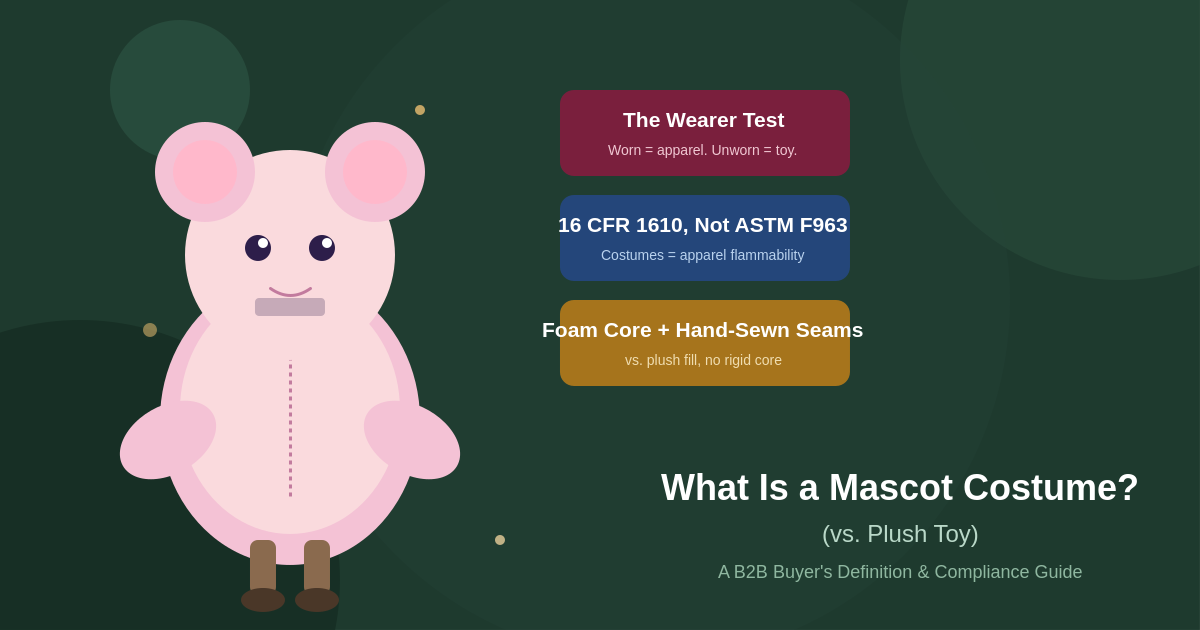
The single test that predicts everything else: does a human wear it? If yes, it’s regulated as apparel (16 CFR Part 1610) and built around performer safety. If no, it’s regulated as a toy (ASTM F963-23) and built around small-parts and material safety for handling.
What this article covers:
• What a mascot costume actually is, and how its construction differs from a plush toy
• The Wearer Test — why costumes and plush toys sit in two separate regulatory frameworks, not one
• A construction and materials comparison table
• Performer safety and ergonomics — a compliance dimension plush toys don’t have at all
• A buyer’s checklist for figuring out whether you need a costume, a plush toy, or both
• MOQ, cost tiers, and how to choose a factory that can actually build both product types well
What Is a Mascot Costume vs. a Plush Toy? — Definition and Construction Differences
A mascot costume is built to be worn and performed in, not held or displayed. In industry terminology it’s sometimes called a walking act costume: the core structure is sculpted from foam — cut, sanded, and shaped into the character’s body and head — and then covered in plush fabric or stuffed and printed textile panels so the final design reads as a soft character from a distance. Embroidery, printed appliqué, and functional elements (rubber-soled feet, ventilation points, a viewing mesh in the head) are added afterward, and any garment components are tailored to fit the performer who will wear it.
A plush toy, by contrast, is a soft-filled object — fabric shell, synthetic or natural filling, sewn seams — with no performer, no rigid core, and no fit requirement. It’s designed to be picked up, hugged, displayed on a shelf, or handed to a customer, not worn and moved through by a person.
The confusion between the two is understandable: they’re often the same character, made by the same factory, sometimes even ordered in the same purchase. But “same character” doesn’t mean “same product.” A mascot costume and a plush toy of the identical design diverge completely once you look past the surface fabric — in what holds them up, who (if anyone) is inside them, and which regulatory system governs them.
Definition Comparison
Attribute | Mascot Costume | |
|---|---|---|
Core structure | Sculpted foam body/head, rigid or semi-rigid | Soft fill (PP cotton or similar), no rigid structure |
Worn by a person? | Yes — built and fitted for a performer | No — held, displayed, or given away |
Industry term | “Walking act costume” | Plush toy / stuffed toy |
Primary use | Live brand activation, events, sports, school spirit | Retail, gifting, giveaway, collectible |
Regulatory starting point | 16 CFR Part 1610 (wearing apparel flammability) | ASTM F963-23 (toy safety) |

The Wearer Test — Why Mascot Costumes and Plush Toys Sit in Two Completely Different Regulatory Frameworks
This is the framework this article is built around, because no source we reviewed while researching this category states it directly: whether a human wears the product is the single variable that determines which entire regulatory system applies. Call it the Wearer Test.
If a human wears it, it’s apparel, not a toy. ASTM F963-23 — the mandatory US toy safety standard — applies to products “designed, manufactured, or marketed as a toy” for children under 14. A mascot costume built for an adult performer at a corporate event, sports game, or school function is not designed, manufactured, or marketed as a toy — it’s performance apparel. It falls instead under 16 CFR Part 1610, the Standard for the Flammability of Clothing Textiles (also called the General Wearing Apparel Standard), which classifies fabrics into three flammability classes and prohibits the most dangerously flammable class (Class 3) from use in clothing entirely.
Adult costumes and children’s costumes carry different certification burdens — but both stay inside the apparel framework, not the toy framework. Adult wearing apparel needs a General Certificate of Conformity (GCC) — a self-certification based on testing or a reasonable testing program, with no requirement for third-party lab testing. Children’s wearing apparel, by contrast, needs a Children’s Product Certificate (CPC), third-party lab testing, tracking labels, and compliance with total lead content and lead-in-paint limits on any components (buttons, snaps, zippers). If your mascot costume program involves a child-sized costume — school mascots occasionally sized for younger performers, for instance — budget for the CPC path, not the lighter adult GCC path.
If a human doesn’t wear it, it’s a toy, not apparel. A plush toy stays inside the ASTM F963-23 / CPSIA / CPC framework covered in our other plush toy compliance research — mechanical hazards, flammability, chemical limits, and (for smaller components) small-parts rules under 16 CFR Part 1501.
Why this distinction matters for a buyer: treating a mascot costume as “basically a big plush toy” and applying toy-safety thinking to it means missing the actual applicable standard (apparel flammability) and the actual required certificate (GCC or CPC) — while a factory that treats a plush toy giveaway as needing costume-grade construction is simply over-building and over-pricing a product that was never going to be worn.

Construction and Materials Comparison
The Wearer Test isn’t just a compliance distinction — it drives a completely different build process.
Mascot costume construction, step by step: the body and head are sculpted from foam, then sanded and shaped to the final character form. The foam core is covered in plush fabric or stuffed/printed textile panels, hand-applied and hand-sewn at the seams rather than glued — glued seams are a mass-market shortcut associated with faster wear and a messier finished look. Functional elements are integrated: a breathable viewing mesh inside the head, ventilation points, rubber-soled feet for grip and durability, and any garment or accessory components tailored to the performer’s fit.
Plush toy construction, by comparison: a fabric shell is cut, sewn, filled with PP cotton or another synthetic fill, and closed. There’s no foam core, no sculpting stage, no fitting-to-a-person stage, and no functional/ventilation engineering — the entire build is oriented around softness, huggability, and shelf/display appeal, not wearability.
Construction & Materials Comparison
Dimension | Mascot Costume | |
|---|---|---|
Core material | Sculpted, sanded foam | None — soft fill only |
Seam construction (quality signal) | Hand-sewn (custom); glued seams are a lower-quality shortcut | Sewn seams, standard plush construction |
Outer covering | Plush fabric or stuffed/printed textile panels over foam | Plush fabric shell, directly filled |
Functional elements | Viewing mesh, ventilation, rubber-soled feet, tailored fit | None — no wearer to accommodate |
Applicable flammability rule | 16 CFR Part 1610 (clothing textiles) | ASTM F963-23 flammability provisions (toy) |
Build complexity driver | Sculpting accuracy + performer fit + durability under repeated wear | Fabric/filling quality + character accuracy |
A quality signal worth putting in your factory brief either way: ask directly whether seams are hand-sewn or glued. This single detail, called out by mascot costume makers as a differentiator between mass-produced and professionally built costumes, correlates strongly with how well the product survives repeated performance use.

Performer Safety and Ergonomics — A Dimension Plush Toys Don’t Have at All
This is the cleanest illustration of why “it’s basically a big plush toy” is the wrong mental model. A plush toy has no wearer, so there is no ergonomics question to ask. A mascot costume has a person inside it, moving, performing, and often working in a warm venue for extended periods — which introduces an entire safety category that doesn’t exist anywhere in plush toy sourcing.
Vision. The performer needs a functional, unobstructed viewing method — typically a mesh panel positioned at mouth or chest height inside the head — that doesn’t compromise the character’s visual design from the outside. Costumes without proper vision engineering are a genuine safety issue for a performer moving through a crowd.
Ventilation. Mascot costumes are worn for extended periods, frequently in warm indoor venues or outdoor events, over a base layer, with the performer moving continuously. Without adequate ventilation, heat buildup inside the costume is a real physical risk, not just a comfort issue.
Mobility. A costume that restricts arm, leg, or head movement limits what a performer can safely do — waving, high-fiving, navigating stairs or crowded areas. Costume construction needs to preserve range of motion, not just visual accuracy.
Foam material safety. Not all foam is appropriate for a garment a person wears against their body for hours. Lower-grade foam (styrofoam-type products, standard upholstery foam) is more prone to breaking down, and upholstery-grade foam in particular is prone to retaining moisture and developing mold or mildew with repeated use and washing — a direct health concern for the performer wearing it. Costume-grade foam should be selected for strength, flexibility, and moisture/bacteria resistance specifically because it’s worn against a person’s body repeatedly.
The buyer takeaway: if your factory brief for a mascot costume program doesn’t include a line item for vision, ventilation, mobility, and foam material grade, it’s an incomplete brief — these aren’t “nice to have” comfort features, they’re the safety dimension unique to a worn product, and they have no equivalent anywhere in a plush toy spec sheet.

Buyer’s Classification and Sourcing Checklist — Do You Need a Costume, a Plush Toy, or Both?
Many B2B buyers in this category end up needing both, and understanding why helps you brief your factory correctly instead of treating one as a scaled-up or scaled-down version of the other.
Why buyers commonly order both. A mascot costume brings a character to life at a live event, game, or brand activation — it’s a performance asset. A plush toy of the same character keeps the brand in the customer’s or fan’s hands after the event ends — it’s a retail or giveaway asset. These serve different points in the customer journey, and ordering both is a common, deliberate pattern rather than redundancy: one client relationship we’ve seen involved a company ordering a plush mascot for retail/giveaway distribution and a matching mascot costume for live performance appearances, as two coordinated but structurally distinct pieces of the same brand program.
Classification checklist for your program:
☐ Wearer test: Will a human be inside this product, performing or appearing at an event? If yes, it’s a costume, and 16 CFR Part 1610 (apparel) is your compliance starting point, not toy safety.
☐ Age of the performer: If the costume will ever be worn by a child-sized performer, budget for the CPC path (third-party testing, tracking labels, lead limits) rather than the lighter adult GCC path.
☐ Distribution intent: Is the product going home with a customer, fan, or employee (retail, gift, giveaway)? That’s a plush toy use case, governed by toy-safety rules, not apparel rules.
☐ Program scope: Does your brand activation need both a live performance presence and a take-home product? If yes, plan for two separate factory builds — not one design scaled two ways.
☐ Factory capability check: Confirm your factory actually runs separate production processes for costume fabrication (foam sculpting, hand-sewn seams, performer-fit construction) and plush toy fabrication (soft-fill, standard plush sewing) — a factory that treats these as the same skill set is a warning sign, not an efficiency.

MOQ, Cost Tiers, and the Factory Brief Checklist
Mascot costumes and plush toys have fundamentally different cost structures, driven by the construction differences covered above. Treat the drivers below as directional planning inputs — confirm actual pricing against your specific design, sizing, and compliance scope with your factory.
Cost drivers for a mascot costume, in rough order of impact:
— Foam sculpting complexity and character detail accuracy
— Seam construction quality (hand-sewn vs. glued — hand-sewn costs more and lasts longer)
— Functional elements (ventilation engineering, viewing mesh, rubber-soled feet)
— Adult vs. children’s sizing (children’s sizing adds CPC/third-party testing cost)
— Sample development and fit iteration with an actual performer
Cost drivers for a matching plush toy, for comparison:
— Size and design complexity (2D flat design vs. 3D character sculpting)
— Fabric and filling grade
— Order volume
Pre-Production Factory Brief: Mascot Costume Programs
☐ Wearer confirmed: adult performer or child-sized — determines GCC vs. CPC path
☐ Fabric flammability class confirmed against 16 CFR Part 1610 (Class 1 or acceptable Class 2 raised-surface fabric only; Class 3 is prohibited)
☐ Foam grade specified for strength, flexibility, and moisture/mold resistance — not standard upholstery foam
☐ Seam construction confirmed as hand-sewn, not glued
☐ Vision, ventilation, and mobility requirements specified and reviewed with an actual performer fitting, not just a static photo approval
☐ GCC (adult) or CPC + tracking label + lead content/lead-in-paint testing (children’s) confirmed as the applicable certification path
☐ If a matching plush toy is also planned, confirmed as a separate line item with its own spec (fabric, filling, ASTM F963-23 scope) — not treated as a scaled version of the costume design

How to Choose a Factory for Mascot Costume Programs
1. Separate production lines for costumes and plush toys. Ask directly whether costume fabrication and plush toy fabrication run on separate lines with separate craftspeople. The two require different skills — foam sculpting and performer-fit construction versus soft-goods sewing — and a factory that runs them as one undifferentiated process is more likely to under-deliver on one or both.
2. Hand-sewn seam capability. Confirm the factory hand-sews seams on costume builds rather than defaulting to glue, and ask to see this in a sample before committing to bulk production.
3. Foam sourcing standards. Ask what foam grade the factory uses and why — a factory that can articulate why it avoids standard upholstery foam (moisture/mold risk) and styrofoam-type products (breaks easily) in favor of costume-grade foam is signaling real category experience.
4. GCC/CPC certification experience. Confirm the factory understands the difference between the adult GCC self-certification path and the children’s CPC third-party-testing path, and ask which one applies to your specific program before production starts — this is a “must-have,” not optional documentation, per direct factory-side confirmation.
5. Performer fitting process. Ask whether the factory conducts an actual fitting review with a person inside the costume (checking vision, ventilation, and mobility) before finalizing production, rather than approving the design from photos alone.
6. Coordinated program experience. If your project includes both a costume and a matching plush toy, ask whether the factory has delivered coordinated programs like this before — the two builds should stay visually consistent as the same character while being engineered as entirely separate products.
Frequently Asked Questions
What is a mascot costume?
A wearable, human-sized garment — sometimes called a “walking act costume” — built around a sculpted foam core covered in plush or textile fabric, designed for a performer to wear and animate at live events, games, or brand activations.
What’s the difference between a mascot costume and a plush toy?
The core test is whether a human wears it. A mascot costume is worn by a performer and built around a rigid foam core, tailored fit, and performer safety features (vision, ventilation, mobility). A plush toy is unworn, soft-filled, and built for handling, display, or giveaway. They fall under different regulatory frameworks entirely — apparel flammability rules (16 CFR Part 1610) for costumes, toy safety rules (ASTM F963-23) for plush toys.
Does a mascot costume need toy safety certification?
No — a mascot costume built for a performer is not designed, manufactured, or marketed as a toy, so ASTM F963-23 doesn’t apply. Instead, it needs to meet 16 CFR Part 1610 (clothing textile flammability) and carry either a General Certificate of Conformity (adult performer) or a Children’s Product Certificate with third-party testing and tracking labels (child-sized performer).
Why do factories often build mascot costumes and plush toys on separate production lines?
Because the construction skills are genuinely different — costume fabrication involves foam sculpting, hand-sewn seams, and performer-fit engineering, while plush toy fabrication is soft-fill sewing with no rigid structure or wearer to accommodate. A factory experienced in this category typically separates the two rather than treating them as the same craft at different scales.
Why would a buyer order both a mascot costume and a matching plush toy?
Because they serve different points in the customer journey: the costume brings the character to life for a live audience at an event, while the plush toy lets the customer or fan take the character home afterward. This is a common, deliberate B2B ordering pattern, not redundant duplication of the same product.
How much does a custom mascot costume cost?
Cost is driven primarily by foam sculpting complexity, seam construction quality (hand-sewn costs more than glued), functional elements like ventilation and vision engineering, and whether the costume needs to meet adult (GCC) or children’s (CPC, third-party tested) certification requirements. Request a factory quote against your specific design and sizing — published general pricing varies too widely by these factors to be useful as a planning figure on its own.
Glossary
Term | Definition |
|---|---|
The Wearer Test | This article’s framework: whether a human wears the product determines whether it’s regulated as apparel (costume) or as a toy (plush) |
Walking act costume | Industry term for a mascot costume — a human-worn costume with a sculpted foam core covered in fabric |
16 CFR Part 1610 | US CPSC standard for the flammability of clothing textiles (General Wearing Apparel Standard); applies to mascot costumes as apparel |
GCC (General Certificate of Conformity) | Self-certification required for adult wearing apparel; no third-party lab testing required |
CPC (Children’s Product Certificate) | Certification required for children’s wearing apparel; requires third-party lab testing, tracking labels, and lead content/lead-in-paint compliance |
ASTM F963-23 | US toy safety standard; applies to products designed, manufactured, or marketed as a toy for children under 14 — not applicable to performer-worn mascot costumes |
Disclaimer: This article describes US wearing-apparel flammability requirements (16 CFR Part 1610) and toy safety requirements (ASTM F963-23) as commonly reported and practiced as of August 2026; specific certification requirements vary by product sizing, intended wearer, and use case — consult a licensed compliance specialist or testing lab before finalizing certification decisions for a mascot costume or plush toy program. Nothing in this article constitutes legal or regulatory advice.
References
1. CPSC.gov — Toy Safety Business Guidance (ASTM F963-23 scope) (Tier 1)
2. CPSC.gov — Clothing Business Guidance (16 CFR Part 1610, GCC, CPC requirements) (Tier 1)
3. eCFR — 16 CFR Part 1610, Standard for the Flammability of Clothing Textiles (Tier 1)
4. Hogtown Mascots — Off-the-Shelf vs. Custom Mascots (construction, materials, performer safety) (Tier 3)
5. Plush Toy Planet — Glossary (“Walking act costume” definition) (Tier 3)
Ready to Source Your Mascot Costume or Matching Plush Toy Program?
Tell us whether you need a performance costume, a take-home plush, or a coordinated program with both — we’ll spec the right construction, safety features, and compliance path for each, built on the production line that actually matches the craft.
→ Request a Mascot Costume / Plush Program Quote: CONTACT – Plush Toy Manufacturer|Customized plush toys
→ Related: What Is a Plush Pillow/Cushion Toy? | What Are Custom Plush Toys Used For?