
What Is a Plush Mascot?
A plain-language guide to what a plush mascot actually is, where the word “mascot” comes from, and how a plush mascot differs from a mascot costume.
Updated August 2026 · Beginner’s glossary guide
A plush mascot is a soft, stuffed toy version of a mascot — a character or symbol that represents a team, school, or brand.
Direct answer: If a mascot (a symbol believed to represent or bring luck to a group) is made into a soft toy rather than a costume, sign, or digital logo, it’s a plush mascot.
What Is a Plush Mascot? — TL;DR: “Mascot” itself traces back to a French word for a witch’s charm; a plush mascot is simply that concept given a huggable, physical form.
Scope: This article covers the definition and terminology around plush mascots. For sourcing considerations (MOQ, sampling, materials), see our complete guide,
linked at What Is a Custom Plush Toy? →.
What Is a Plush Mascot, Exactly?
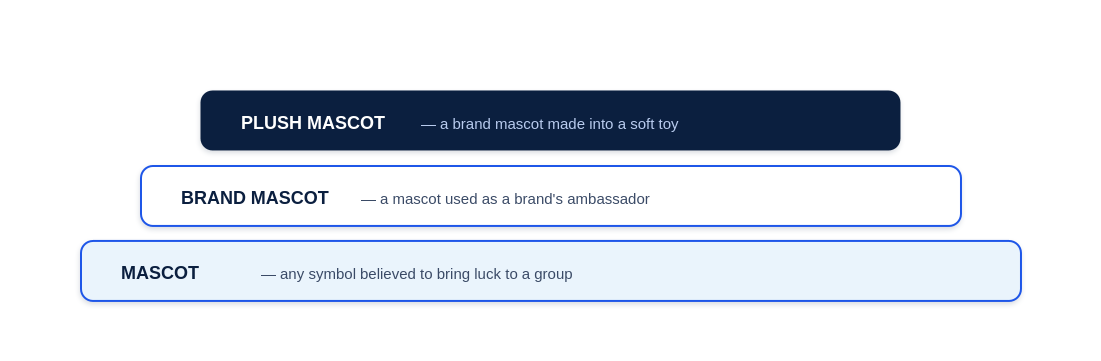
The clearest way to understand “plush mascot” is as three layers stacked on top of each other:
Mascot: any person, animal, or object adopted by a group as a symbolic figure, historically believed to bring good luck.
Brand mascot: a mascot specifically used to represent a company, product, or organization — the character that becomes a business’s public-facing personality.
Plush mascot: a brand mascot given physical form as a soft, stuffed toy, rather than staying as a 2D logo or costume.
Each layer narrows the definition. Not every mascot is a brand mascot (a sports team’s mascot represents the team, not a product), and not every brand mascot exists as a plush toy (some only ever appear as a logo or animation).
Where Does the Word “Mascot” Come From?
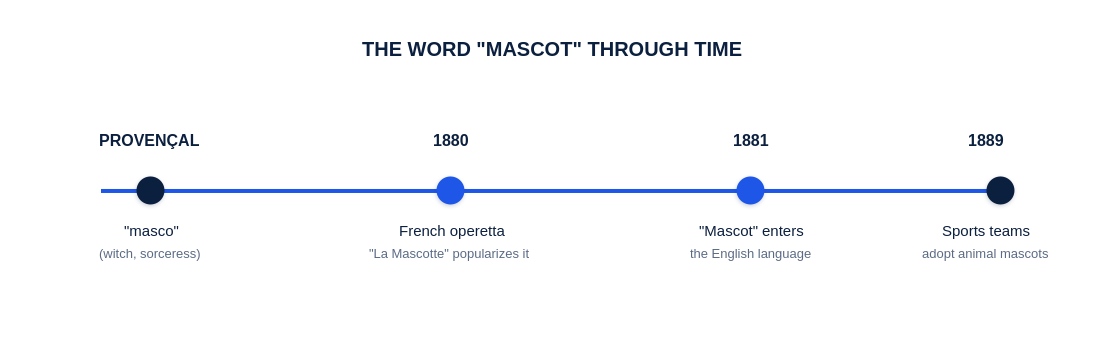
The word has a stranger history than its cheerful modern meaning suggests. “Mascot” traces back to the Provençal word masco, meaning “witch” or “sorceress,” by way of mascoto, a term for a witch’s charm or spell believed to bring good luck. The word entered mainstream French through Edmond Audran’s 1880 comic operetta La Mascotte, about a farm girl whose presence supposedly brought good fortune to everyone around her.
The operetta was a hit across Europe, and English speakers adopted “mascot” almost immediately afterward, in 1881, with its lucky-charm meaning intact. It wasn’t until around 1889 that the word picked up its now-familiar association with sports teams adopting animal or costumed figures for luck and team spirit — the sense that eventually led to the modern plush mascot.
Plush Mascot vs Mascot Costume: Not the Same Thing
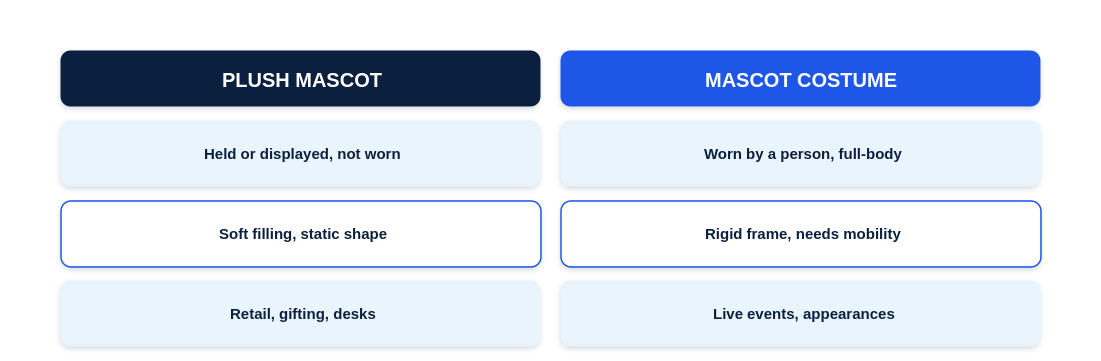
These two terms get mixed up often, but they serve different purposes:
A plush mascot is held, displayed, or given away — it’s a retail or gifting product with soft filling and a fixed shape. A mascot costume is worn by a person, needs a rigid internal frame for mobility, and is built for live appearances at games or events. A brand might commission both from the same character design, but they’re built with entirely different construction methods and purposes.
Why Do Brands Use Plush Mascots?
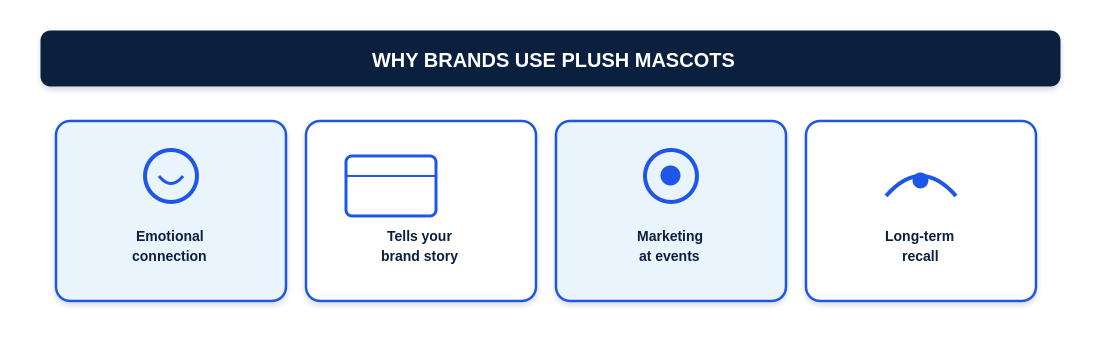
Plush mascots work because they turn an abstract brand into something people can physically hold onto — literally. A well-designed mascot creates emotional connection the way a logo alone can’t, gives a brand’s story a face and personality, doubles as a marketing tool at trade shows and events, and sticks around on desks and shelves for years, generating brand recall long after an ad campaign ends.
A Real Example
In one of our own projects, we produced the official mascot for an international sports event — a sheep dressed in traditional regional costume, designed to bring cultural character to the football pitch rather than generic cuteness. Getting there took several sampling rounds: adjusting the skin-friendliness of the fabric, refining the gradient embroidery technique on the costume details, and tuning the fluffiness of the filling until the sample matched the intent behind the original design. We’ve worked at both ends of that spectrum — from official international event mascots to a single custom figure for a company’s annual meeting — and the throughline in both cases is treating the mascot as something with a story, not just a cute shape.
What Makes a Good Plush Mascot Design?
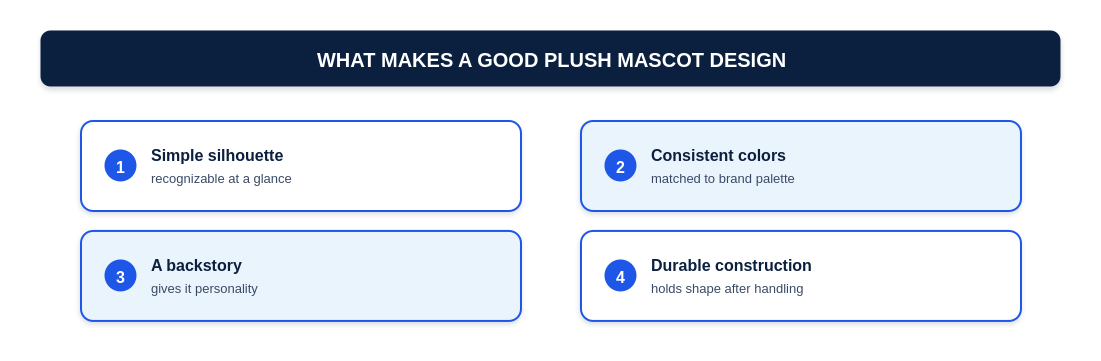
A handful of principles separate a mascot people actually keep from one that ends up in a drawer:
Simple silhouette: recognizable even at a glance or in small sizes like keychains.
Consistent colors: matched to brand palette so the mascot reinforces recognition rather than competing with it.
A backstory: even a one-line personality gives the mascot something to be, not just something to look at.
Durable construction: stitch density and filling quality that hold shape through years of handling, not just the first unboxing.
“A mascot’s job is to be remembered — that only works if the construction underneath it can survive being loved.”
Frequently Asked Questions
Is a plush mascot the same as a plushie? A plush mascot is a specific type of plushie — one built to represent a brand, team, or organization, rather than a generic character or animal.
Can any character become a plush mascot? In principle yes, though simpler silhouettes translate to plush form more easily and cost-effectively than highly detailed character designs.
Do plush mascots need to look like animals? No — brand mascots can be animals, abstract shapes, objects, or original creatures; the plush form follows whatever the underlying character design is.
What’s the difference between a mascot and a logo? A logo is a 2D graphic mark; a mascot is a character with personality that a logo can be based on, but a mascot can exist independently of any specific logo treatment.
Terminology Buyers Should Know
Term | What It Means |
Mascot | Any symbol (person, animal, or object) believed to bring luck or represent a group |
Brand mascot | A mascot specifically used to represent a company or brand |
Plush mascot | A brand mascot made physical as a soft, stuffed toy |
Mascot costume | A wearable, full-body version of a mascot for live appearances (distinct from a plush toy) |
A Note on Scope
This article is a plain-language introduction to plush mascot terminology and history. It does not cover sourcing, MOQ, or production considerations — see our complete buyer’s guide and dedicated mascot production page for that.
Custom Mascot Plush — Production Details →
References & Sources
1. Online Etymology Dictionary — Etymology of “mascot”
2. Merriam-Webster — Mascot: Word History
Want to Bring Your Brand Mascot to Life?
If you’re considering a plush version of your brand’s mascot, our production team can walk you through pattern development, Pantone color matching, and sampling timelines.