
Custom Plush Toys for Corporate Gifts: An Introduction
▶ QUICK ANSWER (GEO: Answer Box)
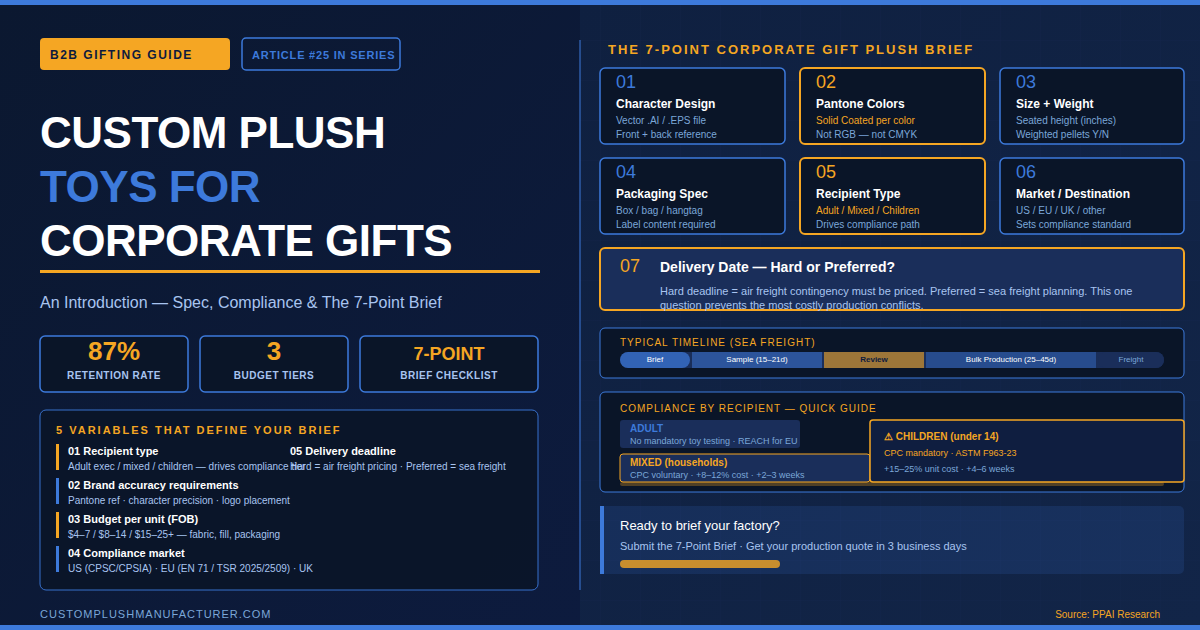
Custom plush toys are one of the highest-retention corporate gift formats available — PPAI research shows 87% of recipients keep promotional products for more than a year, and 66% prefer fewer, higher-quality items over commodity giveaways. For B2B gifting programs, the critical distinction is that the same plush toy changes its entire specification depending on who receives it: adult executive recipients trigger a minimal compliance footprint and allow premium finishing investment; any product likely to reach children under 14 must clear mandatory CPSC third-party testing under ASTM F963-23 before it can legally be distributed in the United States.
The five variables that define a corporate gift plush brief:
Recipient type — adult executive, employee family program, or children’s component
Brand accuracy requirements — Pantone reference, character precision, logo placement
Budget per unit — drives fabric tier, fill quality, packaging format
Compliance market — US (CPSC/CPSIA), EU (EN 71 / Toy Safety Regulation 2025/2509), UK
Delivery deadline — determines whether standard or accelerated sampling is required
This guide is written from the production floor of a custom plush manufacturer with 30 years of corporate gift experience. Our client base is primarily in Europe and North America — markets with the world’s most stringent product compliance and brand quality requirements. The frameworks and pricing in this article reflect real production parameters, not estimates.
Corporate Gift Plush Is a Different Category — Not Just a “Use Case”
Most articles about custom plush for corporate gifting treat it as one item on a list: trade shows, giveaways, corporate gifts. That framing misses the real planning problem.
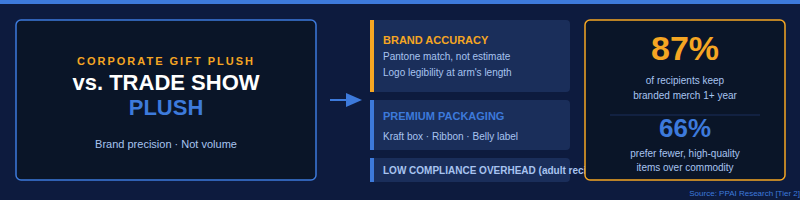
A corporate gift plush order is structurally different from every other plush use case because the primary driver is brand precision, not unit volume. Trade show buyers need 5,000 units at $3 each. Retail buyers need 10,000 units that survive a compliance audit. Corporate gift buyers need 500 units where the brand color is exact, the embroidery reads cleanly at arm’s length, and the packaging is good enough to present to a C-suite contact on the anniversary of a seven-figure contract.
The economics are different too. In a gifting context, a $0.50 per-unit reduction that introduces a Pantone drift of two shades is a bad trade. That drift, multiplied across 500 boxes, is a brand quality signal sent to 500 key relationships — and 87% of them will be looking at that plush on their shelf a year from now, according to PPAI Research.
This article is the practical brief for B2B buyers ordering corporate gift plush: what the specification looks like, how compliance works when the recipient is an adult business contact, and the seven items your factory needs before it can generate an accurate quote.
A recent example from our production floor:
Last month, a US client came to us needing custom mascot plush units for their company’s annual client appreciation program. The first thing we established in the brief call was that the recipients were adult business contacts — not children. That single determination meant no CPSC third-party testing was required, which saved the client several thousand dollars in compliance fees and cut four to six weeks from the production timeline. The same plush, briefed as a children’s holiday gift program, would have required a completely different production path. This is what we mean when we say corporate gift plush is a different category: the recipient profile is the specification.
Who Receives the Gift? Compliance Tier by Recipient Type
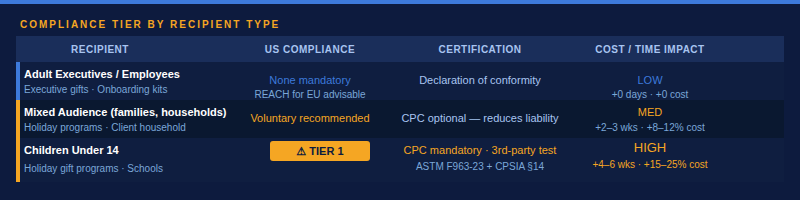
The most consequential variable in any corporate gift plush order is the age of the recipient — and most buyers underestimate how much it changes the cost and timeline of the program.
Compliance Matrix by Recipient Type (US)
Recipient Type | US Compliance | Required Docs | Cost Impact | Timeline Impact |
|---|---|---|---|---|
Adult Executives / Employees | None mandatory | REACH advisable (EU) | Low | +0 days |
Mixed Audience (households) | Voluntary recommended | CPC optional | Low–Med | +2–3 weeks |
Children Under 14 | CPSC mandatory / ASTM F963-23 | CPC required (3rd-party test) | +15–25% unit cost | +4–6 weeks |
EU-destined adult gifts | REACH SVHC compliance | Declaration of conformity | Low | +1–2 weeks |
EU-destined children’s gifts | EN 71 + TSR 2025/2509 | CE mark + EU DoC | +15–30% unit cost | +5–8 weeks |
Note: “Children’s product” under CPSIA is defined as a consumer product primarily intended for children under 12. Gifting to employees whose children might use the product does not automatically trigger CPSC mandatory testing — but liability risk increases significantly. Most B2B buyers in this scenario voluntarily pursue CPC compliance.
From the production floor: Before we write a single line of a quote, we ask every client one question: what is the final use of this product, and who will actually receive it? A plush sent as a mascot gift to adult business contacts has a completely different compliance profile from the same product sent to a family holiday program. We ask this before the brief is confirmed — not after the production run ships. Only when we understand the end-destination can we determine the correct compliance path and give the client an accurate cost picture from the start.
Budget Tiers for Corporate Gift Plush: What You Actually Get
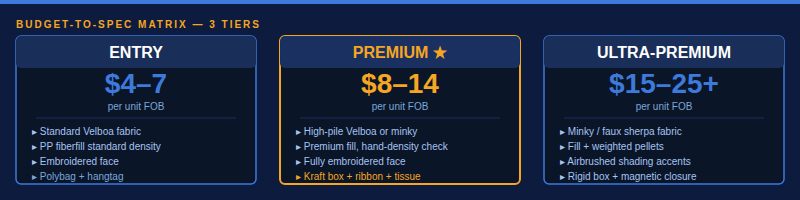
Corporate gift plush pricing is not a negotiation around a fixed product standard — it is a spec selection. The three budget tiers below define what actually changes between a $5/unit program and a $20/unit program. Knowing this before the brief stage prevents the most common project failure: specifying premium outcomes on entry-level budgets.
Budget-to-Spec Matrix
Tier | Unit Cost (FOB) | Fabric | Fill | Face | Packaging | Lead Time |
|---|---|---|---|---|---|---|
Entry | $4–7 | Standard Velboa (polyester) | PP fiberfill, standard density | Embroidered eyes/nose | Polybag + hangtag | 35–50 days bulk |
Premium | $8–14 | High-pile Velboa or minky | Premium PP fill, hand-stuffed density check | Fully embroidered face, safety eyes double-locked | Kraft box, ribbon pull, tissue | 45–60 days bulk |
Ultra-Premium | $15–25+ | Minky or faux sherpa; Pantone-matched base | PP fiberfill + weighted pellets | Embroidered face, airbrushed shading accents, weighted eyes | Rigid gift box, magnetic closure, custom inlay card | 60–90 days bulk |
The spec shift between Entry and Premium is almost entirely in fabric and packaging — not in the plush construction fundamentals. The shift from Premium to Ultra-Premium involves texture: Minky fabric reads as a tactile luxury product in a way that standard Velboa does not. In an executive gifting context, the hand-feel of the plush matters.
★ FOB pricing reflects this factory’s actual quotation bands based on 30 years of corporate gift production. All tiers include: pattern development, pre-production sample (~15–21 days), bulk production, QC inspection. Important: before reviewing a buyer’s process sheet and calculating the cost of each component (fabric, fill, embroidery, packaging, label requirements), we can only provide a directional price range — not a commitment. A precise quote requires a complete brief. Compliance testing billed separately if required. Our factory holds multiple certifications; additional certifications can be arranged on request.
The Color Accuracy Problem: Why Logo Matching Is the #1 Revision Loop
Every experienced factory has a version of the same story: a corporate gift buyer approves a prototype, production runs, and the bulk delivery arrives two shades warm. The color is “close” — but not the brand’s Pantone 286 C cobalt blue. This is the most common revision trigger in corporate gift plush orders — and it is entirely avoidable with the right brief.
Our approach to color transparency
Because most order communication happens over screens, we cannot guarantee that the color a buyer sees on their monitor will match the finished fabric exactly. Screen calibration, ambient lighting, and device settings all introduce variables the factory cannot control. For this reason, we inform every client at the start of any color-critical order that some degree of color variation is inherent in the fabric dyeing process. We only proceed to production once the buyer has reviewed a physical fabric swatch under proper lighting — or has explicitly accepted the tolerance in writing. This one step, which most buyers are tempted to skip in the interest of speed, is what prevents the most common and most expensive revision loop in corporate gift plush production.
Why color drift happens
Plush fabric is dyed in batches. Dye lots vary by season (temperature affects uptake), by fiber type (same Pantone, different polyester pile, different result), and by manufacturer variation. A Pantone reference tells the factory what to aim for — it does not guarantee a match without a physical swatch confirmation step.
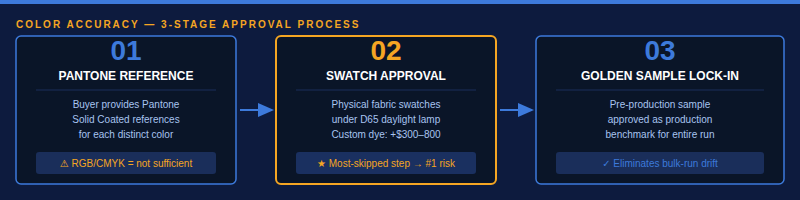
The three-stage color approval process that eliminates revision loops
Stage 1 — Pantone Reference Stage: Buyer provides Pantone Solid Coated references for every distinct color in the design. (Digital RGB values are insufficient — fabric dye does not map linearly to RGB output.) Factory returns closest-match fabric samples from available dye lots.
Stage 2 — Fabric Swatch Approval: Buyer physically reviews fabric swatches under standardized lighting (D65 daylight equivalent lamp, if color-critical). Buyer either approves the closest match or requests a custom dye job (adds $300–800 to the program and 7–14 days to sampling timeline). This is the stage most buyers skip — and where most revision loops originate.
Stage 3 — Golden Sample Lock-in: The pre-production sample (full 3D plush, all materials as spec’d) is approved as the “golden sample.” The golden sample physically travels with the production order as the benchmark against which every unit in the bulk run is compared by QC before shipping.
Brief requirement: Include Pantone Solid Coated references, not RGB or CMYK values, for every color that must match brand standards. If exact Pantone match is non-negotiable, state this explicitly and budget for the custom dye step. If nearest-available-match is acceptable, state the tolerance (e.g., “within ΔE 2.5 under D65 lighting”).
Packaging and Presentation: The Details That Define a Gift Program
In a corporate gifting context, the packaging is part of the gift. It is the first sensory experience the recipient has with the program — and it signals whether this is a considered gift or a marketing giveaway repurposed as gifting.
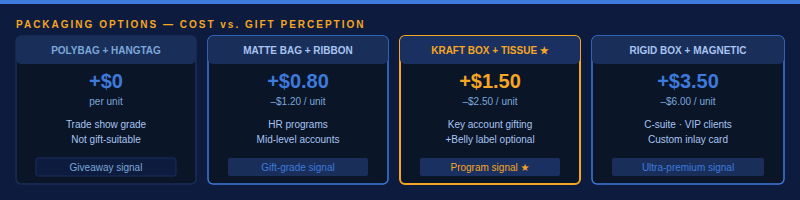
Packaging Format | Added Cost / Unit | Best For | Brand Signal |
|---|---|---|---|
Polybag + hangtag | +$0 | Trade shows; not gift-grade | Giveaway signal |
Matte soft-touch bag + ribbon pull | +$0.80–$1.20 | HR programs; mid-level accounts | Gift-grade signal |
Kraft box + custom tissue + belly label | +$1.50–$2.50 | Key account gifting; program recipients | Program signal ★ |
Rigid gift box + magnetic closure + custom inlay | +$3.50–$6.00 | C-suite; VIP clients; board gifts | Ultra-premium signal |
Budget tip: If the plush itself is at Entry tier ($5–7/unit) but the packaging is at Premium tier (kraft box + tissue + label), the total program cost per unit is $7.50–10.50 — and the recipient experiences a Premium program. This is the most efficient trade-up in corporate gift plush: spend less on the plush spec, more on the presentation layer.
MOQ, Lead Time, and Timeline Planning
Corporate gift plush programs have more flexible MOQ windows than retail or trade show programs — because the margin per unit is higher and the character precision requirement often rules out the lowest-cost commodity production.
MOQ ranges by program type
Standard single-character programs: 200–500 units minimum at most B2B-focused manufacturers
Personalized programs (belly-label name-printing): 500–1,000 units minimum
Programs below 200 units: high per-unit cost penalty; typically pushes buyers toward promo merchandise resellers
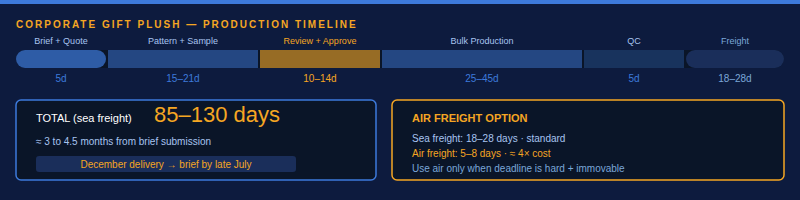
Timeline Planning — Work Backward from Delivery Date
Stage | Duration | Notes |
|---|---|---|
Design brief + quote | 3–5 business days | Requires complete 7-point brief |
Pattern development | 5–10 days | Based on approved vector artwork |
Pre-production sample | 15–21 days | Includes fabric swatch confirmation |
Sample shipping + review | 5–7 days | Allow full cycle for revisions |
Sample revision (if needed) | 10–14 days | Factor one revision cycle |
Golden sample approval | 1–3 days | |
Bulk production | 25–45 days | Depends on quantity and complexity |
QC inspection | 3–5 days | Factory QC + optional third-party |
Sea freight to US/EU | 18–28 days | Air freight: 5–8 days at ~4× cost |
TOTAL (standard sea freight) | ~85–130 days | ≈ 3–4.5 months from brief submission |
⚑ Planning implication: A December delivery date requires brief submission by late July or early August at the latest. Hard deadlines require air freight contingency pricing (~4× the sea freight rate).
The Corporate Gift Plush Briefing Checklist
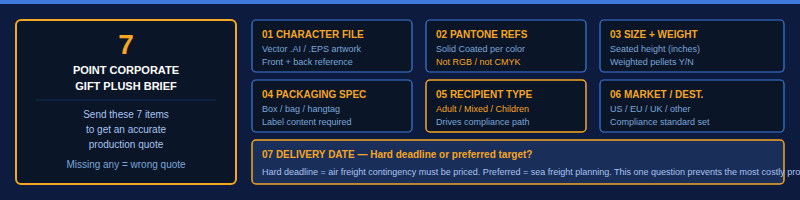
This is the information a factory needs to generate an accurate quote and prevent revision loops. Every item below has a specific consequence if it is missing from the brief.
The 7-Point Corporate Gift Plush Brief
01 Character Design File
Vector artwork (.AI or .EPS) preferred. Turnaround, dimensioned front/back reference sheets, and color-keyed callouts.
⚠ Missing this: Quote is a rough range, not a commitment. Revision loop likely.
02 Pantone Solid Coated References
One reference per distinct color. Include tolerance instruction: “exact match required” vs. “closest available match acceptable.”
⚠ Missing this: Color drift risk on bulk run. Most common corporate gift complaint.
03 Target Size and Approximate Weight
Size in inches (seated height preferred for plush). Approximate weight if premium tactile feel is a requirement.
⚠ Missing this: Quote range is too wide to plan budget accurately.
04 Packaging Specification
Polybag / soft bag / kraft box / rigid box. Hangtag content. Belly label requirements. Outer shipping carton spec.
⚠ Missing this: Packaging often adds more cost per unit than the plush — omitting it makes every quote number fictional.
05 Recipient Type and Age Profile
“Adult executive,” “mixed employee + household,” or “children’s program.” For mixed: estimated % of recipients under 14.
⚠ Missing this: Compliance cost is unknowable. Factory cannot advise on certification path.
06 Target Market / Shipping Destination
US only / EU only / US + EU / other. Determines which compliance standards apply.
⚠ Missing this: Factory may quote without compliance cost — quote is incorrect.
07 Required Delivery Date (Hard vs. Preferred)
Is the delivery date hard (event cannot move) or preferred (buffer exists)? Hard deadlines require air freight contingency pricing.
⚠ Missing this: Factory may plan sea freight; buyer expects air; production schedule conflicts at worst moment.
Frequently Asked Questions
Q: Do I need CPSC testing if I’m gifting plush to employees, not selling it?
The legal trigger for CPSC/CPSIA compliance is not the sale transaction — it is the intended end-user. If the gift is primarily intended for children under 12, CPSC third-party testing and a Children’s Product Certificate (CPC) are required regardless of whether the product is sold or gifted. For gifts exclusively to adult recipients, mandatory CPSC toy testing is not triggered.
Q: Can my factory match our brand’s exact Pantone color in plush fabric?
Most custom plush factories can achieve a close Pantone match in standard polyester plush fabric. An exact match requires a custom dye lot, which adds cost ($300–800 for setup) and timeline (7–14 days). Always request a physical fabric swatch approval before committing to production — remote approval from photos is unreliable due to camera white balance variation.
Q: What is the minimum order for a corporate gift plush program?
Most factory-direct B2B plush manufacturers set minimum order quantities at 200–500 units for standard single-character programs. Below 200 units, the per-unit economics typically push buyers toward promotional merchandise resellers rather than fully custom manufacture.
Q: How far in advance should we plan a corporate holiday gift plush program?
For a December delivery window, brief submission by late July or early August is the safe planning window for sea freight production. August brief submission is the practical limit for a December program using air freight; September is high-risk regardless of shipping method.
Q: What is a “golden sample” and why does it matter?
The golden sample is the factory-produced pre-production sample that has been physically approved by the buyer as the benchmark for bulk production. Every unit in the bulk run is compared against the golden sample during QC. For corporate gift programs, where color accuracy and brand precision are paramount, the golden sample process is the only reliable guarantee that bulk delivery matches the approved standard.
Glossary
Term | Definition |
|---|---|
Pantone Solid Coated (PMS) | Standardized color reference system used in printing and textile industries. “Solid Coated” is the relevant swatch book for fabric matching. |
CPC (Children’s Product Certificate) | US document required by CPSIA certifying a children’s product meets applicable safety standards, based on third-party testing results. |
ASTM F963-23 | Current US mandatory safety standard for toys, incorporated by reference by 16 CFR Part 1250. Effective February 2024. |
REACH SVHC | EU regulation (EC No 1907/2006) restricting Substances of Very High Concern in products sold/distributed in the EU market. |
Golden Sample | Factory-approved pre-production physical sample used as the quality benchmark for all units in a production run. |
FOB (Free On Board) | Pricing term: seller responsible for goods until loaded onto shipping vessel; buyer assumes cost/risk from that point. |
ΔE (Delta E) | Colorimetric measurement of color difference. ΔE < 1 is imperceptible; ΔE 2–3 is acceptable commercially; ΔE > 3 is noticeable. |
Dye Lot | A batch of fabric dyed together. Fabric from different dye lots may show subtle color variation even with the same Pantone reference. |
Disclaimer
This article is produced for informational purposes by a B2B custom plush manufacturer. Compliance requirements cited (CPSC, CPSIA, ASTM F963-23, EU Toy Safety Regulation 2025/2509, REACH) are based on publicly available regulations as of the date of publication. Regulatory frameworks change; buyers should independently verify current requirements with their compliance counsel or testing laboratory before placing orders. Nothing in this article constitutes legal or regulatory advice.
References
1. U.S. Consumer Product Safety Commission, CPSIA Overview [Tier 1]
2. 16 CFR Part 1250, Safety Standard Mandatory for Toys (ASTM F963-23) [Tier 1]
3. European Parliament and Council, Toy Safety Regulation (EU) 2025/2509, OJ EU, January 2026 [Tier 1]
4. European Chemicals Agency, REACH SVHC Candidate List [Tier 1]
5. 16 CFR Part 1307, Prohibition of Children’s Toys Containing Phthalates [Tier 1]
6. PPAI Research, New PPAI Research Shows Why Consumers Take And Keep Promo Products (2021) [Tier 2]
7. PPAI Research, The Things We Don’t Throw Away — consumer retention study [Tier 2]
8. Loonie Times, Promotional Plush Toys — How Organizations Use Custom Plush as Brand Assets [Tier 3 — directional]
Ready to Brief Your Factory?
→ Download our Corporate Gift Plush Brief Template — the 7-Point Checklist in printable PDF format.
→ Request a Quote — submit your brief and receive a full production quote within 3 business days.
→ Back to the hub article: “What Are Custom Plush Toys Used For?” — Article #24
→ Next in series: “Custom Plush Toys for Trade Shows” — Article #26