
Custom Plush Keychains:
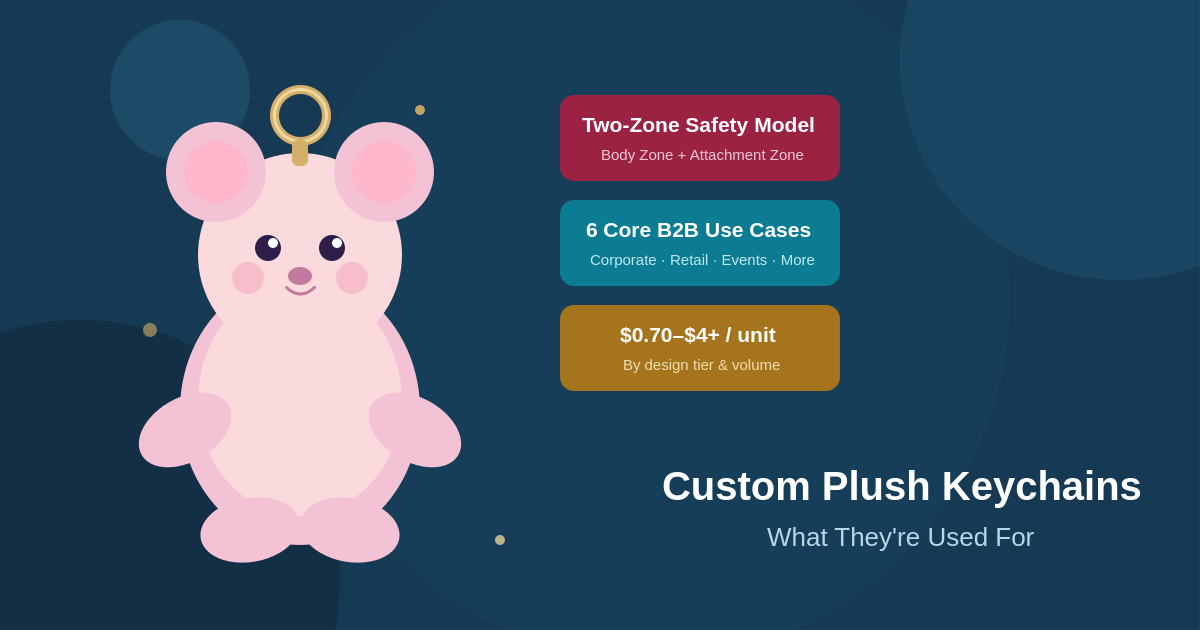
What They’re Used For
Last reviewed: August 2026 | Audience: Promotional product distributors, corporate gifting buyers, retail buyers, e-commerce sellers, IP/licensing managers | Reading time: ~10 min
Quick Answer
Custom plush keychains are used across six core B2B programs: corporate merchandise, retail point-of-sale add-ons, trade show and event giveaways, e-commerce bundle upsells, school/loyalty/membership rewards, and IP or character collectible series.
The detail most buyers miss: a plush keychain has two separate safety and durability systems — the soft body, and the hardware attachment (keyring, clasp, or strap), which is subject to its own small-parts and tension requirements.
Most first-order failures trace back to the hardware, not the fabric.
What this article covers:
• The six B2B use cases and what each requires from your factory
• The Two-Zone Safety Model — why hardware needs its own compliance review
• Which attachment hardware fits which use case
• A buyer’s quality inspection checklist
• Real-world MOQ and cost tiers by design complexity
• A factory brief checklist and six criteria for choosing a manufacturer
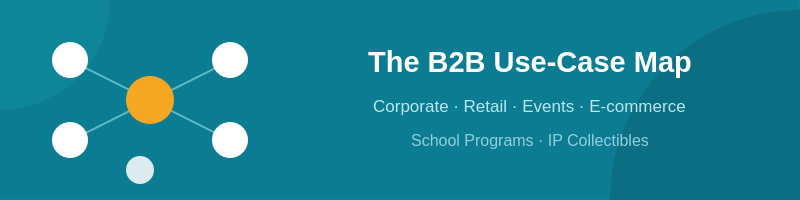
What Custom Plush Keychains Are Used For — the B2B Use-Case Map
A custom plush keychain sits in a specific product niche: smaller and cheaper than a full plush toy, warmer and more tactile than a metal or acrylic keychain. That combination makes it useful across a wider range of B2B programs than most buyers initially plan for — but each use case pulls the product spec in a different direction.
Corporate merchandise and employee gifts. Companies use mascot-based plush keychains as onboarding gifts, internal culture items, or client giveaways. The priority here is brand accuracy and a premium feel — these are lower-volume, higher-perceived-value orders.
Retail point-of-sale add-ons. Gift shops, museum stores, and theme park retailers stock plush keychains as checkout-counter impulse buys. This use case demands retail infrastructure: barcodes, hangtags, SKU-level color control, and display-ready packing — not just a good-looking product.
Trade show and event giveaways. Plush keychains outperform flat giveaways (stickers, pens, badges) at booths because they have texture and personality — attendees are more likely to keep and carry them. High-volume orders here prioritize fast turnaround and carton-level packing logic over premium finish.
E-commerce bundle upsells. DTC and marketplace sellers add plush keychains as low-cost bundle items or standalone SKUs to increase average order value. This use case is volume-sensitive and price-sensitive, and increasingly ties into the same platform compliance requirements covered in our e-commerce sourcing guide (Amazon FNSKU, Etsy production partner disclosure).
School, club, and loyalty programs. Mascot keychains for student stores, sports teams, and membership rewards need to survive daily wear — attached to backpacks, keys, and gym bags for months. Durability, not premium finish, is the priority.
IP and character collectible series. Brands and licensors use plush keychains to test character demand at low cost before committing to a full plush doll line, or to build blind-box and limited-edition collectible programs. Character accuracy at small scale is the technical challenge here.
Use-Case Requirements Matrix
Use Case | Volume Range | Unit Budget | Priority | Compliance Focus |
|---|---|---|---|---|
200–2,000 | $2.50–5 | Brand accuracy, premium finish | Low (adult recipients) | |
Retail POS add-on | 1,000–10,000+ | $1.50–3 | Barcode/SKU infrastructure | Medium (child-accessible retail) |
Trade show giveaway | 2,000–10,000+ | $1–2.50 | Fast turnaround, carton packing | Medium (mixed audience) |
E-commerce bundle | 500–5,000 | $1.50–3 | Price efficiency, channel packaging | Medium-High (platform-specific) |
School/loyalty program | 300–3,000 | $1.50–3.50 | Durability, hardware strength | High (daily use by minors) |
IP collectible series | 500–5,000/character | $2–4.20+ | Character accuracy | Medium (licensing + safety) |
The pattern across every use case: the hardware attachment is doing more work than buyers give it credit for. That’s the subject of the next section.
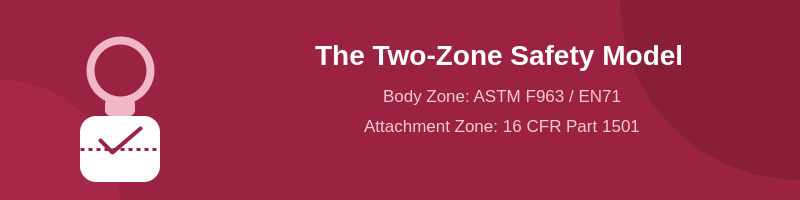
The Two-Zone Safety Model — Why a Plush Keychain Has Two Safety Profiles, Not One
Most sourcing guidance for plush products — including our own compliance research on full-size custom plush toys — treats the product as a single safety unit: fabric, filling, seams, and surface decoration, tested against ASTM F963-23, CPSIA, and EN71. That coverage is necessary but incomplete for a keychain, because a keychain has a second component a full-size plush toy doesn’t: a rigid or semi-rigid attachment mechanism designed to be pulled, twisted, and load-bearing every day.
We call this the Two-Zone Safety Model: every custom plush keychain has a Body Zone and an Attachment Zone, and they are governed by different failure risks.
Body Zone — the plush shell, stuffing, and surface decoration. Standard requirements apply: ASTM F963-23 (mechanical hazards, flammability, chemical limits) in the US, EN71 in the EU, and CPSIA/CPC certification for children’s products.
Attachment Zone — the keyring, clasp, chain, or strap. This component is subject to a rule most keychain content overlooks entirely: under 16 CFR Part 1501 (the CPSC’s small parts ban), any piece that breaks off during simulated use-and-abuse testing is treated as a small part — regardless of whether it was part of the original design. (Source: CPSC.gov, Small Parts Ban and Choking Hazard Labeling — Tier 1) A keyring or clasp that snaps off under normal pulling force doesn’t just fail functionally — it can trigger a small-parts compliance failure if the product is intended for or reasonably accessible to children under 3. Products that are or contain small parts are also subject to choking hazard warning labeling under 16 CFR §1500.19.
From the sourcing side: Buyer feedback we’ve reviewed on keychain quality consistently lands on the same point — most keychain returns and complaints are not about the plush body at all. They’re about the hardware: thin stamped hooks that bend, hollow plastic buckles that crack, split rings that pull open under light tension. A keychain with a flawless plush sculpt and a weak attachment point is still a failed product, because the attachment is the part doing the daily mechanical work.
What this means for your factory brief: specify the Attachment Zone with the same rigor you’d specify fabric and stuffing. Ask for the keyring gauge (thickness), the clasp type and its rated pull strength, and whether the attachment point on the plush body itself is reinforced (bar-tack stitching, not a single loop of thread). None of this shows up in a product photo.
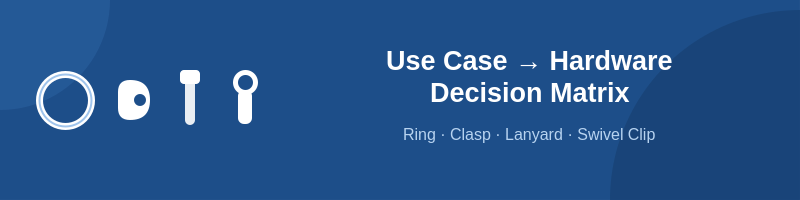
Use Case → Attachment Hardware Decision Matrix
Different use cases call for different hardware — and the hardware choice affects both durability and safety classification. This is the layer most plush keychain content skips entirely.
Attachment Type | Best Fit | Durability | Safety Note |
|---|---|---|---|
Split key ring (solid metal) | Everyday carry, school/loyalty programs, corporate gifts | High — closed-loop design resists pull-open failure | Preferred for daily-use programs; closed ring reduces detachment risk |
Lobster clasp | Bag charms, retail add-ons, fashion-forward positioning | Medium-high — depends on clasp gauge and spring tension | Check spring mechanism doesn’t fatigue after repeated open/close cycles |
Lanyard/strap | Event giveaways, conference badges, quick distribution | Medium — fabric straps wear at the stitch point over time | Reinforce the strap-to-body seam; avoid thin cord as a strangulation risk for young children |
Bag charm clip (swivel hook) | E-commerce bundles, backpack/luggage accessories | Medium — swivel mechanism is a common failure point | Confirm swivel base is riveted, not glued, to the plush body |
Fine wire ring / thin stamped hook | Avoid for B2B programs | Low — bends, opens under light tension, most common return driver | Most associated with quality complaints; do not approve for bulk orders |
The decision isn’t purely aesthetic. A school loyalty program running for a full academic year needs the split-ring durability profile; an event giveaway distributed once and rarely reused can tolerate a lighter-duty lanyard. Specify the hardware type in the factory brief by use case, not by what looks best in the sample photo.

How to Judge Plush Keychain Quality Before You Order — A Buyer’s Inspection Checklist
This checklist reflects practical, hands-on quality assessment points — the kind of thing that shows up in a physical sample review, not in a spec sheet.
1. Fabric — check pile density, not just color match. Dense, short-pile fabric with good rebound (springs back when pressed) sheds minimally and holds its shape. Sparse, long-pile fabric with visible gaps between fibers sheds heavily after the first wash and looks worn within weeks of daily use.
2. Filling — the smell test is a real quality signal. A properly filled keychain has little to no odor, with a faint fabric smell that clears within minutes. A strong chemical, musty, or adhesive smell usually indicates recycled or low-grade filling material and poor-quality bonding adhesive — and that smell typically doesn’t fully dissipate over the product’s life.
3. Hardware — this is where most keychains actually fail. Reject thin, hollow plastic buckles, fine stamped wire rings, and loosely closed split rings — these bend, crack, or pull open under normal use. Approve thickened metal buckles, solid-core cord or chain, and tightly closed rings that don’t shift or gap under moderate pull force.
4. Weight — lighter is better for daily-carry items. An overly heavy keychain stresses bag straps and zipper pulls over time and can leave wear marks on leather or canvas bags. A well-made keychain should feel light and airy, not dense.
5. Stitching — check seam tightness under light tension. Even, dense stitching with no stray threads and tight seam closure is the standard. Loose stitching, visible gaps, or fraying at the seams under a light pull test signals a product that won’t survive daily handling.
6. IP and licensing status — verify before you commit to a design. Popular character IP is typically under active copyright or trademark protection. A factory willing to reproduce a protected character without a licensing agreement in place is a sourcing risk, not a shortcut. If your program is built around original branded characters or generic, unlicensed designs, this risk doesn’t apply — but confirm the factory’s position on licensing before sending IP-based artwork.

MOQ and Cost Tiers for Custom Plush Keychains
Pricing for custom plush keychains varies more by design complexity and hardware spec than by fabric alone. The tiers below reflect typical market pricing patterns; treat these as directional planning figures, not a quote — confirm actual pricing against your specific design and hardware spec with your factory.
Tier | Unit Price (Approx. USD) | Typical Volume | Key Cost Drivers |
|---|---|---|---|
Basic (flat embroidery or printed graphic) | $0.70–2.10 | 500 units | Small size (3–5cm) keeps cost low; 2D design, minimal hardware |
Basic, higher volume | $0.56–2.10 | 500–1,000 units | Same design, cost amortized across a larger run |
Mid-tier (3D character sculpt, multi-layer embroidery, accessories) | $2.50–3.50 | 1,000 units | Premium plush fabric, character accuracy work, added charms |
Mid-tier, smaller batch | $3.50–4.20 | 500 units | Same complexity at lower volume raises per-unit cost |
Premium (exclusive/licensed IP, special materials) | $4.20–14+ | Small batch, high customization | Design/licensing fees, specialty fabrics, multi-round sampling ($40–85/round) |
Approximate USD conversion from RMB-denominated market pricing at ~7.15 CNY/USD — directional only; confirm current exchange rate and get a factory quote before budgeting. This range is consistent with the $1.50–4/unit benchmark for wearable plush formats established in our broader custom plush use-case research.
Sample development typically runs 3–15 business days depending on batch size and design complexity — simple flat-graphic samples turn around fastest; multi-part 3D character sculpts with custom hardware take longer.
Factory Brief Checklist for Custom Plush Keychain Programs
Pre-Production Factory Brief: Custom Plush Keychains
☐ Use case confirmed: corporate gift / retail POS / trade show / e-commerce bundle / school-loyalty program / IP collectible
☐ Body Zone: fabric type specified (pile height, material), filling type (PP cotton grade), ASTM F963-23 / EN71 testing scope confirmed
☐ Attachment Zone: hardware type specified (split ring / lobster clasp / lanyard / swivel clip), keyring gauge/thickness confirmed, attachment point reinforcement (bar-tack stitching) confirmed
☐ Pull-test / tension requirement communicated to factory for the attachment hardware — not just the plush body
☐ Small parts compliance reviewed against 16 CFR Part 1501 if product may reach children under 3; choking hazard warning label applied if applicable (16 CFR §1500.19)
☐ IP/licensing status confirmed in writing before artwork is sent, if design is based on existing character or brand IP
☐ Packaging and labeling confirmed against target channel (retail barcode/hangtag, e-commerce FBA/Etsy requirements, event carton marking)
☐ Physical sample approved — including a hands-on pull test of the hardware — before bulk production release

How to Choose a Factory for Custom Plush Keychain Programs
1. Hardware testing capability. Ask whether the factory pull-tests keyrings and clasps as a standard QC step, separate from body-fabric inspection. A factory that only inspects the plush body is missing the Attachment Zone entirely.
2. Small-parts compliance experience. Confirm the factory understands that hardware components are subject to small-parts and use-and-abuse testing under CPSC rules — not just the plush body. This is a newer and less commonly understood requirement; many factories default to testing only the fabric and filling.
3. IP/licensing handling. For programs based on licensed or brand-protected characters, confirm the factory requires licensing documentation before production — a factory that doesn’t ask is a red flag, not a convenience.
4. Sampling speed and lead time track record. Standard sample development runs 3–15 business days; ask about the factory’s current queue and whether they can realistically hold to that window for your specific hardware and design complexity.
5. MOQ flexibility against your actual design. Some factories quote a low general MOQ but revise upward for 3D character sculpts, multi-part hardware, or specialty fabric. Confirm MOQ against your actual reference design, not a generic keychain spec.
6. Audit and safety certifications. For programs with retail or wholesale distribution ambitions, confirm BSCI, Sedex/SMETA, ISO 9001, and (for licensed character work) Disney FAMA or equivalent certifications where applicable.
Frequently Asked Questions
What are custom plush keychains typically used for?
Six core B2B use cases: corporate merchandise and employee gifts, retail point-of-sale add-ons, trade show and event giveaways, e-commerce bundle upsells, school/club/loyalty program rewards, and IP or character collectible series. Each use case has a different volume, budget, and compliance profile — the use case should shape the factory brief, not just the character design.
Why do plush keychains fail more often at the hardware than the fabric?
Because the attachment hardware — keyring, clasp, or strap — is the only part of the product doing continuous mechanical work: it’s pulled, twisted, and load-bearing every time the item is used. Thin stamped hooks, hollow plastic buckles, and loosely closed split rings are the most common failure points, and they’re also the components most likely to trigger small-parts compliance issues if they break off under normal use.
Do custom plush keychains need the same safety certification as full-size plush toys?
The plush body does — ASTM F963-23, EN71, and CPSIA/CPC requirements apply the same way they do to any plush toy. But the attachment hardware has an additional compliance layer: under CPSC’s 16 CFR Part 1501, any hardware component that detaches during use-and-abuse testing is treated as a small part, which can trigger choking hazard labeling requirements under 16 CFR §1500.19 if the product may reach children under 3.
What is the minimum order quantity for custom plush keychains?
MOQs commonly start around 500 units for simple, flat-graphic designs. Complex 3D character sculpts with custom hardware may carry a higher effective MOQ even if a factory advertises a lower general minimum — always confirm MOQ against your specific reference design before committing to sample development.
How much do custom plush keychains cost?
Basic designs with flat embroidery or printed graphics typically run $0.70–2.10 per unit at 500–1,000 units. Mid-tier designs with 3D character sculpting and added hardware accessories run $2.50–4.20 per unit depending on volume. Premium, licensed, or highly customized designs can exceed $4.20–14+ per unit. These are directional figures — request a factory quote against your specific design and hardware spec.
How do I know if a plush keychain factory understands IP licensing risk?
Ask directly whether they require licensing documentation before producing a design based on an existing character or brand. A factory that doesn’t ask, or that offers to reproduce a popular IP character without documentation, is signaling a quality-control and legal risk — not a shortcut.
Glossary
Term | Definition |
|---|---|
Body Zone | The plush shell, stuffing, and surface decoration of a keychain — governed by standard plush toy safety standards (ASTM F963-23, EN71, CPSIA) |
Attachment Zone | The keyring, clasp, chain, or strap component of a plush keychain — subject to separate small-parts and tension-related compliance requirements |
16 CFR Part 1501 | US CPSC regulation defining the small parts ban; any component that detaches during use-and-abuse testing is treated as a small part |
16 CFR §1500.19 | US regulation requiring choking hazard warning labels on products that are or contain small parts |
Bar-tack stitching | Reinforced stitching technique used at stress points to prevent seam failure under repeated pulling |
ASTM F963-23 | US toy safety standard covering mechanical hazards, flammability, and chemical limits |
EN71 | European toy safety standard series; basis for CE marking in the EU |
MOQ | Minimum Order Quantity — smallest production run a factory will accept per design |
Disclaimer: Pricing figures cited in this article are directional, based on market and factory-floor sourcing knowledge as of August 2026, and converted from RMB at an approximate exchange rate — actual costs vary by factory, design complexity, and current currency rates. CPSC small parts and labeling requirements are legal obligations for US market imports — consult a licensed customs broker or compliance specialist before finalizing product certification. Nothing in this article constitutes legal or regulatory advice.
References
1. CPSC.gov — Small Parts Ban and Choking Hazard Labeling (16 CFR Part 1501) (Tier 1)
2. eCFR — 16 CFR §1500.19, Choking Hazard Warning Labeling (Tier 1)
3. ASTM F963-23 Toy Safety Standard (Tier 1)
4. CPSC.gov — Children’s Product Certificate (Tier 1)
5. Custom plush keychain quality-inspection and pricing knowledge — sourcing/buyer-side practical experience (Tier 3)
Ready to Source Your Custom Plush Keychains?
Tell us your use case — corporate gift, retail POS, event giveaway, e-commerce bundle, loyalty program, or IP collectible — and we’ll spec the hardware, safety documentation, and packaging around that program, not a generic keychain template.
→ Request a Channel-Ready Keychain Quote: CONTACT – Plush Toy Manufacturer|Customized plush toys
→ Related: What Are Custom Plush Toys Used For? | Custom Plush Toys for E-commerce Sellers