
What Is a Licensed Plush Toy?
A plain-language guide to what makes a plush toy licensed, who holds which rights along the chain, and how an IP licence is actually obtained.
Updated August 2026 · Beginner’s glossary guide
A licensed plush toy is a soft toy featuring a character owned by someone else, produced and sold under written permission from that IP owner.
Direct answer: The character is the product. What makes it “licensed” is a signed agreement granting the right to use that character — without one, the same toy is simply an infringing product.
What Is a Licensed Plush Toy? — TL;DR: Licensing is about permission, not production. The manufacturing may be identical to any custom plush project; the difference is a contract defining category, territory, channel and term.
Scope: This article explains the definition, the rights chain, and how licences are obtained. It is general business information, not legal advice — licensing agreements should be reviewed by qualified IP counsel in your market. For production considerations, see our complete guide,
linked at What Is a Custom Plush Toy? →.
What Is a Licensed Plush Toy, Exactly?
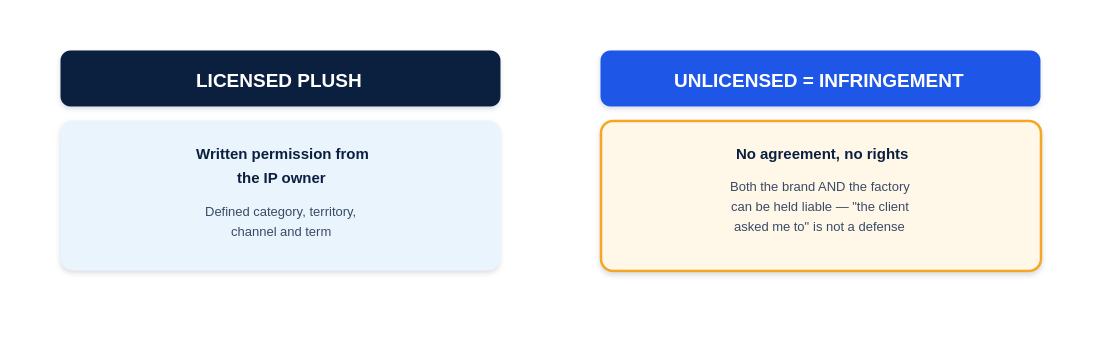
A licensed plush toy features a character that belongs to someone else — a film studio, game developer, publisher, or brand — and is made under a written agreement granting permission to use it. That agreement is what separates a licensed product from an infringing one. The toy itself may be manufactured in exactly the same way either path; the difference sits entirely in the paperwork.
This matters more than buyers often realise. Producing a protected character without authorisation exposes both the brand placing the order and the factory fulfilling it. “The client asked us to make it” is generally not a defence, which is why established manufacturers ask to see licence documentation before quoting.
The License Chain: Who Holds What Rights?
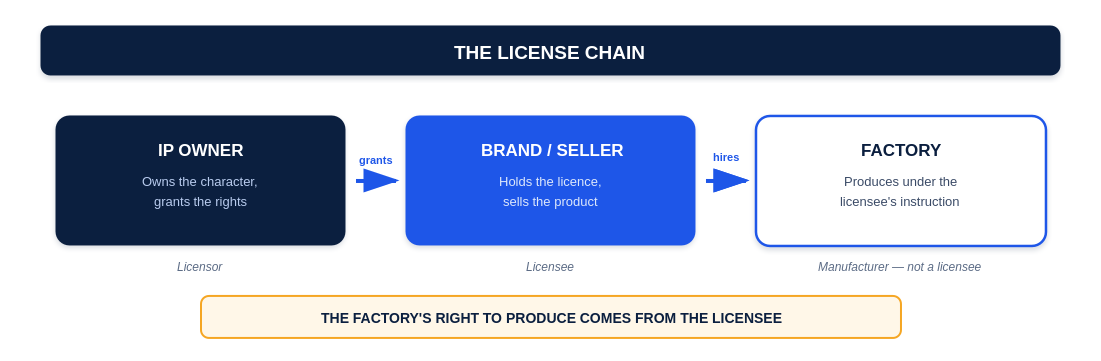
Most confusion around licensed plush comes from not knowing where each party sits. There are three positions:
The IP owner (licensor): owns the character, its name, and its visual identity. They grant rights — they don’t usually manufacture.
The brand or seller (licensee): holds the licence. They pay for the rights and sell the finished product. This is the party a factory contracts with.
The factory (manufacturer): is not a licensee. A factory’s right to produce comes from the licensee’s written instruction, within the boundaries of that licensee’s own agreement.
A licence normally covers manufacturing and selling together — you can’t be authorised to make something you’re not authorised to sell. It will also be limited by product category, territory, sales channel, and term. Major rights holders frequently add requirements on top: the factory may need to be listed as an approved vendor, pass a social-compliance audit, and submit samples for the IP owner’s approval before mass production begins.
Licensed vs Custom vs Private Label
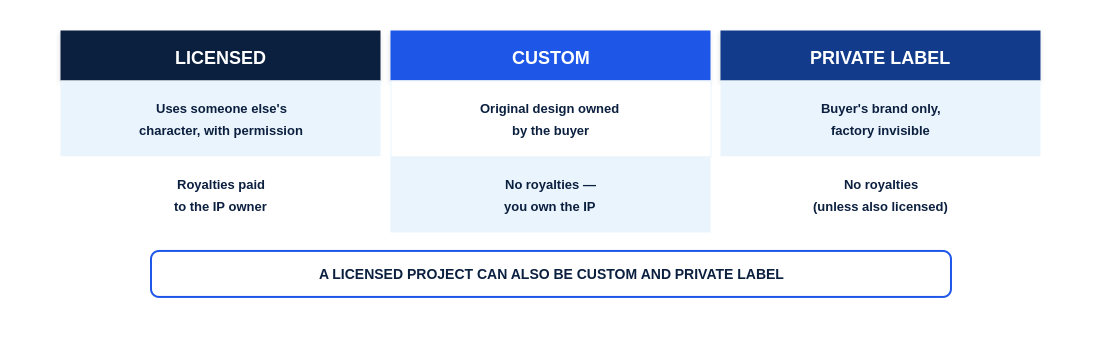
These three describe different things and often overlap in a single project:
A licensed plush uses someone else’s character with permission, and royalties flow back to the IP owner. A custom plush (see our complete guide →) is built from a design the buyer owns outright, with no royalties. A private label plush (see What Is a Private Label Plush Toy? →) is defined by the factory staying invisible behind the buyer’s brand. A licensed product is very often custom-manufactured and private-labelled at the same time — the terms describe different layers, not competing options.
How Do You Actually Get an IP Licence?
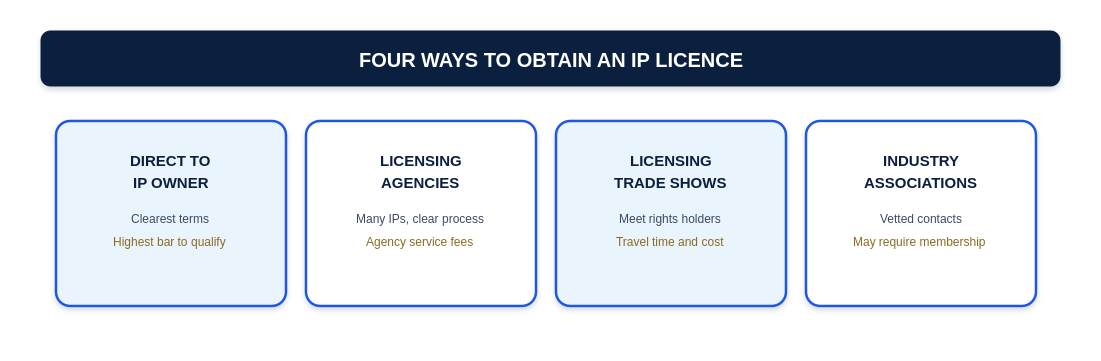
There are four practical routes, each with a trade-off:
Direct to the IP owner: large rights holders run their own licensing departments. Terms are clearest this way, but the qualification bar is high — they will assess your brand, your sales channels, and your ability to deliver volume.
Licensing agencies: agents represent portfolios of IP and handle the introduction and paperwork. This is usually the most accessible route for small and mid-sized buyers, at the cost of an agency fee.
Licensing trade shows: dedicated licensing expos put rights holders and prospective licensees in the same room. Useful for reading market direction and building relationships, but it costs time and travel.
Industry associations: toy and juvenile-products associations can point you toward legitimate rights holders and agents. Credible contacts, though membership may be required.
What the Application Process Looks Like
Broadly, five stages: define what you need (which IP, which product categories, which markets), approach the rights holder or their agent with a proposal, pass a qualification review of your brand and distribution capability, negotiate scope and fees and sign, then pay according to the agreed structure. Expect the qualification stage to take longer than you’d like — rights holders are protecting a valuable asset and are selective about who represents it.
How Are Licence Fees Structured?
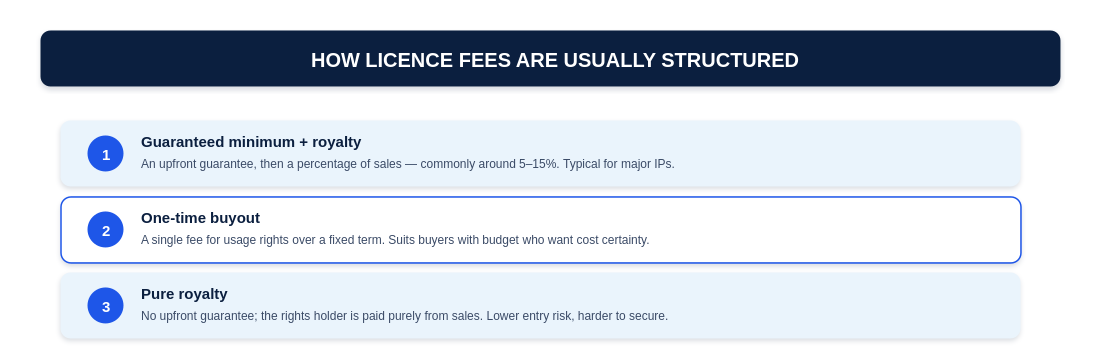
Three models cover most agreements. Which one you’re offered depends on the IP’s commercial pull and your track record — a first-time buyer approaching a major entertainment property should expect the first model, not the third.
What to Watch for in the Agreement
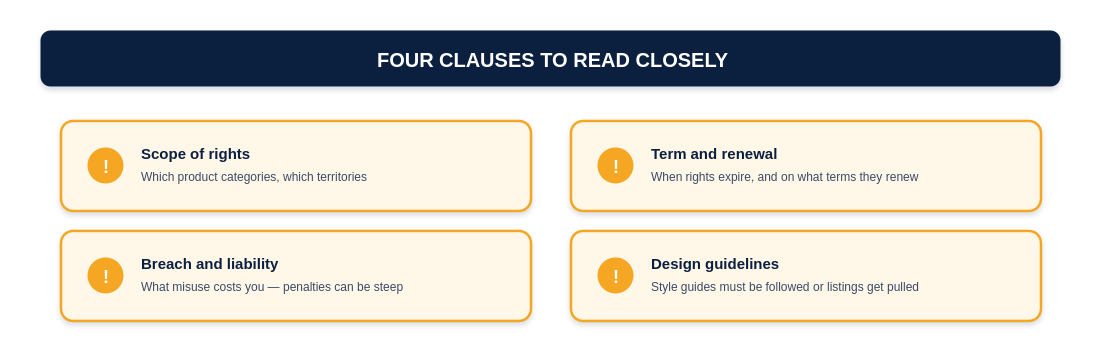
Scope of rights: confirm exactly which product categories and territories are covered. A licence for plush toys in North America does not let you sell keychains in Europe.
Term and renewal: know when the rights expire and what renewal requires. Stock you can’t legally sell after expiry is a real and expensive problem.
Breach and liability: understand the penalties for misuse. Infringement claims under a licensing agreement can be considerably more costly than the licence itself.
Design guidelines: rights holders issue style guides specifying how the character may be depicted. Deviating from them can get products rejected at approval or delisted after launch.
Using Licensed IP to Build Your Brand
The commercial logic of licensing is borrowed recognition — you’re paying for an audience that already exists. That only pays off if the IP genuinely matches your brand’s tone and your customers’ interests. Co-branded limited editions, seasonal tie-ins, and gift-set formats tend to perform well because they give existing fans a reason to buy now rather than eventually. A mismatched licence, by contrast, costs royalty money without transferring much affinity.
Frequently Asked Questions
Can a factory get its own licence to produce a character? Generally no — licences are granted to the party selling the product. A factory’s authorisation comes from the licensee’s written commission, not from a licence of its own.
What happens if we produce a character without a licence? Both the seller and the manufacturer can face infringement claims, product seizures, and platform delisting. Marketplaces also remove listings on rights-holder complaint.
How long does it take to secure a licence? It varies widely by rights holder and by how established your brand is; the qualification review is usually the longest stage. Plan for months rather than weeks.
Do we still need safety testing for licensed plush? Yes. Licensing covers the right to use the character; it has no bearing on toy safety compliance, which applies exactly as it would to any other plush toy.
Terminology Buyers Should Know
Term | What It Means |
Licensor | The party that owns the intellectual property and grants rights to use it |
Licensee | The party granted rights to make and sell products featuring the IP |
Royalty | A percentage of sales paid to the IP owner under the licence |
Guaranteed minimum | An upfront payment credited against future royalties |
Style guide | The rights holder’s rules for how the character may be depicted |
Approved vendor | A factory the rights holder has cleared to manufacture licensed goods |
A Note on Scope
This article is a general introduction to how plush toy licensing works. It is not legal advice, and it does not describe the requirements of any specific rights holder. Licensing agreements vary substantially, and obligations differ by jurisdiction — have any agreement reviewed by qualified IP counsel before signing. Safety and compliance obligations are separate from licensing and apply regardless.
References & Sources
1. Cambridge Dictionary — Plush toy: definition
Working on a Licensed Plush Project?
If you hold a licence and need a manufacturing partner, we can walk you through sample approval workflows, style-guide compliance, and the documentation rights holders typically expect.