
What Are Custom Plush Toys Used For? How Each Use Case Changes the Brief
A B2B buyer’s guide mapping six core custom plush toy use cases — corporate gifts, trade shows, retail, e-commerce, wearables, and institutional programs — to their specific MOQ, compliance, quality, and lead time requirements.
Updated August 2026 · B2B sourcing guide
Most buyers arrive at a custom plush factory with a design brief. They know the character concept, the approximate size, the color palette. What they often haven’t mapped out is how the purpose of the toy shapes every constraint before the design conversation starts.
Direct answer: Custom plush toys are used for corporate gifting, trade show giveaways, retail merchandise lines, brand mascot programs, e-commerce merchandise, wearable accessories, and institutional/cause-driven distribution. The variable buyers consistently underestimate: each use case creates an entirely different product specification.
TL;DR: Volume, compliance jurisdiction, and end-recipient (child vs. adult) are the three variables that determine every meaningful constraint in a custom plush brief — before design begins.
Scope: This guide covers B2B procurement of custom plush toys for business use cases. It does not cover consumer retail purchasing or DIY/craft plush making.
→ See the full sourcing guide: How to Order Custom Plush Toys: A B2B Buyer’s Complete Guide
Quick Answer: Six Core B2B Use Cases
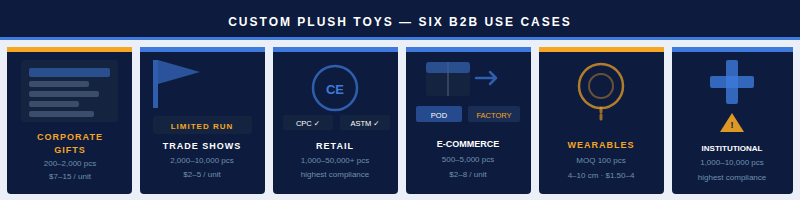
Custom plush toys are used for corporate gifting, trade show giveaways, retail merchandise lines, brand mascot programs, e-commerce merchandise, wearable accessories, and institutional/cause-driven distribution. The variable buyers consistently underestimate: each use case creates an entirely different product specification. A trade show giveaway and a retail shelf product can be physically identical toys, yet require completely different compliance documentation, quality standards, packaging, and pricing structures.
The six core B2B use cases:
Corporate gifts and executive presentation pieces
Trade show and event marketing giveaways
Retail branding and licensed merchandise lines
E-commerce and DTC brand merchandise (including the POD-to-factory transition)
Wearable formats: plush keychains and backpack clips
Institutional and cause-driven programs (hospitals, schools, public safety)
The Plush Use-Case Requirements Matrix
Read across the compliance column: four of the seven use cases carry high or highest compliance burden. That is the column most buyers neglect when building initial budgets — and where most project timelines slip.
Use Case | Volume Range | Unit Budget | Quality Bar | Compliance Priority | Typical Lead Time |
|---|---|---|---|---|---|
Trade show giveaway | 2,000–10,000+ | $2–5 | Presentable, brand-accurate | Medium (child/adult split) | 6–10 weeks |
Corporate gift | 200–2,000 | $5–15 | Premium, brand-precise | Low (adult recipients) | 8–12 weeks |
Retail product line | 1,000–50,000+ | $3–8 | Premium + full packaging | Highest (CPC mandatory) | 12–20 weeks |
Brand mascot / hero piece | 1–100 | $50–300 | Museum-grade sculpt | Low | 10–18 weeks |
E-commerce / DTC | 500–5,000 | $3–8 | High + photography-ready | High (market-dependent) | 8–14 weeks |
Wearable (keychain/clip) | 100–5,000 | $1.50–4 | Durable hardware + compact form | Medium (EN71-1 mechanical) | 4–8 weeks |
Institutional / cause | 1,000–10,000 | $3–7 | Durable, washability-rated | Highest (CPC + wash cycle) | 10–16 weeks |
Lead times include 7–14 days for pre-production sample approval. Rush production is available at premium on select programs.
Custom Stuffed Animals for Business: Corporate Gifts and Executive Presentations
Corporate gifting is one of the highest-margin use cases in custom plush, and one of the most underserved by factories that default to volume-first thinking. Buyers ordering custom stuffed animals for business gifting programs face a fundamentally different brief than trade show buyers: the recipient here is almost always an adult — a key account celebrating a contract renewal, a new hire receiving an onboarding kit, a conference keynote speaker, a client’s executive team. The plush toy in this context is not a toy at all. It is a brand statement delivered in three dimensions.
What this use case demands from the brief:
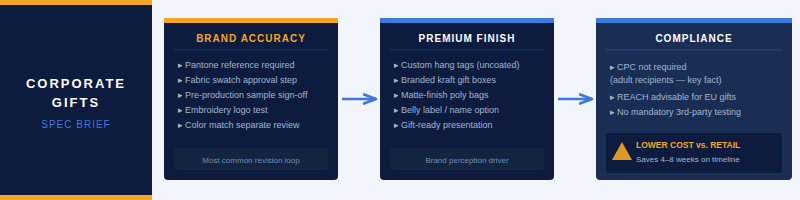
Brand accuracy over cost compression. A $0.50 difference in per-unit cost is irrelevant if the embroidered logo reads poorly at arm’s length or the brand color drifts two shades from the Pantone reference. Specify Pantone references in the brief, and build a fabric swatch approval step before bulk production begins.
Premium finishing details. Custom hang tags on uncoated stock, belly labels with the recipient’s name, branded kraft boxes or matte-finish poly bags — these are the signals that separate a considered gift from a bulk order.
Reduced compliance footprint. Because recipients are adults, CPC testing under CPSIA is not triggered. REACH compliance is still advisable for EU-destined gifts. This meaningfully reduces both cost and lead time relative to retail or institutional programs.
Practical spec implications: MOQ can be as low as 200–500 units for standard designs. Budget $7–15/unit for gift-quality plush with branded packaging. Plan 8–12 weeks from approved design to delivery.
From the production floor: The single most common revision loop on corporate gift orders is color matching. Building a physical fabric swatch approval step into the pre-production timeline — separate from the 3D sample approval — eliminates this loop entirely and keeps the bulk production date intact.
Promotional Plush Toys: Trade Shows and Event Marketing
Promotional plush toys are one of the most effective trade show giveaway formats precisely because they combine tactile memorability with visual brand presence. A mid-size trade show activation might require 3,000–5,000 branded pieces across a three-day event. The unit cost ceiling drops to $2–5, the giveaway transaction happens in under ten seconds, and the product needs to be photogenic enough to generate social sharing without requiring retail-level finishing quality.
What this use case demands:
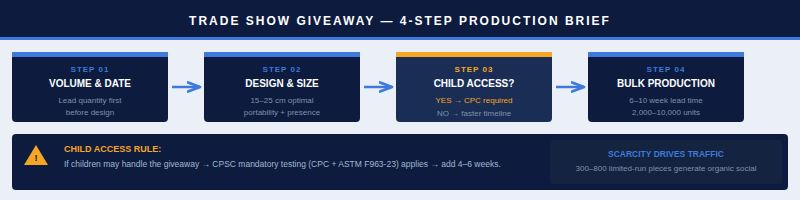
Volume capacity and deadline reliability come first. If the factory cannot guarantee your unit count before your show date, no amount of design quality is recoverable. Lead with quantity and ship date in your brief — not design.
Portability over size. Characters in the 15–25 cm (6–10 inch) range in sitting or standing poses offer the best trade-off between visual presence and take-away practicality.
The child-access compliance decision. If the giveaway reaches only adult professionals at a B2B industry conference, compliance requirements are minimal. If children are reasonably likely to handle the item, CPSC mandatory testing (CPC + ASTM F963-23) applies. Getting this wrong changes your timeline by 4–6 weeks.
Scarcity drives booth traffic. Limited-run positioning — 300–800 pieces — creates urgency that pulls foot traffic and drives organic social content when attendees photograph and post the limited item.
Retail Branding and Licensed Merchandise Lines
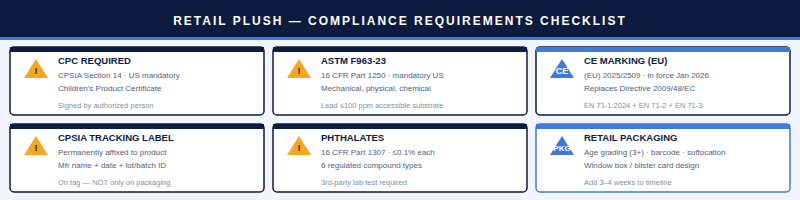
Retail is the use case with the highest compliance overhead — and the highest revenue ceiling when executed correctly. A plush character on a retail shelf is a children’s product under both US and EU law the moment a child might reasonably select it, regardless of the brand’s intended buyer.
US compliance requirements for retail plush (as of 2024):
CPC (Children’s Product Certificate) — mandatory under CPSIA Section 14
CPSIA tracking label permanently affixed (manufacturer name, date, lot/batch identifier)
ASTM F963-23 — current mandatory version per 16 CFR Part 1250
Lead: ≤100 ppm in accessible substrate; ≤90 ppm in surface coatings
Phthalates: ≤0.1% for six regulated compounds per 16 CFR Part 1307
EU compliance requirements for retail plush (current):
CE marking under Toy Safety Regulation (EU) 2025/2509, in force January 1, 2026
EN 71-1:2024+A1:2026 — mechanical and physical safety
EN 71-2 — flammability
EN 71-3 — migration of chemical elements
REACH SVHC compliance (≥253 substances on the candidate list as of 2025)
Digital Product Passport (DPP) applies from August 1, 2030
The factory you select for retail must provide a complete compliance documentation package: test reports from accredited third-party labs (Bureau Veritas, SGS, or Intertek), factory audit documentation (ICTI or BSCI), and the signed CPC.
Packaging as a separate brief. Retail plush requires retail packaging: suffocation warning text on poly bags (US), age grading markings (3+), barcode placement, and potentially window box or blister card construction depending on the retail channel. Add 3–4 weeks for packaging design, dieline development, and structural approval.
From the production floor: Buyers entering retail for the first time frequently underestimate the gap between ‘compliance’ and ‘retail-ready compliance.’ A test report from a recognized lab is necessary but not sufficient. The tracking label must be permanently affixed — not just included on packaging — and the CPC must be signed by someone with actual authority over the production records. We’ve seen first-time retail programs delayed by 6–8 weeks not because of production failures, but because the compliance documentation package didn’t match what the retail buyer’s compliance team required at onboarding.
E-Commerce and DTC Brands: When to Move from POD to Factory Production
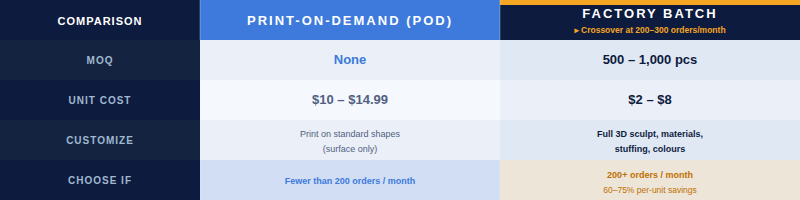
Print-on-demand platforms offer no-MOQ custom plush starting around $10–14.99 per unit. For a DTC brand or independent creator launching a first product run, POD removes inventory risk entirely — and for early-stage launches, that risk elimination is genuinely valuable.
The economics shift at scale.
Factor | POD (e.g., Printify) | Factory Batch |
|---|---|---|
MOQ | None | 500–1,000 units minimum |
Unit cost | $10–14.99 | $2–8 |
Customization depth | Print on surface (standard shapes only) | Full 3D sculpt, materials, stuffing, colors |
Fulfillment lead time | 3–7 days per order | 30–45 days from production completion |
Compliance responsibility | Platform-managed | Buyer sources third-party testing |
Per-unit margin at 1,000 units | ~$6–12 gross before platform fees | ~$12–18 gross at $15 retail |
The crossover point is roughly 200–300 units per month in consistent, predictable orders. Below that level, POD’s zero-inventory model is worth the per-unit premium. Above it, factory batch pricing — typically 60–75% lower per unit — justifies carrying inventory and managing your own compliance documentation.
DTC brief requirements: E-commerce products are photographed under controlled studio lighting and reviewed by buyers zoomed in on a phone screen. This means: cleaner seam execution, consistent stuffing distribution without lumps or hollow areas, and facial feature placement that reads well in both hero and close-up shots. Specify AQL 2.5 inspection standards in your purchase order, and request photography-grade samples before approving bulk production.
Wearable Formats: Plush Keychains and Backpack Clips
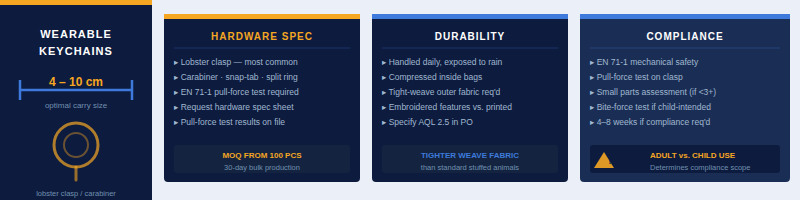
Wearable plush formats have a meaningfully lower entry point than standard stuffed animals. The MOQ for plush keychains is typically 100 pieces, versus 500–1,000 for a standard plush character — making them accessible for smaller brand programs, merchandise test runs, or event accessories that would otherwise be priced out at standard plush MOQ thresholds.
What changes in the brief for wearables:
Hardware specification and testing. The attachment mechanism — lobster clasp, carabiner, snap-tab, split ring — is subject to EN 71-1 mechanical and physical safety testing. Request hardware specification sheets and pull-force test results from your factory before finalizing material selection.
Dimensional constraints. Functional keychains typically run 4–10 cm. Below 4 cm, the plush character loses sufficient surface area to communicate design detail. Above 10 cm, the piece becomes unwieldy as a daily-carry item.
Durability context. A keychain is handled daily, exposed to rain and friction, and compressed inside bags. The outer fabric should be of tighter weave than standard plush, and embroidered feature details are more durable over time than printed or sublimated alternatives.
Speed advantage. At 100–500 units, sample turnaround is 7–10 working days and bulk production runs approximately 30 days — considerably faster than full character plush development.
Institutional and Cause-Driven Programs
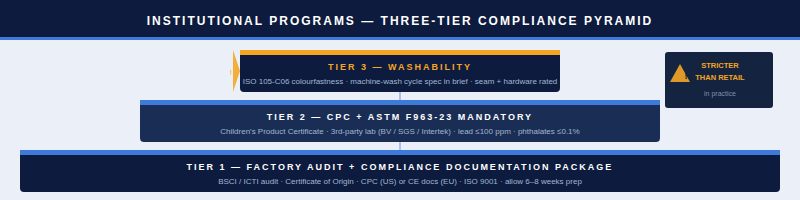
Hospitals, schools, public safety departments, and nonprofits represent a distinct procurement category — one where compliance requirements are actually higher in practice than many buyers assume, and where the procurement process itself extends timelines substantially.
Why compliance is stricter, not looser, in institutional settings: A plush toy distributed to pediatric patients in a children’s hospital ward is a children’s product under CPSIA, full stop. CPC testing is mandatory. ASTM F963-23 applies. The institution’s internal approval process does not substitute for federal testing requirements.
Healthcare settings frequently add a further requirement: washability. Standard plush is not designed for repeated machine washing. If the institution requires machine-washable product, brief the factory on the washing cycle parameters before material selection — fabric choice, seam construction, and eye/nose hardware all change accordingly. ISO 105-C06 colorfastness testing is the relevant standard.
Procurement process timeline implications: A 6–8 week compliance documentation preparation period should be built into your timeline before production begins. Expect to provide:
Third-party test reports (ASTM F963-23 / EN 71 as applicable)
Factory audit certification (BSCI, ICTI, or equivalent)
Certificate of Origin
CPC (US market) or CE documentation package (EU market)
ISO 9001 factory certification for larger institutional contracts
Use case breakdown by institution type:
Hospitals — Pediatric comfort toys; ER calming tools; gift shop fundraising merchandise; branded plush sold in support of a charity affiliation.
Schools — Mascot character merchandise; reading incentive program rewards; bullying prevention campaign characters; PTA fundraising product lines.
Public safety — Community relations plush for police and fire departments; outreach program items; disaster relief and emergency comfort kits.
Nonprofits — Awareness campaign characters; donor recognition gifts; fundraising merchandise sold at events or online.
From the production floor: Institutional orders almost always arrive with a compliance documentation checklist from the buyer’s procurement team. Before quoting, ask for that checklist. We have seen institutional programs that spec’d a product, approved a sample, placed an order — then arrived 10 weeks later asking for a factory social compliance audit report that wasn’t in the original quote scope.
How to Write the Right Brief for Your Use Case
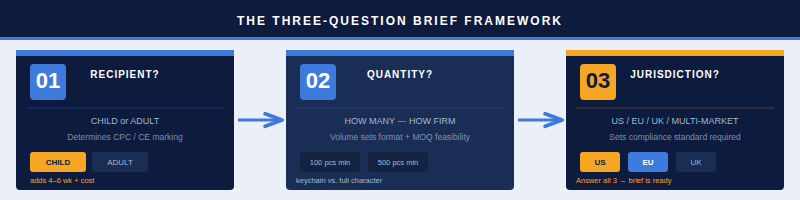
Before briefing any factory, answer three questions. The answers determine your brief’s constraints before a single design decision is made.
Step 1: Who is the end recipient — child or adult? This single question determines whether CPC testing is mandatory (US) or CE marking is required (EU). If the answer is ‘children,’ add 4–6 weeks and meaningful per-unit cost to your program estimate. If the answer is ‘adults only,’ your compliance footprint shrinks significantly — but document that audience determination in writing.
Step 2: What is the committed quantity, and how firm is that number? Use case determines volume, and volume determines unit price, MOQ feasibility, and factory allocation. If your budget supports only 300 units, a wearable format (keychain at 100-piece MOQ) may serve the program better than a standard plush at 500-piece minimum.
Step 3: What compliance jurisdiction applies? US distribution requires ASTM F963-23 testing and CPC. EU distribution requires EN 71 testing and CE marking under (EU) 2025/2509. UK distribution requires UKCA marking. If your product ships into multiple markets, you need a compliance program that satisfies all of them.
Once these three questions are answered, the rest of the brief is mechanical: design brief, material preferences, delivery address, ship date. The constraints that cause programs to fail — compliance gaps, timeline overruns, unit cost surprises — all trace back to these three questions being left unanswered at brief stage.
Ready to brief a factory? Request a use-case-specific quote →
Not sure which format fits your program? Order samples before committing to bulk →
Frequently Asked Questions
What is the minimum order quantity for custom plush toys?
It depends on the format. Standard stuffed animals typically require a minimum of 500–1,000 units per design. Plush keychains and backpack clips can start at 100 units. Single-unit prototypes and hero pieces are possible but cost $50–300+ per unit depending on complexity, with lead times of 10–16 weeks for original 3D sculpts.
Do custom plush toys require CPC certification or CE marking?
Only if they will be sold or distributed to children. In the US, any product reasonably intended for use by children under 12 requires a Children’s Product Certificate (CPC) and third-party testing to ASTM F963-23. In the EU, CE marking under Toy Safety Regulation (EU) 2025/2509 applies. Adult promotional merchandise and corporate gifts have significantly lower compliance requirements.
What is the difference between a trade show giveaway spec and a retail product spec?
A trade show giveaway for adult recipients needs brand-accurate design and basic durability; CPC testing is only required if children are likely recipients. A retail product requires CPC, a permanently affixed CPSIA tracking label, full ASTM F963-23 testing, age grading, retail-grade packaging, and barcoding — adding 4–8 weeks and meaningful cost.
When should a DTC brand switch from print-on-demand to factory production?
When consistent monthly demand exceeds approximately 200–300 units. POD pricing of $10–14.99/unit versus factory batch pricing of $2–8/unit represents per-unit savings of 50–75%. At 300 units per month, the inventory commitment of factory production is more than offset by per-unit savings.
Can the same plush design be used for both retail and corporate gifting?
Yes — the design can be identical, but the production program is different. Retail requires CPC, tracking labels, retail packaging, and third-party test reports. Corporate gifting typically requires none of these. Specify the intended end use on each purchase order.
How far in advance should a custom plush order be placed?
Standard bulk orders of 1,000+ units with an existing design: 10–14 weeks from design approval. New character sculpts: add 4–6 weeks for tooling and sample approval rounds. Retail orders with compliance documentation: add 4–8 weeks for third-party testing. Trade show orders: place 16–20 weeks before the event date.
Terminology
Term | What It Means |
|---|---|
CPC | Children’s Product Certificate — mandatory US compliance document for children’s products, certifying third-party lab testing to applicable safety standards |
CPSIA | Consumer Product Safety Improvement Act (2008) — US federal law establishing mandatory third-party testing and CPC requirements for children’s products |
ASTM F963-23 | Current mandatory US toy safety standard (per 16 CFR Part 1250); covers mechanical/physical safety, flammability, and chemical requirements |
(EU) 2025/2509 | EU Toy Safety Regulation in force January 1, 2026; replaces Directive 2009/48/EC; introduces Digital Product Passport from 2030 |
MOQ | Minimum Order Quantity — the minimum number of units a factory will produce per design in a single production run |
POD | Print on Demand — fulfillment model where products are manufactured individually per order, with no inventory commitment |
AQL 2.5 | Acceptable Quality Limit 2.5 — standard inspection protocol; ≤2.5% defective units in a production lot are acceptable |
EN 71-1 | European standard for toy mechanical and physical safety; governs pull-force, bite-force, and small parts tests for toys and wearable plush |
REACH / SVHC | EU chemical regulation; Substances of Very High Concern candidate list includes 253+ substances as of 2025; applies to all EU-market products |
A Note on Scope
This guide focuses exclusively on B2B procurement of custom plush toys for business purposes: promotional programs, retail merchandise lines, corporate gifting, institutional distribution, and brand merchandise. It is written for buyers working with OEM/ODM factories, not for individual consumers purchasing retail products.
Compliance figures cited reflect US and EU regulatory requirements as of the 2025–2026 regulatory period. Regulations are subject to amendment; verify current requirements with your compliance team or factory before finalizing a production program. The Digital Product Passport requirement under (EU) 2025/2509 is listed here for awareness; it does not take effect until August 1, 2030.
References & Sources
U.S. CPSC, 16 CFR Part 1250 — Safety Standard Mandatory for Toys (ASTM F963-23), effective February 2024 [Tier 1]
European Commission, Toy Safety Regulation (EU) 2025/2509, Official Journal of the EU, in force January 1, 2026 [Tier 1]- CPSIA Section 14, Children’s Product Certificate and Third-Party Testing Requirements [Tier 1]
- 16 CFR Part 1307, Prohibition of Children’s Toys and Child Care Articles Containing Specified Phthalates [Tier 1]
Loonie Times, Custom Plush Toys for Industry Applications, loonietimes.com [Tier 3 — directional]
Custom Plush Maker, Why U.S. Airports, Restaurants and Retailers Need Custom Plush Toys, customplushmaker.com [Tier 3]
Plushtoys-Factory, Custom Plush Keychains — MOQ and Specifications, plushtoys-factory.com [Tier 3]
Printify, Custom Stuffed Animals — Print on Demand Product Page, printify.com [Tier 3]
Perfect Imprints, Promotional Products Business Case Data, perfectimprints.com [Tier 3]
Everlighten, Brand Mascot Design Process, everlighten.com [Tier 3]
Ready to Brief a Factory?
Use this guide as a pre-brief checklist before reaching out to any custom plush factory. If you’ve answered the three key questions — end recipient, committed quantity, compliance jurisdiction — you’re ready to receive an accurate quote.
Request a use-case-specific quote → [Your factory contact page URL]
Not ready to commit to bulk? Order a sample to confirm quality, compliance documentation, and finishing standard before placing a production order.