
Toy Safety Standards Explained: ASTM, EN71 & CPSIA
What these standards actually are, how they relate to each other, which version applies to your product, and who carries which responsibility.
Updated August 2026 · B2B buyer’s orientation
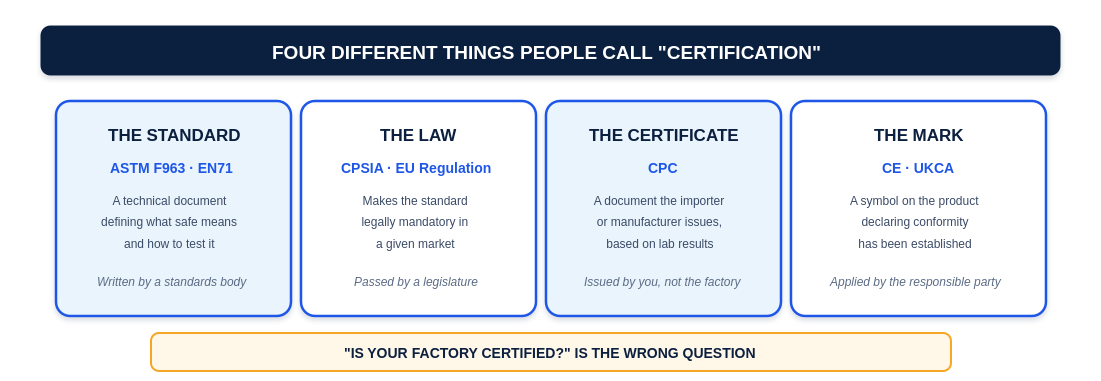
ASTM F963 and EN71 are technical standards. CPSIA is a US law that makes ASTM F963 mandatory. A CPC is a certificate you issue. CE is a mark you apply. They are four different things.
Direct answer: For the US market, CPSIA makes ASTM F963 legally binding, testing must be done at a CPSC-accepted laboratory, and the importer or manufacturer issues a Children’s Product Certificate. For the EU, the EN71 series sits under EU toy safety law and conformity is declared through CE marking.
Toy Safety Standards Explained — TL;DR: Most confusion in this area comes from treating “certification” as one thing. Separating the standard, the law, the certificate and the mark makes the whole system legible — and makes clear that the legal obligation sits with the importer or brand, not the factory.
Scope and disclaimer: This article is general buyer education, not legal or compliance advice. Requirements differ by market, product type and age grade, and they change over time. Confirm what applies to your specific product with a qualified testing laboratory or regulatory adviser before production. Facts below are drawn from official sources current at the time of writing and linked in the references.
Standard, Law, Certificate, Mark: Four Different Things
Buyers routinely ask suppliers “are you ASTM certified?” or “do you have EN71?” Neither question quite makes sense, and understanding why is the fastest route to understanding the whole system.
A standard is a technical document. ASTM F963 and the EN71 series define what counts as safe and how to test for it. On its own, a standard has no legal force.
A law gives a standard force in a particular market. In the United States, the Consumer Product Safety Improvement Act of 2008 made ASTM F963 a mandatory consumer product safety standard for children’s toys.
A certificate is a document attesting that a specific product meets those requirements, based on laboratory results. In the US this is the Children’s Product Certificate, and it is issued by the manufacturer or importer — not by the factory that sewed the toy.
A mark is a symbol applied to the product declaring conformity. CE marking in the EU works this way.
So a certificate belongs to a product and a production batch, not to a factory. A supplier who says “our factory is EN71 certified” is either using shorthand or doesn’t understand the system — worth clarifying which.
The United States: CPSIA, ASTM F963 and 16 CFR Part 1250
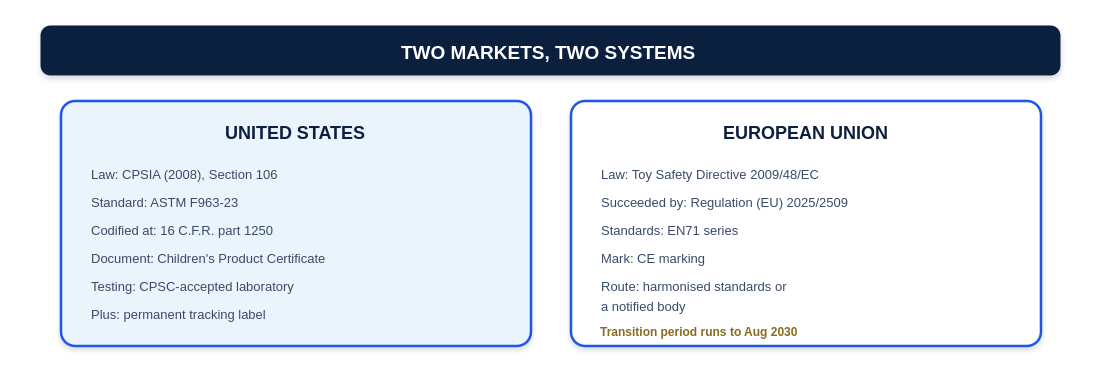
Section 106 of the CPSIA made ASTM F963 mandatory for children’s toys, and the requirement is codified at 16 C.F.R. part 1250. Testing for US children’s products must be carried out at a CPSC-accepted laboratory, and the importer or manufacturer then issues a Children’s Product Certificate citing the applicable sections.
Two details are worth knowing because they surprise people. First, although ASTM F963 covers toys intended for children under 14, the CPSC’s third-party testing and certification requirements apply only to products designed or intended primarily for children aged 12 or younger. Second, children’s products also carry a separate tracking-label requirement, and those permanent markings must appear on the product and on its packaging — not just one or the other.
Which Version Applies? It Depends on the Manufacturing Date
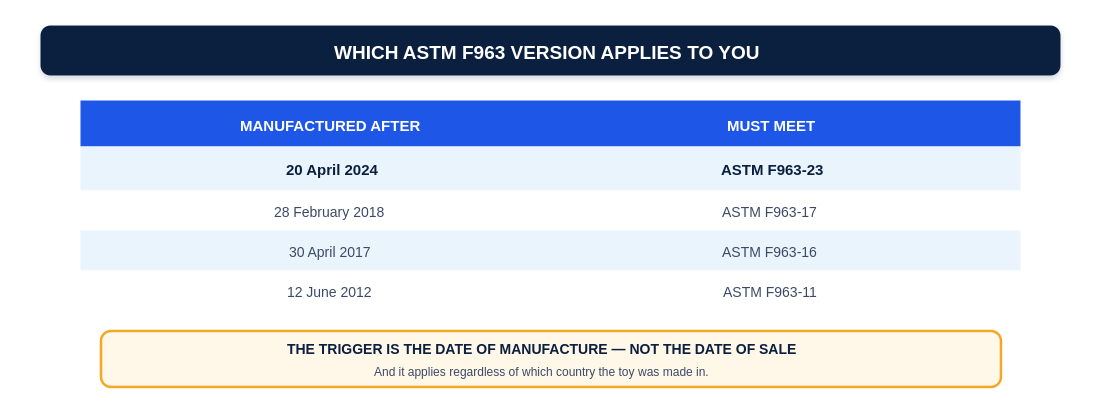
This is the single most useful thing a buyer can know about ASTM F963, and it explains why people still search for older versions of the standard.
The obligation is tied to the date a toy was manufactured, not the date it was sold or imported. Toys manufactured after 20 April 2024 must meet ASTM F963-23. Product manufactured earlier may legitimately have been certified to an earlier version, such as F963-17, and remain compliant on that basis. The rule applies regardless of which country the toy was made in.
For anyone placing a new order, the practical implication is simple: your production will fall under the current version, so test reports from an older run don’t automatically carry over to a new one.
Section 4.27: The Clause Written Specifically for Plush
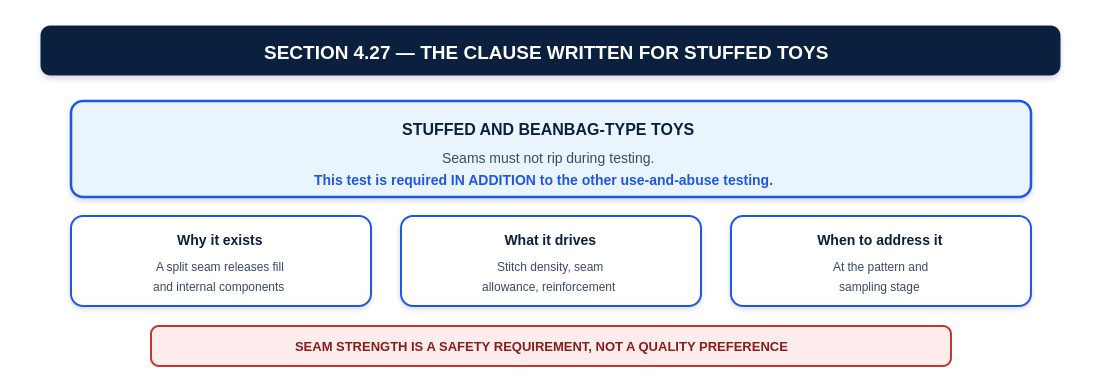
Most of ASTM F963 covers toys in general. One clause is written specifically for this product category: section 4.27, covering stuffed and beanbag-type toys, which requires that seams must not rip during testing — and specifies that this test is required in addition to the other applicable use-and-abuse testing.
The reasoning is straightforward. A plush toy’s entire hazard profile changes if a seam opens: fill escapes, internal components become accessible, and anything sewn inside is no longer contained. That is why seam strength on a plush toy is a safety requirement rather than a quality preference, and why stitch density, seam allowance and reinforcement points are worth specifying at the pattern stage rather than treating as factory discretion.
If you’re at the design stage, our guide to how custom plush toys are made → covers where these decisions get locked in.
The European Union: EN71, CE Marking and a Regulation in Transition
The EU system is structured differently. Toy safety law sets out essential safety requirements, and the EN71 series provides the harmonised technical standards used to demonstrate conformity — EN71-3, for example, covers migration of certain elements. Conformity is declared by applying the CE marking, either through self-verification against harmonised standards or, in some cases, via a notified body.
The framework is currently changing. The Toy Safety Directive 2009/48/EC has governed this area for years, and a new Toy Safety Regulation, (EU) 2025/2509, has since been adopted with a multi-year transition period running to August 2030. For buyers, the practical takeaway is not to memorise the transition schedule but to confirm with your testing laboratory which framework applies to your production window, since guidance will continue to develop through the transition.
Who Is Responsible for What
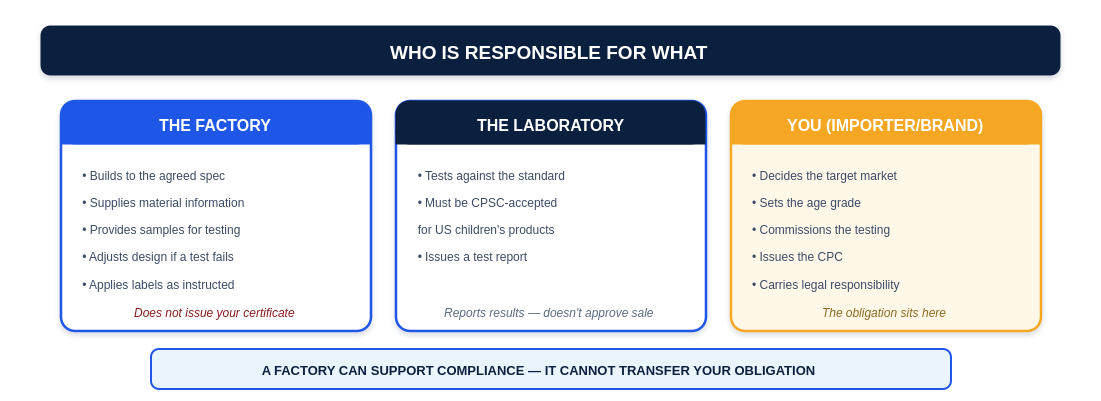
This is where a lot of B2B relationships go wrong, usually because both sides assumed the other was handling something.
The factory builds to the agreed specification, supplies material information, provides samples for testing, adjusts the design if something fails, and applies labels as instructed. What a factory cannot do is issue your certificate or assume your legal obligation. The laboratory tests against the standard and reports results; it does not approve a product for sale. The importer or brand decides the target market and age grade, commissions the testing, issues the certificate and carries the legal responsibility.
To be direct about our own position: we are a manufacturer, not a testing body. We do not hold — and could not hold — a certificate on your behalf. What we do is support the process: building to spec, providing samples and material information for your chosen laboratory, and revising the design where a test result requires it. Any supplier claiming their factory certification removes your obligation is describing something that doesn’t exist.
What This Means at the Design Stage
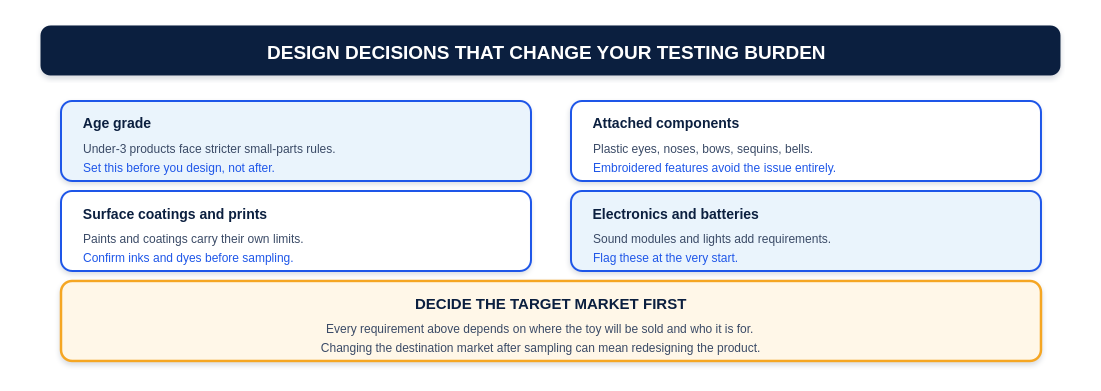
Compliance is cheapest to address before sampling, because several ordinary design decisions change what testing your product will face.
Age grade. Products intended for children under three face stricter small-parts requirements. Decide the age grade before you design, not after the sample arrives.
Attached components. Plastic eyes, noses, bows, sequins and bells are all attachment-strength questions. Embroidered features sidestep the issue entirely, which is often why they’re recommended for younger age grades.
Surface coatings and prints. Paints and similar surface coatings carry their own limits, so inks and dyes are worth confirming before sampling rather than after.
Electronics and batteries. Sound modules, lights and battery compartments add a further layer of requirements. Flag them at the very start of a project.
Above all, decide the destination market first. Every requirement above depends on where the toy will be sold and who it is for, and changing the target market after sampling can mean redesigning the product rather than simply re-testing it.
Frequently Asked Questions
Is my factory ASTM F963 certified? Certification applies to products and production batches, not to factories. The meaningful questions are whether the factory can build to the standard’s requirements, supply samples and material data for testing, and revise the design if a test fails.
Which version of ASTM F963 do I need to meet? It depends on when the toys are manufactured. Toys manufactured after 20 April 2024 must meet ASTM F963-23. Earlier production may have been certified to an earlier version and remain compliant on that basis.
Do I need both ASTM F963 and EN71? Only if you are selling into both markets. ASTM F963 relates to the United States and EN71 to the European Union; each market has its own requirements, documents and marks.
Who issues the Children’s Product Certificate? The manufacturer or importer issues it, based on testing at a CPSC-accepted laboratory. It is not issued by the factory or by the laboratory.
Can a toy be sold to adults to avoid toy safety testing? Age grading is based on the product’s design, marketing and likely users, not simply on a label. Deliberately mislabelling a children’s product to avoid requirements creates significant legal exposure.
Terminology Buyers Should Know
|
Term |
What It Means |
|
ASTM F963 |
The US toy safety standard; current mandatory version is F963-23 |
|
CPSIA |
The 2008 US law that made ASTM F963 mandatory and added lead, phthalate and tracking-label rules |
|
16 C.F.R. part 1250 |
Where ASTM F963 is codified in US federal regulation |
|
CPC |
Children’s Product Certificate — issued by the importer or manufacturer, not the factory |
|
EN71 |
The European series of toy safety standards; EN71-3 covers migration of certain elements |
|
CE marking |
The mark declaring a product meets applicable EU requirements |
|
Tracking label |
Permanent identifying marks required on the product and its packaging |
|
Use-and-abuse testing |
Standardised stress testing simulating how children actually handle toys |
A Note on Scope
This article is general orientation for buyers, not legal or compliance advice, and it does not cover every requirement that may apply to a given product. Toy safety requirements vary by market, product type, age grade and materials, and they change over time — the EU framework in particular is mid-transition at the time of writing. Individual US states and other jurisdictions may impose additional requirements beyond those described here. Always confirm current obligations for your specific product and target market with a qualified testing laboratory or regulatory adviser before committing to production.
We are a plush toy manufacturer. We support customers through testing by building to specification and supplying samples and material information, but we do not issue certificates and nothing in this article should be read as a compliance guarantee for any product.
References & Sources
1. U.S. Consumer Product Safety Commission — Toy Safety Business Guidance
2. eCFR — 16 C.F.R. part 1250, Children’s toys
3. European Commission — Toy Safety
Planning a Project That Needs Testing?
If you’re developing a plush product for a regulated market, the earlier compliance enters the conversation, the cheaper it is. We can review a design for the things that commonly cause test failures — attachment strength, small parts, seam construction — before you commit to sampling.