
This guide is written from the production floor of a custom plush manufacturer with 30 years of experience supplying corporate giveaways and promotional products to clients in North America and Europe — markets where compliance standards are among the world’s most stringent, and where trade show deadlines are non-negotiable.
Custom Plush Toys for Trade Shows and Events: The B2B Sourcing Playbook
⚡ Quick Answer
Custom plush toys for trade shows are ordered in quantities of 100–1,000+ units, typically 8–12 weeks before the event, at sizes between 3 and 10 inches. Even adult-targeted giveaways require ASTM F963 compliance consideration. The most effective programs combine the right size for portability, brand-consistent color matching via physical swatch, and packaging designed to carry post-show messaging.
What this guide covers: Why the data supports plush over other giveaways → Compliance requirements most buyers overlook → MOQ and pricing economics → Size and design specs → A 12-week order timeline → Packaging options → How to brief your factory.
Why Promotional Plush Toys Work at Trade Shows: What the Data Shows
The case for promotional plush toys at trade shows isn’t intuitive — you’re competing for floor space in a bag that’s already full of brochures, USB drives, and tote bags. But the numbers are unambiguous.
According to research cited by the Promotional Products Association International (PPAI), high-quality promotional giveaways are twice as likely to produce brand recall compared to low-quality equivalents. In a trade show context specifically, 76% of participants who received a promotional product at an exhibition could still name the company that gave it to them 12 months later — compared to just 53.5% who remembered a magazine advertiser after one week. And 52% of trade show attendees said they were more likely to visit a booth that offered a giveaway or freebie.
Plush toys earn an outsized share of that attention because they’re tactile, visually distinct, and — for branded stuffed animals that carry a company mascot or character — genuinely shareable. They go home. They sit on desks. They get photographed. A pen gets lost in a drawer; a well-made mascot plush gets introduced to people.
Recall Rate Comparison: Plush vs. Other Trade Show Giveaway Formats
Giveaway Type | Post-Event Recall | Keep/Use Rate | Desk Display |
|---|---|---|---|
Custom plush / branded stuffed animals | 12+ months | High | High |
Branded tote bag | 6–12 months | High (functional) | Low |
USB drive / tech item | 3–6 months | Medium | Low |
Branded pen / stationery | 1–3 months | Low–Medium | Low |
Printed brochure | Days–weeks | Very low | Very low |
“High-quality promotional products are twice as likely to result in brand recall as low-quality equivalents.” — PPAI Consumer Study
The implication for trade show buyers is direct: the choice isn’t whether to give a giveaway, but whether to give one that people will keep. A well-produced branded plush at a per-unit cost of $8–15 FOB delivers brand presence that outlasts most digital ad impressions — and 73% of recipients who use a promotional product report using it at least once a week.
Compliance Requirements for Trade Show Plush Giveaways
This is the section most trade show buyers skip — and it’s where orders get delayed, recalled, or create liability exposure after the show floor clears.
“Promotional products intended for adults given at tradeshows and other events often end up in the hands of children.” — PPAI
A branded stuffed animal handed out at a technology conference or pet industry trade show may be intended for the adult attendee, but it will frequently end up in the hands of that attendee’s child. The product’s physical form — soft, squeezable, animal-shaped — invites exactly that outcome. This means the question “does my trade show giveaway need compliance testing?” is usually answered “yes” for plush, even when the nominal recipient is an adult.
Adult-Targeted vs. Children’s Product Compliance: What Changes
Compliance Area | Adult-Targeted (Risk-Aware) | Children’s Product (≤12 yrs) |
|---|---|---|
ASTM F963-23 (US Toy Safety) | Strongly recommended | MANDATORY (Apr 20, 2024) |
CPSIA / CPC | Not technically required | REQUIRED |
Heavy metals testing (8 metals) | Recommended | Required |
Flammability (16 CFR 1500.44) | Recommended | Required |
CA Prop 65 | Required if distributing in CA | Required |
State registration (PA, MA, OH) | Required in applicable states | Required |
Tracking labels (CPSC) | Best practice | Required |
EN71 / CE marking | Required for EU/UK markets | Required for EU/UK markets |
Our factory’s approach: Before confirming any trade show order, we ask the buyer to specify the final recipient profile — is the product intended to be handed directly to children at the booth, or to adult attendees who happen to have children? That single question determines the compliance path and affects both cost and production timeline. We only proceed to production once the compliance scope is confirmed in writing.
For most US trade show programs, we recommend requesting ASTM F963-23 third-party test reports as a baseline, regardless of the stated recipient age. This protects the exhibitor, satisfies the most commonly asked distributor compliance questions, and eliminates the liability uncertainty created by the PPAI warning above.
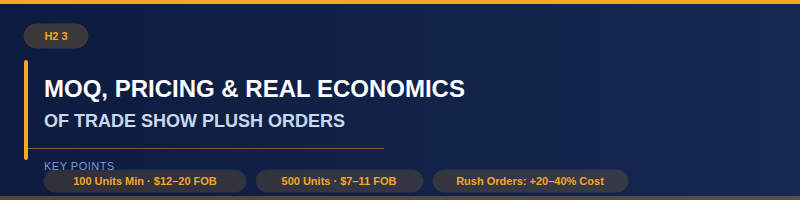
MOQ, Pricing, and the Real Economics of Trade Show Plush Orders
The first question every trade show buyer asks is “what’s the minimum order quantity?” The better question is “what quantity actually makes sense for this show?”
Calculating your real quantity need: Multiply expected daily qualified-lead booth traffic × number of show days × your distribution rate (not everyone who visits the booth will receive one). A show with 400 daily visitors over 3 days at a 60% distribution rate suggests 720 units — rounding to 750 or 1,000 gives buffer for staff, VIP sets, and post-show follow-up packages.
MOQ Tier Comparison: What to Expect from Factory-Direct Suppliers
Order Quantity | Unit Price (FOB) | Lead Time | Best Fit For |
|---|---|---|---|
100–299 units | $12–$20+ per unit | 45–60 days | Pilot programs, VIP gifting |
300–499 units | $9–$14 per unit | 40–55 days | Mid-size shows, first-time programs |
500–999 units | $7–$11 per unit | 35–50 days | Standard trade show programs |
1,000–2,999 units | $5–$8 per unit | 30–45 days | Large shows, multi-event programs |
3,000+ units | $4–$6 per unit | 30–40 days | Annual campaigns, multi-show bulk |
Note: FOB pricing reflects directional ranges based on a standard 8–10″ plush with embroidered logo, PP cotton fill, and single-color hang tag. Actual pricing requires review of the design brief and process sheet. Rush production adds 20–40% to base unit cost.
Sea freight vs. air freight break-even: For orders over 500 units, sea freight is almost always more cost-effective if the timeline allows 4–6 weeks for transit. Air freight on a 500-unit order can add $600–1,200 in shipping costs — enough to offset the per-unit savings from ordering at a higher MOQ. The practical implication: if your event is less than 8 weeks away and you haven’t placed your order, you’re almost certainly paying for air freight.
Multi-show strategy: Ordering across multiple annual events in one production run reduces per-unit cost significantly and eliminates re-sampling costs for the same design. If your organization attends the same 3–4 trade shows per year, a single consolidated order produces better unit economics than four separate orders.
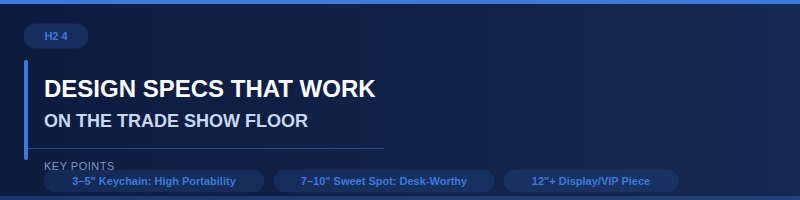
Design Specs That Actually Work on the Trade Show Floor
Not all plush sizes work in a trade show context. The right choice depends on your distribution method, the show’s floor dynamics, and what happens to the product after the attendee leaves the booth.
Size Guide: Three Zones for Trade Show Plush
Zone 1 — Keychain/Clip (3–5 inches): Ideal for shows where attendees travel long distances or carry minimal bags. Keychain plush attach to badge lanyards and bags, creating mobile brand visibility throughout the show floor. High portability; lower perceived premium value.
Zone 2 — Giveaway Sweet Spot (7–10 inches): The most commonly recommended trade show size. At 7–10 inches, the plush feels substantial and well-made without being difficult to carry home in a roller bag. Sufficient surface area for accurate character reproduction, embroidered logo placement, and meaningful facial detail. This is the size that tends to end up on desks.
Zone 3 — Display/Feature Piece (12 inches+): Less commonly given away in volume; more often used as a booth display centerpiece or limited VIP gift. Creates strong visual presence at the booth; less practical for volume distribution. Higher unit cost.
Fabric and finish options: Ultra-soft plush (minky-style fabric) has become the standard for branded stuffed animals in premium trade show programs — it’s the tactile quality that triggers the “I want to keep this” reaction. Standard short-pile plush works for tighter budgets. Embroidery holds up better than heat-transfer printing for logos that need to survive in a bag for a full show day — printing can crack or peel under typical trade show booth handling.
Color matching: Because brand color accuracy is non-negotiable for trade show giveaways, we require all buyers to confirm colors via physical fabric swatches before bulk production begins. A Pantone reference number defines the target, but the actual fabric color depends on the dye lot, fiber content, and weave of each specific material. We include physical swatch sign-off as a standard step — it adds 3–5 days but eliminates color disputes at delivery.
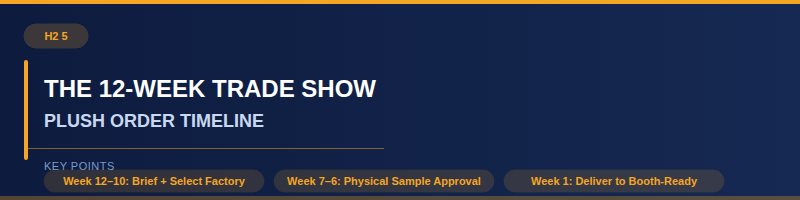
The 12-Week Trade Show Plush Order Timeline
The single most common reason trade show plush programs fail isn’t design, compliance, or budget — it’s timing. Orders placed with insufficient lead time produce one of three outcomes: rush surcharges, compromised quality from a compressed approval process, or missed delivery.
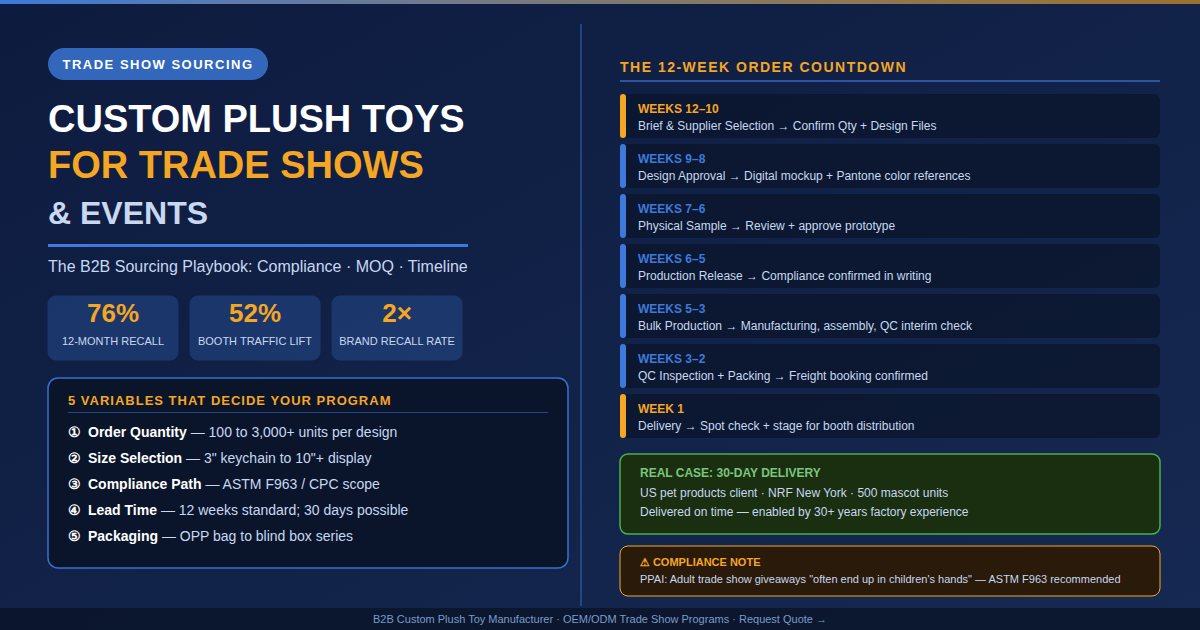
The 12-Week Trade Show Plush Countdown
Weeks Before Event | Phase | Key Actions |
|---|---|---|
Week 12–10 | Brief & Supplier Selection | Finalize design concept, confirm quantity, select factory |
Week 9–8 | Design Approval | Submit artwork files, confirm Pantone references, approve digital mockup |
Week 7–6 | Physical Sample | Factory produces prototype; buyer reviews and approves (or requests revision) |
Week 6–5 | Production Release | Compliance scope confirmed in writing; factory schedules production slot |
Week 5–3 | Bulk Production | Manufacturing, fill, and assembly; interim production photos provided |
Week 3–2 | QC & Packing | Third-party or factory QC inspection; packaging confirmed; cartons labeled |
Week 2–1 | Shipment | Freight booking confirmed; cargo departs (sea or air by timeline) |
Week 1 | Arrival & Prep | Delivery to booth/warehouse; spot-check units; stage for distribution |
Holiday season caveat: For shows in November and December (CES pre-show, holiday corporate events), factory capacity is typically constrained from September onward. Orders for Q4 shows should follow a 14–16 week timeline and be placed no later than August to secure a production slot.
Rush Order Reality: What’s Actually Possible
Most suppliers quote 8–12 weeks as their standard recommendation. The real floor — the timeline a capable factory can hit under pressure — is shorter, but it comes with tradeoffs.
📦 Real Case: 30-Day Delivery — NRF New York
Earlier this year, we received an order from a US pet products company preparing for NRF in New York. They needed 500 custom corporate mascot plush units with a 30-day delivery requirement. Based on our decades of operational experience and our team’s rapid response capability, we delivered the full order on time and to quality standard. The client had their mascots on the booth floor at NRF. What made a 30-day delivery possible: the design was a clean character with no complex articulation, the compliance scope was confirmed in the first call, there were no revision rounds on the physical sample, and air freight was authorized from the start. Remove any one of those conditions and the timeline would have slipped.
The practical conclusion: 30-day delivery is achievable for buyers who are prepared, decisive, and working with an experienced supplier. It is not a safe planning assumption for a first-time order or a complex design. Build in 12 weeks. Treat 8 weeks as acceptable-with-awareness. Treat anything under 6 weeks as a rush scenario with corresponding cost and risk.
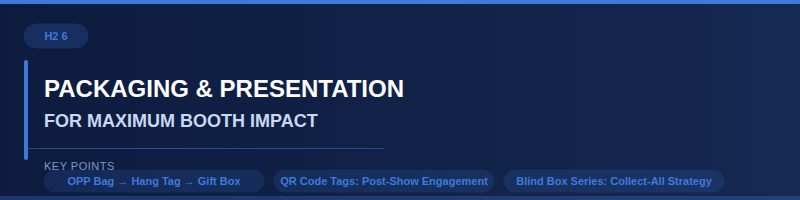
Packaging and Presentation for Maximum Booth Impact
Packaging is the part of the trade show plush order that most buyers decide last and should decide first. Once a product is in production, changing the packaging spec creates delays and often requires additional tooling or artwork.
The Packaging Spectrum for Trade Show Plush
Clear OPP polybag (lowest cost) — keeps the product clean during transit and on the booth. Minimal brand presence on the package itself. Appropriate for high-volume distribution where the plush is the brand statement.
Printed hang tag (low cost, high impact) — a custom-designed hang tag adds brand messaging, website URL, QR code, or “collect all” series information. The most cost-effective packaging upgrade for most trade show programs.
Branded drawstring pouch — adds a reusable secondary item to the gift. The pouch itself becomes a branded takeaway.
Custom printed gift box — appropriate for VIP gifting, C-suite giveaways, or premium programs under 500 units where the economics work.
Blind box series packaging — for brands running a collectible character series (“4 characters, collect them all”). Creates incentive to return to the booth. Requires 2+ character designs and 300–500 units minimum per character.
Our recommendation for most trade show programs: Clear OPP bag + custom hang tag. The hang tag carries the QR code linking to your product page, show special, or follow-up content — turning the plush into a post-show lead nurturing tool. We finalize the hang tag design alongside the physical sample, not after bulk production begins.
How to Brief a Custom Plush Factory for Trade Show Orders
An underspecified brief is the root cause of most trade show plush delays, revision cycles, and quality disappointments. A complete brief allows the factory to give you an accurate quote, a realistic timeline, and a first sample that’s close to final.
8-Point Factory Brief for Trade Show Plush
1. Quantity and delivery date: Specify the required arrival date at the event venue or your warehouse, not just the event date. Include distribution buffer.
2. Dimensions: Specify the finished height of the character in inches or centimeters. Reference a similar product if possible.
3. Character design files: Vector files (AI or EPS preferred) for logos. Reference images for 3D characters — front, back, and side.
4. Fabric and fill specification: Ultra-soft (minky), short-pile standard plush, or other. Fill weight preference. Specify recycled fill if sustainability is a requirement.
5. Color references: Pantone numbers for all key colors. Acknowledge that physical swatch confirmation will be required before bulk production.
6. Compliance scope: Final use: adult giveaway only, or potentially accessible to children? Destination market (US, EU, UK, Canada)? Any specific certifications required?
7. Packaging requirements: OPP bag only? Hang tag? Gift box? Blind box? QR code content needed?
8. Label and marking requirements: Tracking label requirements, country of origin, care instruction label language, brand-specific requirements.
⚠ The question we always ask before confirming a trade show order
“Who is actually going to receive this product, and is there any path for it to reach a child under 12?” That question determines the compliance path, the testing requirement, and ultimately the cost and timeline. Buyers who answer it clearly in the brief save two to three weeks of back-and-forth later in the process.
Frequently Asked Questions
Q: What is the typical lead time for custom plush toys for trade shows?
For a standard order of 500+ units with a new design, plan for 10–12 weeks from brief confirmation to delivery. This includes 2–3 weeks for physical sampling, 4–6 weeks for bulk production, 1–2 weeks for QC, and 2–3 weeks for sea freight. Rush orders (6–8 weeks) are possible with experienced suppliers but typically add 20–40% to unit cost and require air freight.
Q: Do promotional plush toys need to comply with ASTM F963 if they’re for adult trade show attendees?
Not technically required for adult-only products — but PPAI has explicitly noted that trade show giveaways intended for adults frequently end up in the hands of children. Most experienced suppliers and distributors recommend requesting ASTM F963-23 third-party test reports for plush giveaways regardless of the nominal recipient age. This eliminates compliance liability and satisfies distributor documentation requirements.
Q: What is a realistic MOQ for a trade show plush order?
Factory-direct suppliers typically accept orders starting at 100–500 units per design, depending on complexity. Simple designs with standard construction can often be ordered at 100 units minimum. Complex character designs with detailed facial features tend to have higher minimums (300–500 units) because tooling and sampling costs are amortized across the run.
Q: How do I calculate how many units to order for my trade show?
Multiply expected daily booth traffic × number of show days × your planned distribution rate. For a 3-day show with 400 daily visitors and a 50% distribution rate, that’s approximately 600 units. Add 10–15% buffer for staff use, VIP sets, and post-show follow-up packages. If the same design will be used at multiple shows during the year, ordering in one run reduces unit cost significantly.
Q: What size custom plush works best for trade show giveaways?
The 7–10 inch range is generally the most effective trade show size. It’s substantial enough to feel premium, small enough to carry home in a roller bag, and offers enough surface area for character detail or logo placement. Keychain-size plush (3–5 inches) work well for high-volume distribution or shows where attendees travel by air and have limited bag space.
Q: Can I order branded stuffed animals with custom packaging?
Yes — options range from simple OPP polybags to full custom gift boxes with foam inserts and brand storytelling cards. For most trade show programs, the highest value-to-cost packaging upgrade is a custom printed hang tag with a QR code linking to post-show content. Packaging specifications should be finalized before or during the sampling phase, not after bulk production begins.
Glossary of Terms
Term | Definition |
|---|---|
MOQ | Minimum Order Quantity — the lowest unit count a factory will accept for a given production run |
FOB | Free on Board — pricing includes delivery to origin port; buyer arranges freight from that point |
CPC | Children’s Product Certificate — CPSC-required documentation for US children’s products |
ASTM F963-23 | Current US mandatory toy safety standard (effective April 20, 2024) |
Lead time | Total calendar days from order confirmation to delivery at destination |
Physical swatch | Physical fabric sample required before bulk production to confirm Pantone-to-fabric color accuracy |
OPP bag | Oriented polypropylene bag — clear plastic bag used for product protection and packaging |
Tracking label | CPSC-required label: manufacturer, country, production date, batch code |
Disclaimer
Pricing ranges in this article are provided as directional guidance based on FOB production costs from factory-direct suppliers. Actual pricing depends on design complexity, material specifications, and order quantities — and can only be confirmed after review of a complete design brief and process sheet. Compliance requirements referenced are accurate as of the publication date; regulatory frameworks change and buyers should consult with their compliance advisor or test laboratory for current requirements. Lead times are estimates based on standard production conditions; holiday season capacity constraints and force majeure events may affect actual timelines.
References
1. PPAI Consumer Study: Why Promo Clicks with Gen Z
2. ASTM F963-23 Toy Safety Standard
3. 47 Trade Show Statistics Shaping 2025 and Beyond — Cvent
4. 50 Interesting Trade Show Facts and Statistics — UPrinting
5. CPSC: Children’s Product Certificate Requirements
6. Stuffed Toy Testing & Regulations Guide — QIMA
📦 Ready to Brief Your Factory? Planning a custom plush program for your next trade show? Request a quote with your event date, quantity estimate, and any existing brand assets — we’ll respond within 24 hours with a directional timeline and price range.
Also read: Custom Plush Toys for Corporate Gifts: An Introduction — companion guide covering gifting-specific compliance and specification considerations.