
What Is a Plush Toy Prototype (Sculpt)?
Last reviewed: August 2026 | Audience: Promotional product distributors, corporate gifting buyers, retail buyers, brand owners, IP/licensing managers | Reading time: ~10 min
Quick Answer
A plush toy prototype — sometimes called a “sculpt” — is the first physical build of a plush toy design, made before mass production to confirm shape, proportion, posture, and overall silhouette against the approved 2D artwork.
What it does not consistently mean across the industry is which materials it’s built from. Some factories build prototypes from spare fabric already on hand, leaving color and final material selection for a later “production sample” stage. Others build the prototype in the customer’s actual selected fabric from day one, deferring only the embroidery or print artwork.
The single question that determines what you can and can’t judge from your prototype: is it built in your final fabric, or a placeholder? Ask before you approve anything.
What this article covers:
• What a plush toy prototype (sculpt) actually is, and what it’s built to confirm
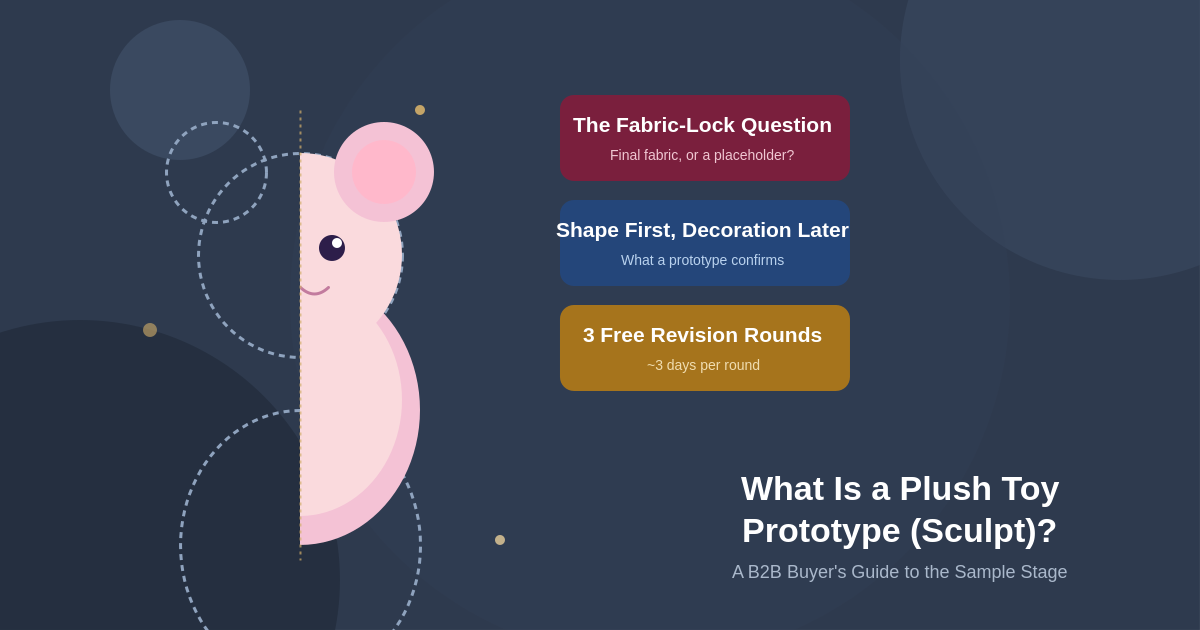
• The Fabric-Lock Question — why “prototype” doesn’t mean the same build across every factory
• What a prototype confirms, and what’s still deferred to a later stage
• A buyer’s inspection checklist for reviewing a prototype
• Revision rounds, turnaround time, and what’s typically included in prototype cost
• How to brief your factory so nothing about the prototype stage surprises you
What Is a Plush Toy Prototype (Sculpt)? — Definition and Purpose
A plush toy prototype is the first three-dimensional, sewn-and-filled build of a design that previously existed only as 2D artwork. Its job is narrow and specific: confirm that the physical shape — proportions, posture (sitting, standing, lying), silhouette from front, side, and back — actually matches what the artwork implied. A 2D sketch can look perfect on screen and still fail once translated into fabric and stuffing, because fabric stretches differently in different directions, seams pull neighboring features in or out, and a head-to-body ratio that reads correctly as a flat drawing can look off once it exists in three dimensions.
Sculpt” is used in the plush industry largely as an alternate term for this same stage — the physical shaping of the design, as distinct from the later stage where decorative details (embroidery, printing) and final production specs get locked in. Whether a factory calls it a “prototype,” a “sculpt,” or a “first sample” depends on the shop, but the underlying purpose across all three terms is the same: confirm the shape works before committing to production.
What a prototype is *not*: it is not automatically the same thing as a finished, production-representative sample. That distinction — and the confusion it can cause — is the subject of the next section, because it’s the single most common source of buyer surprise at this stage of a plush toy program.
The Fabric-Lock Question — Why “Prototype” Doesn’t Mean the Same Build at Every Factory
Reviewing how different plush manufacturers describe their own prototype process surfaces a real and largely unflagged inconsistency: factories differ on whether the prototype is built in the customer’s actual selected fabric, or in whatever spare fabric happens to be available in the shop at the time.
One documented approach: prototypes are built from spare fabric on hand specifically because the prototype’s only job at that stage is to confirm shape and design — locking the final material (pile length, finish, weight, custom color) is treated as a separate, later conversation that happens once the shape is approved and full production sourcing begins.
The practice behind this guide takes a different approach: the prototype is built in the customer’s final selected fabric from the very first build. The only element deferred to a later stage is the embroidery or printed artwork — the decorative execution, not the base material. Because the fabric is locked from day one, color and material questions simply don’t come up as a source of confusion during prototype review — what the customer sees in the prototype photos and physical sample is the actual fabric and color they’ll receive in production.
Why this matters for you as a buyer: these are two legitimately different practices, and neither is “wrong” — a spare-fabric prototype is faster and cheaper to iterate on early, while a final-fabric prototype gives you a more accurate preview sooner but commits material sourcing earlier in the process. What matters is that you know which one you’re getting before you open the box. If you receive a prototype in a color or texture that doesn’t match what you expected, the first question to ask your factory isn’t “what went wrong” — it’s “was this built in final fabric or a placeholder?”
A one-question factory brief addition that prevents this entire category of confusion: ask directly, before development starts, “Will my prototype be built in the final fabric we’ve selected, or in a placeholder material?” Get the answer in writing as part of your brief.

What a Prototype/Sculpt Actually Confirms — and What’s Still Deferred
Regardless of which fabric-lock approach your factory uses, a prototype at this stage is built to answer a specific, limited set of questions — not every question about the final product.
What a prototype reliably confirms:
— Shape and proportion — does the head-to-body ratio, limb length and placement, and overall silhouette match the approved artwork from front, side, and back views
— Posture and stability — does the toy sit, stand, or hold its intended pose correctly
— Structural feasibility — do features that looked simple on paper (a curved cheek, a specific ear shape, a multi-panel body) actually sew together cleanly, or do they pull and distort neighboring areas
— Fabric and color accuracy — if your factory builds in final fabric from day one, this is confirmed at the prototype stage; if your factory uses spare/placeholder fabric, this is not yet confirmed and shouldn’t be judged from the prototype
What’s typically still deferred, even with a final-fabric prototype:
— Embroidery and printed artwork execution — the actual stitched or printed decorative details (facial features, logos, patterns) are commonly finalized after the shape is approved, since embroidery scaling and placement need to be tested and calibrated separately from the body construction
— Full production-line consistency — a single hand-built prototype doesn’t confirm how consistent 1,000 or 10,000 units will look coming off a production line; that’s a question for quality control during mass production, not the prototype stage
— Compliance testing results — safety and regulatory testing (mechanical, flammability, chemical) is typically performed on a later production-representative sample, not the early prototype, since testing the wrong-stage sample wastes both time and testing fees
This is a useful mental model for reviewing any prototype: treat it as an answer to “does the shape and construction work,” plus — if your factory confirms final fabric was used — “is the material and color right,” and hold your judgment on decoration and full-batch consistency for the stages built specifically to confirm those things.

Buyer’s Inspection Checklist for a Prototype/Sculpt
Use this checklist when your prototype arrives, adjusted for what your factory has confirmed about fabric-lock and what’s still deferred.
Design and shape accuracy
☐ Compare the prototype from front, side, and back against the approved artwork — does the character identity, style, and visual balance hold up in three dimensions?
☐ Check head-to-body ratio and limb placement against the design — even small proportion shifts change the character’s read
☐ Confirm the toy sits, stands, or holds its intended pose stably
Material accuracy (only if your factory confirmed final fabric was used)
☐ Verify fabric type, pile length, and texture match your approved selection
☐ Confirm color accuracy against your approved reference, checking for consistency across different panels
Construction quality
☐ Inspect seam lines, especially at high-stress points (neck, limb joints, multi-panel areas) for straight, tight, gap-free stitching
☐ Gently test structural integrity — pull lightly on limbs, press connection points, confirm nothing feels loose or unstable
☐ Check stuffing distribution for evenness — no lumps, no empty pockets, shape holds under light pressure
What to explicitly not judge yet (unless your factory says otherwise)
☐ Embroidery or print execution, if your factory defers decorative artwork to a later stage — review placement intent from any paper mock-up or digital reference instead, not final stitch quality
☐ Full-batch color/material consistency — a single prototype can’t confirm this

Revision Rounds, Timeline, and Cost
Revision policy varies by factory, and it’s worth pinning down before development starts, since it affects both your timeline and your budget.
A directional industry benchmark (based on publicly documented factory processes, not a universal standard): two to three prototype revisions is commonly described as typical, with each round taking roughly a few days to a couple of weeks depending on the scope of changes, and overall prototype development often spanning two to four weeks end-to-end. Some factories also structure prototype work with a refundable deposit that credits toward the final production invoice once the order proceeds.
The practice behind this guide: three rounds of free revisions are included, continuing until the customer is satisfied, with each revision round completed in about three days. This is more generous than the two-to-three-round benchmark commonly described elsewhere, and the fast per-round turnaround (three days rather than a week or more) means the full revision cycle typically moves faster than industry-typical timelines even when all three rounds are used.
Questions to confirm with any factory before development starts:
☐ How many revision rounds are included before additional charges apply?
☐ What’s the typical turnaround per revision round?
☐ Is there a prototype deposit, and does it credit toward the production order if you proceed?
☐ What triggers an “additional charge” revision versus a covered one — is it new design ideas versus tweaks to the already-approved concept?

How to Brief Your Factory for the Prototype/Sculpt Stage
A clear brief at this stage prevents most of the confusion buyers run into later. Confirm these points in writing before development begins.
1. Ask the fabric-lock question directly. “Will my prototype be built in my final selected fabric, or a placeholder?” Get this in writing so you know exactly what you can and can’t judge from what arrives.
2. Clarify what’s deferred to a later stage. Confirm whether embroidery/print execution, full compliance testing, and production-line consistency checks happen at the prototype stage or a later one — so you’re not waiting on (or judging) something that was never meant to be assessed yet.
3. Confirm the revision policy in writing. Number of included rounds, turnaround time per round, and what counts as a “new idea” (chargeable) versus a “tweak” (covered) — before you’re mid-revision and discover the boundary the hard way.
4. Provide complete reference material upfront. Front, side, and back reference art if you have it — a single front-view sketch leaves the side and back proportions to interpretation, which is a common source of avoidable revision rounds.
5. Set a realistic timeline expectation. Even a fast, generous revision policy has a floor — three free rounds at roughly three days each is still over a week of calendar time if you use all three, before production even starts. Build this into your launch or event timeline rather than around it.
6. Ask what happens if the shape reveals a problem the artwork didn’t show. Complex features (a specific sitting posture, a multi-panel face, an accessory attachment point) sometimes only reveal construction issues once built in fabric — confirm your factory flags these proactively rather than silently simplifying the design to make production easier.
Frequently Asked Questions
What is a plush toy prototype?
The first three-dimensional, sewn-and-filled build of a plush toy design, made to confirm shape, proportion, posture, and silhouette match the approved 2D artwork before committing to production. “Sculpt” is commonly used as an alternate term for the same stage.
Is a plush toy prototype made from the final fabric?
It depends on the factory — this varies and isn’t standardized across the industry. Some factories build prototypes from spare fabric on hand and lock final materials at a later stage; others build in the customer’s final selected fabric from the first prototype, deferring only embroidery or print execution. Always confirm this directly with your factory before reviewing your prototype.
What’s the difference between a prototype and a “sculpt”?
In plush toy development, the terms are largely used interchangeably to describe the same physical shape-confirmation stage — as distinct from later stages that lock decorative details (embroidery, printing) and production specs. Terminology varies by factory, so confirm what a specific factory means when they use either term.
What should I check when I receive a plush toy prototype?
Compare the shape, proportion, and posture against your approved artwork from all angles; check construction quality (seams, stuffing, structural stability); and — only if your factory confirmed final fabric was used — check color and material accuracy. Don’t judge embroidery/print execution or full-batch consistency from a single prototype unless your factory has told you those are finalized at this stage.
How many revision rounds are normal for a plush toy prototype?
This varies by factory. Two to three rounds is commonly described as typical elsewhere in the industry; some factories, including the practice behind this guide, include three free rounds continuing until the customer is satisfied, with roughly a three-day turnaround per round. Confirm the included rounds and turnaround time in writing before development starts.
Does the prototype stage include safety compliance testing?
Typically not. Compliance testing (mechanical, flammability, chemical) is generally performed on a later production-representative sample, not the early prototype — testing the wrong-stage sample wastes time and testing fees. Confirm with your factory when compliance testing occurs in their specific process.
Glossary
Term | Definition |
|---|---|
The Fabric-Lock Question | This article’s framework: whether a prototype is built in final selected fabric or placeholder material — the single question that determines what a buyer can and can’t judge from it |
Prototype (Sculpt) | The first physical, sewn-and-filled build of a plush toy design, made to confirm shape, proportion, and posture against approved artwork |
Production sample | A later-stage, fully production-representative build used for final approval before mass production begins, in factories that separate prototype and material-lock stages |
Spare/placeholder fabric | Fabric already on hand at the factory, used to build an early prototype when final material selection is deferred to a later stage |
Disclaimer: This article describes plush toy prototype development practices as commonly documented and practiced as of August 2026; specific processes, timelines, and revision policies vary by factory — confirm your specific factory’s approach in writing before development begins. Nothing in this article constitutes a guarantee of any particular factory’s process or turnaround time.
References
Ready to Start Your Plush Toy Prototype?
Tell us your design, and we’ll build your first prototype in your actual selected fabric from day one — no placeholder-material guesswork, three free revision rounds until you’re satisfied, roughly three days per round.
→ Request a Prototype Quote: CONTACT – Plush Toy Manufacturer|Customized plush toys
→ Related: What Is a Mascot Costume? (vs. Plush Toy) | What Is a Plush Pillow/Cushion Toy?