
Custom Plush Toys for E-commerce Sellers:
An Overview
Last reviewed: August 2026 | Audience: Amazon FBA sellers, Etsy shop owners, Shopify DTC brands, TikTok Shop merchants | Reading time: ~12 min
Quick Answer
Custom plush toys give e-commerce sellers a high-margin, brand-building SKU across Amazon FBA, Etsy, Shopify, and TikTok Shop — each platform with distinct fee structures, compliance requirements, and sourcing logistics.
Standard minimum: 500 pieces per design. Sample: 10–15 business days. Bulk production: 30–45 days.
Key rule: give your factory a channel-specific brief before sample approval — not after bulk production starts.
What this article covers:
• Why custom plush is a growth category for e-commerce brands
• Side-by-side platform cost analysis — the 4-Channel Plush Profit Stack
• MOQ realities and a validation-first ordering sequence
• Platform-specific compliance requirements (Amazon, Etsy, CPSC)
• A factory brief checklist to avoid the most costly sourcing mistakes
• Six criteria for evaluating a custom plush factory for e-commerce
Custom plush has moved from a niche product category into a meaningful revenue stream for e-commerce operators who understand the sourcing mechanics. The channel is genuinely forgiving in some dimensions — design flexibility, character IP expression, high perceived value — and genuinely demanding in others: compliance requirements, packaging specifications, and the briefing process with overseas factories. This overview covers what experienced e-commerce sellers know before they place their first plush order.

Why E-commerce Sellers Are Adding Custom Plush to Their Product Lines
Custom plush toys have become a meaningful category for online sellers who want a product that stays with a customer beyond the first purchase. A well-designed character plush carries brand identity in a way that kitchen accessories or phone cases do not: it lives on a shelf, gets photographed, and lands in the “gifting” consideration set that commodity products never reach.
Three mechanics make plush particularly effective for online channels.
Limited drop strategy. A 500-piece launch run creates genuine scarcity without overcommitting to inventory. Plush toys sell out in ways that generic storage products do not — customers who miss the first drop come back for the second. This structure suits e-commerce brands that want to build a waiting list before scaling production.
UGC velocity. Plush toys rank among the most-photographed product categories on TikTok and Instagram. Customers who receive a quality plush — one that matches its listing photos and arrives in attractive packaging — typically post without being prompted. That organic content compounds over time and costs nothing to produce.
Repeat character launches. Brands that establish a character IP can release new colorways, sizes, and seasonal variants without rebuilding the design process from scratch. The factory retains the approved pattern; the customer has a reason to return. This is the basis of the “character series” model that has driven repeat purchase rates for branded plush brands across Shopify and Amazon alike.
The margin structure also favors operators willing to commit to a minimum production run. Unlike consumables or electronics, where price competition compresses margins systematically, a custom-character plush with distinctive design language is not easily comparison-shopped. Buyers are not hunting for the cheapest plush — they are buying that specific plush. That distinction protects margin in a way that commodity products cannot.
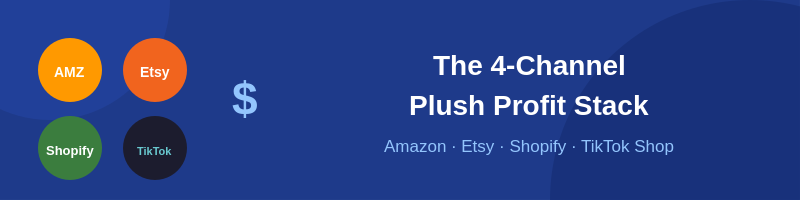
The 4-Channel Plush Profit Stack — Amazon, Etsy, Shopify, and TikTok Shop
Not all channels cost the same, and not all channels suit the same product positioning. The table below presents platform costs side-by-side. These are platform costs only — they do not include COGS, shipping to end consumers, or advertising unless specified.
Channel | Referral / Transaction Fee | Payment Processing | Other Mandatory Costs | True Total Cost of Sale | Best Fit For |
|---|---|---|---|---|---|
Amazon FBA | 15% (Toys & Games) [1] | Included in referral | FBA pick/pack ~$3–8/unit | ~30–45% of revenue at scale | Catalog-driven brands with existing search demand |
Etsy | 6.5% of sale price + shipping [2] | 3% + $0.25/order (US) | $0.20 listing fee; 12–15% Offsite Ads on qualifying sales | ~10–25% depending on ad enrollment | Custom/handmade positioning; production partner must be disclosed (eff. July 9, 2026) |
Shopify DTC | None | 2.9% + $0.30 (Shopify Payments) | $39–79/month platform; seller builds all traffic | ~25–40% including paid acquisition | Brands with existing audience, email list, or strong organic social |
TikTok Shop | ~5% (Home & Garden / novelty) | 2.0% + $0.30/order | Affiliate commissions 5–20%; Shop Ads 15–25%; content production 4–8% | 35–55% of revenue [3] | Visually compelling products with creator ecosystem potential |
The TikTok Shop margin reality
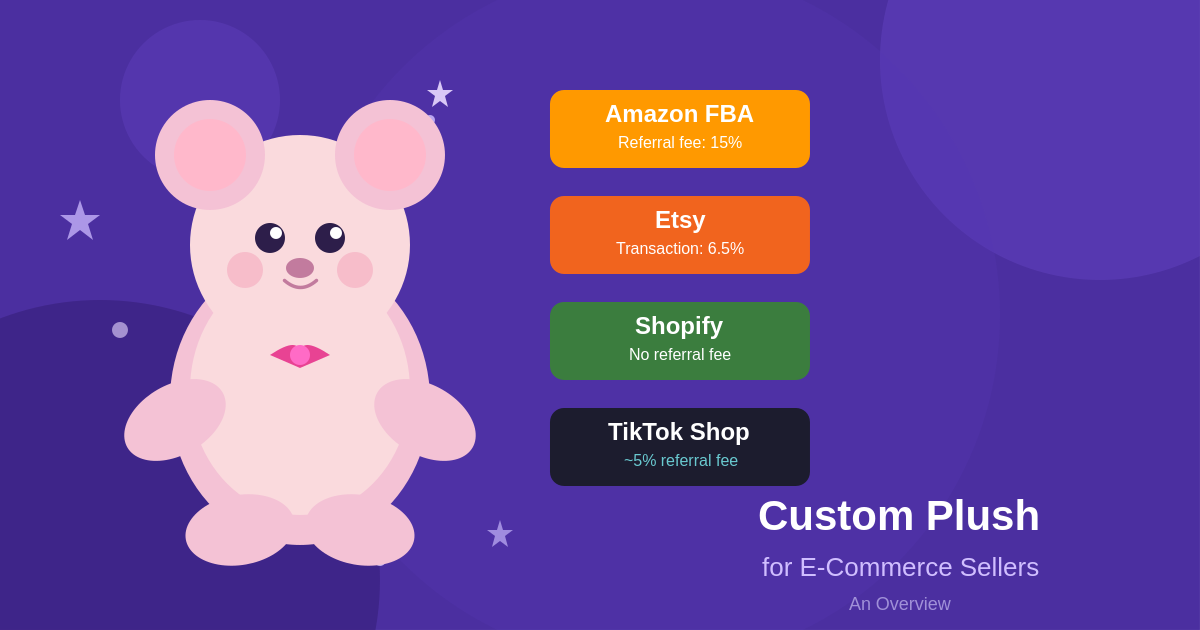
TikTok Shop’s referral fee (approximately 5% for most plush-adjacent categories) looks dramatically lower than Amazon’s 15%. This comparison is frequently cited as a reason to prioritize TikTok Shop as a starting channel. The problem: TikTok Shop’s total cost of sale — once you add affiliate creator commissions (the market average for competitive plush is approximately 13% per referred sale), Shop Ads investment required for algorithmic visibility (15–25% of revenue), and content production overhead (4–8% of revenue for consistent video output) — runs 35–55% of revenue. That is comparable to, or higher than, a mature Amazon FBA business.
For custom plush specifically, TikTok Shop has genuine product-market fit: plush toys are inherently photogenic, tactile review content performs well in short-form video, and a creator-driven launch can generate first-week sales velocity that Amazon PPC cannot replicate. But the economics require a different model. Sellers who enter TikTok Shop pricing for a 5% platform cost and discover the true cost stack at month three have already committed to inventory and packaging formats that may not support the margin they need.
From a supplier’s perspective: We now recommend that sellers planning a TikTok Shop launch model their retail price at a 50% total cost of sale before committing to production volumes. The plush toy itself needs to carry enough margin to absorb creator commissions and content investment without sacrificing reorder viability.
MOQ Reality Check — How Much Inventory Do You Actually Need?
The default assumption in custom plush sourcing is that factories require 1,000 to 5,000 pieces minimum per design. For many facilities, that remains accurate. Larger factories with high setup costs and long production queues set these minimums because smaller orders do not justify pattern-making and line-change overhead.
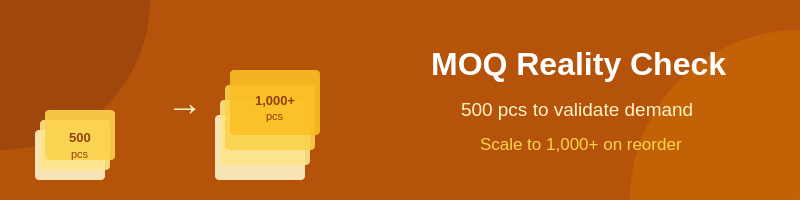
The factory landscape for e-commerce-oriented custom plush has shifted, however. Manufacturers specifically serving DTC brands, Amazon sellers, and Shopify founders have restructured around lower minimums — 500 pieces per design is a documented entry point for factories positioned for this segment. At 500 pieces, first-order economics are tighter, but unit cost at this quantity supports e-commerce margin at typical retail price points ($25–$60 for a standard custom plush), and the inventory commitment is small enough to test channel fit before scaling.
A validation-first ordering sequence for first-time plush sellers
1. Order 500 units of your hero design on the channel where you have the strongest existing audience or traffic — not the channel with the lowest listed platform fee.
2. List and measure for 60–90 days: sell-through rate, return rate, customer feedback on quality and packaging.
3. Reorder at 1,000+ units once the design has demonstrated demand. Per-unit cost drops at this quantity, and sea freight becomes more economical than air.
4. Expand the line — new colorways, sizes, seasonal variants — using the same factory pattern. Reorder lead time compresses to 30 days once the pattern is approved and on file.
Timeline reference
Production Phase | Typical Duration |
|---|---|
Artwork submission → initial quote | 1–2 business days |
Sample development (from artwork approval) | 10–15 business days |
Sample revision round (if needed) | 3–7 days per round |
Bulk production | 30–45 days |
Reorder (existing pattern, no new development) | 30–45 days |
First order: concept to delivery (total) | ~55–70 days |
Custom retail boxes add approximately $0.80–$2.50 per unit to landed cost but meaningfully increase perceived value and average order value for DTC and gifting channels. For Amazon FBA, a polybag is standard — adding a full retail box introduces dimensional weight cost and packaging overhead without proportional benefit at the FBA price point.
A common misconception: New e-commerce sellers frequently assume that a 500-unit validation order can be followed by a reorder whenever inventory runs low. In practice, factory production schedules fill up — particularly in Q3 ahead of peak season. A seller whose first batch sells out in 45 days, who then places a reorder expecting a 30-day turnaround, may find the factory booked out for 60–90 days. The sellers who maintain continuous channel presence plan the reorder timing before the first shipment arrives — not after it sells out.
Compliance Requirements for E-commerce Plush Sellers
Compliance is where most first-time e-commerce plush sellers lose money — not because the rules are obscure, but because they brief their factory on the product and forget to brief them on the channel. The requirements below are channel-specific. Meeting Amazon FBA packaging standards does not automatically satisfy Etsy’s production partner disclosure requirement. Both are independent obligations.
Amazon FBA: Packaging and Labeling Requirements
Polybag suffocation warning — Poly bags with an opening of 5 inches or larger (measured flat) must display a suffocation warning, either printed directly on the bag or attached as a label. This applies to virtually all custom plush, since the bag required to contain a standard-size plush toy consistently exceeds the 5-inch opening threshold. FBA receiving will reject shipments where this label is absent. (Amazon Seller Central, reference G200141500 — Tier 1)
FNSKU barcode — Every product variation requires a unique FNSKU assigned through your Seller Central account. Each unit’s exterior packaging must carry a scannable FNSKU barcode. The most efficient approach: provide your FNSKU to your factory before bulk production, so labels are applied during the packaging stage rather than at a US prep center after import. (Amazon Seller Central — Tier 1)
Carton labels and shipment IDs — Master cartons require a shipment ID, box count, and weight/dimensions formatted to Amazon’s inbound specification. FBA-experienced factories have standard templates for this. Confirm it explicitly — do not assume.
Etsy: Production Partner Disclosure (effective July 9, 2026)
Etsy’s Seller Policy, updated July 9, 2026, requires that sellers working with production partners — including overseas manufacturers — disclose that partnership in each relevant product listing. This is a mandatory requirement, not a recommendation, and applies to existing listings as well as new ones. (etsy.com/legal/sellers/ — Tier 1)
The underlying Etsy rule is that items must be “made, designed, handpicked, or sourced” by the seller. A custom plush manufactured to a seller’s original character design by a disclosed factory partner meets this standard. Reselling generic stock does not. The practical implication for custom plush sellers: request written production partner documentation from your factory — a letter or agreement confirming the working relationship — before you list. This document provides the disclosure reference your Etsy listing requires.
CPSC eFiling (United States, effective July 8, 2026)
Custom plush toys marketed to children are children’s products under CPSC (Consumer Product Safety Commission) classification. Effective July 8, 2026, all children’s product imports into the US require advance eFiling with CPSC. There is no de minimis exemption based on shipment value or size. A 500-unit first-order batch requires the same compliance filing as a 20,000-unit container shipment. (CPSC — Tier 1)
If your factory or freight forwarder has suggested that small-batch imports are exempt from this requirement, that guidance does not reflect the current regulatory position. Consult a licensed customs broker or compliance specialist before your first import.
Safety Certification by Market
Market | Required Standard | Scope |
|---|---|---|
United States | ASTM F963 | Mechanical hazards, flammability, chemical limits (lead, phthalates) |
European Union | CE / EN71 (series) | Mechanical safety, flammability, heavy metal migration |
United Kingdom | UKCA / BS EN71 | Post-Brexit equivalent of CE/EN71 |
Australia | AS/NZS 8124 | Australian toy safety standard |
Amazon (all markets) | Market-specific (above) | Amazon requires applicable certification for the listing’s target market |
Testing should be initiated on the approved production sample, not on pre-production prototypes. Do not wait for bulk production to begin testing — in a 30–45 day production window, a parallel test timeline is achievable and reduces your total time-to-market.
A common misconception: A quality-related return costs the seller one order — that is the standard assumption. On Amazon, the cost compounds: return rate factors into seller metrics that affect Buy Box eligibility and search ranking. A 5% return rate on a new ASIN can suppress the listing before it builds enough review velocity to recover. On Etsy, a one-star review citing quality sits on the listing permanently. The real cost of a quality failure is not the refunded order — it is the compounding effect on every future sale from that listing.

The E-commerce Seller’s Factory Brief Checklist
Most sourcing failures in custom plush are not design failures or quality failures — they are briefing failures. The factory knew how to make the plush. They did not know what the plush needed to look like when it left their facility to pass your fulfillment channel’s intake requirements. The checklist below is designed to be shared with your factory before sample approval.
Pre-Production Factory Brief: Custom Plush for E-commerce
Section 1 — Channel Packaging Requirements
☐ Confirm which sales channel(s) this SKU will be shipped to: Amazon FBA / Etsy self-ship / Shopify 3PL / TikTok Shop FBT
☐ Amazon FBA: Poly bag required; opening ≥5″ (flat) requires printed or labeled suffocation warning
☐ Amazon FBA: Minimum poly bag thickness 1.5 mil for plush with small-part considerations
☐ Amazon FBA: FNSKU barcode applied to exterior packaging — provide FNSKU code to factory before bulk production begins
☐ Amazon FBA: Master carton label format and shipment ID to be provided by seller before cartons are sealed
Section 2 — Compliance Documentation
☐ Safety testing timeline confirmed: ASTM F963 (US) / EN71 (EU) — testing initiated on approved sample, not on production run
☐ CPSC eFiling: factory to provide production records and material composition list for customs broker
☐ Age grading determined (0+, 3+, 6+) and appropriate age warning labels specified to factory
☐ Country of origin (“Made in China” or applicable) required on all units — confirm placement with factory
Section 3 — Etsy Sellers
☐ Written production partner documentation requested from factory before listing goes live
☐ Factory confirms willingness to be named as production partner in Etsy product listing disclosure
Section 4 — Quality and Reorder Infrastructure
☐ Approved reference sample retained at factory for bulk production comparison
☐ Inline QC checkpoint agreed: at what production percentage will factory conduct first inspection?
☐ Final 100% visual inspection before packing confirmed
☐ Pattern and spec storage: factory confirms approved pattern is retained on file for reorders

How to Choose a Custom Plush Factory for Your E-commerce Program
From the Factory Floor
Working with e-commerce sellers is different from serving traditional wholesale buyers in three ways that consistently catch first-time clients off guard.
Compliance requires channel-specific briefing. An Amazon FBA seller who doesn’t provide their FNSKU before bulk production begins will face re-labeling costs at a US prep center — costs that erode the margin calculated at the FOB stage. An Etsy seller who doesn’t request production partner documentation before listing will have to pull live listings to fix the disclosure. We ask every new e-commerce client for their channel specifications before cutting a single sample, because retrofitting compliance after production is consistently more expensive than building it in from the start.
Delivery timing has a different cost structure for e-commerce. Demand can spike without warning — a product goes viral, a creator posts a review, a platform runs a promotion. A seller whose inventory runs out during that window doesn’t just lose the direct sales: BSR drops, stockout penalties apply, and recovery takes weeks. The sellers who avoid this are not the ones who order more inventory than they need. They are the ones who confirm reorder lead time before their first shipment arrives, and place the reorder while the first batch is still selling.
Quality failures carry a longer tail than most sellers expect. A return on an Amazon order costs the unit, the return shipping, and a fraction of the seller’s review score — and at a high enough return rate, it costs the Buy Box. For Etsy sellers, a one-star review citing quality sits on the listing indefinitely and affects search placement. The sellers who scale successfully on these platforms treat quality failures as existential risks to their store, not operational inconveniences. That is the standard we hold ourselves to when producing for e-commerce programs.
Not every custom plush manufacturer is equipped for e-commerce logistics. Many factories have historically served bulk wholesale buyers — retail distributors, corporate gift programs — where one customer takes a full container and manages their own logistics. E-commerce fulfillment works differently: each unit needs to pass Amazon FBA intake, ship individually through a 3PL, or carry Etsy production partner documentation. The capabilities you are evaluating are different from what a traditional wholesale buyer would check.
1. Amazon FBA compliance experience. Ask the factory how many Amazon FBA sellers they currently serve. Request to see how they handle FNSKU label application, poly bag suffocation warning placement, and carton label formatting. A factory that has done this at scale will have standard templates and documented procedures. A factory without FBA experience will ask you to explain Amazon’s requirements from scratch — a time investment and a quality-control risk on your first order.
2. Safety testing laboratory relationships. A factory with established relationships with ASTM F963-accredited testing labs will get you test reports faster and with fewer logistics complications than one that expects you to manage testing independently. Ask which specific labs they work with and whether they can include testing cost and timeline estimates as part of the project quote.
3. MOQ flexibility confirmed against your actual design. Some factories quote 500 pieces as a general figure but revise upward for designs with complex multi-part embroidery, articulated accessories, or specialty fabrics. Get the MOQ confirmed against your actual reference artwork — not against a generic plush specification — before committing to sample development costs.
4. Lead time track record, not just a quoted timeline. Sample development of 10–15 business days and bulk production of 30–45 days are standard benchmarks for this category. Ask the factory about their current production queue and whether they can realistically hold to these timelines for your project. A factory booking 90 days out may quote the right lead times but not be positioned to deliver them.
5. Audit certifications for downstream channel expansion. If you have any intention of wholesale distribution alongside your e-commerce business, factory audit certifications become relevant: BSCI, SMETA (Sedex Members Ethical Trade Audit), ISO 9001, and Disney FAMA are the most commonly requested for plush manufacturers. Verify these before onboarding if they apply to your future channel plans.
6. Etsy production partner documentation. For sellers who plan to list on Etsy, a factory that is familiar with — and willing to provide — written production partner documentation makes your compliance straightforward. This is a newer and increasingly important filter. A factory unfamiliar with Etsy’s production partner disclosure requirement creates unnecessary friction at the listing stage.
Frequently Asked Questions
What is the minimum order quantity for custom plush toys?
Most traditional manufacturers require 1,000–5,000 pieces per design. Factories specifically structured for e-commerce brands and DTC sellers offer lower entry points — 500 pieces per design is an available threshold for a validation-first first order. MOQ figures should always be confirmed against your specific design, as complexity (multi-part limbs, embroidery detail, specialty fabrics) can push the minimum upward even at factories that advertise low MOQ.
Do I need FNSKU barcodes on custom plush toys for Amazon FBA?
Yes. Amazon requires a unique FNSKU for each product variation, with a scannable barcode on the exterior packaging of every unit. The most cost-effective approach is to have your factory apply FNSKU labels during production packaging — before cartons are sealed — rather than using a US prep center for re-labeling after import. Provide your FNSKU code to the factory before bulk production begins, and confirm the label placement and barcode readability on the approved sample.
Can I sell factory-made custom plush on Etsy?
Yes, provided you disclose the production partner in your listings. Etsy’s Seller Policy (updated effective July 9, 2026) requires sellers to name any production partner — including overseas manufacturers — in each relevant product listing. A custom plush that you designed and that is produced to your specifications by a disclosed factory partner is fully compliant with Etsy’s policy. Generic inventory purchased for resale is not. Request written production partner documentation from your factory before your listings go live.
What safety certifications do custom plush toys need for the US market?
Custom plush sold in the US must comply with ASTM F963, the US toy safety standard covering mechanical hazards, flammability, and chemical limits including lead and phthalates. Products sold as children’s toys also require a Children’s Product Certificate (CPC) and — since July 8, 2026 — CPSC eFiling for all imports regardless of shipment size. For the EU market, CE marking under EN71 is required separately. Testing is typically initiated on the approved production sample during the bulk production window to avoid extending your total lead time.
How long does it take to get a first order of custom plush from factory to warehouse?
From artwork submission to first delivery: approximately 55–70 days. Sample development runs 10–15 business days from artwork approval; revision rounds add 3–7 days per cycle; bulk production takes 30–45 days. Sea freight from China to a US warehouse adds 20–35 days. Running safety testing in parallel with bulk production on the approved sample is the most time-efficient approach. Air freight can shorten transit time but at significantly higher cost per unit.
What does TikTok Shop actually cost for custom plush sellers?
TikTok Shop’s referral fee for plush-adjacent categories is approximately 5%, plus a $0.30 per-order transaction fee and 2.0% payment processing — visible platform costs of roughly 7–8% on a $50 order. The true total cost of sale, however, is 35–55% of revenue when you add affiliate creator commissions (market average approximately 13% per referred sale, set by the seller), Shop Ads investment (15–25% of revenue required for consistent algorithmic visibility), and content production (4–8% of revenue for a viable posting cadence). Build your retail price around the full cost stack before committing to production quantities for this channel.
Glossary
Term | Definition |
|---|---|
FNSKU | Fulfillment Network Stock Keeping Unit — Amazon-specific barcode assigned per product variation for FBA inventory tracking |
MOQ | Minimum Order Quantity — smallest production run a factory will accept per design |
ASTM F963 | US toy safety standard (mechanical hazards, flammability, chemical limits); required for US market sales |
EN71 | European toy safety standard series (mechanical safety, flammability, chemical hazards); basis for CE marking in EU |
CPSC eFiling | US Consumer Product Safety Commission advance notification system for children’s product imports; mandatory from July 8, 2026 |
Production Partner | Etsy’s term for a manufacturer or factory producing goods on a seller’s behalf; must be disclosed in product listings per Etsy Seller Policy (eff. July 9, 2026) |
FBT | Fulfilled by TikTok — TikTok Shop’s own warehousing and fulfillment program |
CPC | Children’s Product Certificate — CPSC-required documentation confirming a children’s product meets applicable US safety standards |
BSCI | Business Social Compliance Initiative — factory social compliance audit standard |
SMETA | Sedex Members Ethical Trade Audit — widely recognized supply chain ethical audit framework |
Disclaimer: Fee rates, platform policies, and regulatory requirements cited in this article reflect publicly available information as of August 2026. Amazon, Etsy, and TikTok Shop revise their fee schedules and seller policies independently. Verify current fees through your seller account before pricing decisions. CPSC eFiling requirements and ASTM F963 are legal obligations for US market imports of children’s products — consult a licensed customs broker or compliance specialist before importing. Nothing in this article constitutes legal or regulatory advice.
References
1. Amazon Seller Central — Referral Fees: Toys & Games (15%) (Tier 1)
2. Amazon Seller Central — Product Packaging Requirements (poly bag / suffocation warning) (Tier 1)
3. Etsy Seller Policy — Production Partner Disclosure (effective July 9, 2026) (Tier 1)
4. TikTok Shop US — Requirements to Register as a Seller (Tier 1)
5. CPSC — eFiling for Importers of Children’s Products (Tier 1)
6. Craftybase — Etsy Fee Calculator (6.5% transaction / 3% + $0.25 processing reference) (Tier 3)
7. Darkroom Agency — TikTok Shop Fees: Complete Seller Cost Breakdown 2026 (Tier 3)
Ready to Source Your Custom Plush?
Tell us your target channel — Amazon FBA, Etsy, Shopify, or TikTok Shop — and we will build your project quote around the specific packaging, labeling, and compliance requirements it needs, not a generic plush spec.
→ Request a Channel-Ready Plush Quote: CONTACT – Plush Toy Manufacturer|Customized plush toys
→ Related: Custom Plush Toys for Retail Branding | Custom Plush Toys for Trade Shows and Events