
What Is a Plush Pillow/
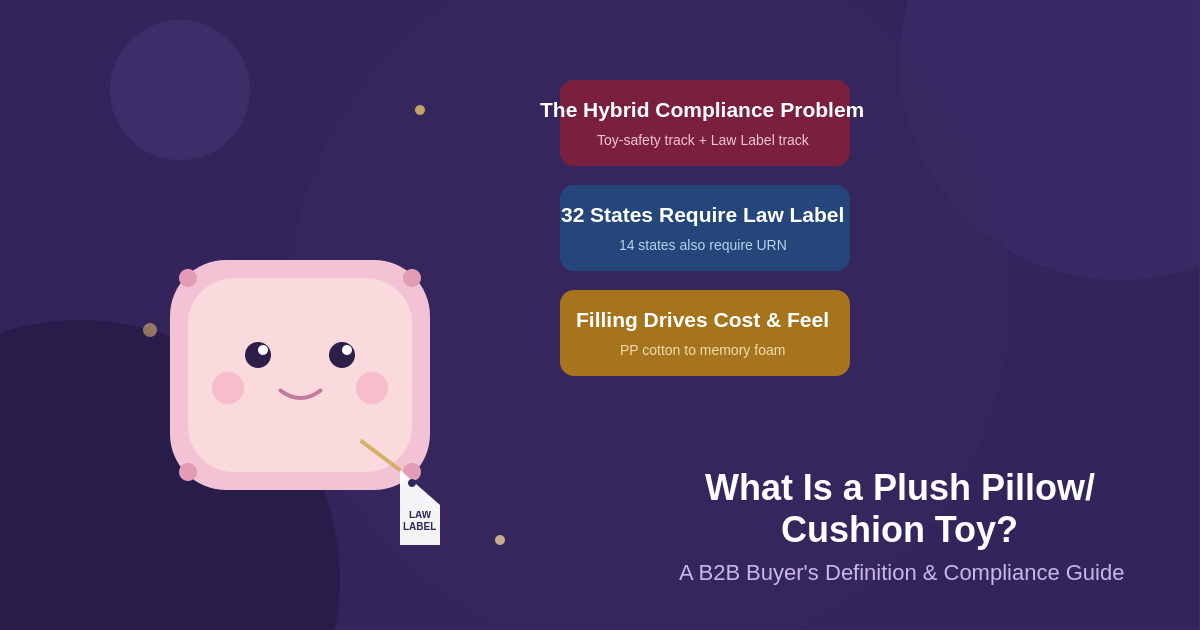
Cushion Toy?
Last reviewed: August 2026 | Audience: Promotional product distributors, corporate gifting buyers, retail buyers, e-commerce sellers, school/youth program buyers | Reading time: ~11 min
Quick Answer
A plush pillow/cushion toy is a soft-filled product that sits in a specific middle category — it borrows the fabric, filling, and often the character design of a plush toy, but its primary function is a pillow or cushion (support, seating, decorative bedding), not a handheld companion object.
That hybrid identity creates a compliance problem most sourcing guides never mention: a plush pillow can fall under two independent regulatory tracks at once — CPSC toy-safety rules (if toy-marketed or child-directed) and state-level Law Label / URN registration rules, which apply to virtually any filled or stuffed article regardless of toy classification.
Buyers who assume “it’s not a toy, so toy rules don’t apply, so I’m done” are missing the second track entirely.
What this article covers:
• What a plush pillow/cushion toy actually is, and where it sits relative to a standard plush toy or doll
• The Hybrid Compliance Problem — why this category can trigger two separate regulatory tracks
• Filling material differences that actually affect support, feel, and cost
• A buyer’s classification checklist: is your design a toy, a home good, or both?
• Law Label and URN registration basics every B2B buyer sourcing filled products should know
• MOQ, cost tiers, and how to choose a factory that understands both compliance tracks
What Is a Plush Pillow/Cushion Toy? — Definition and Category Placement
A plush pillow/cushion toy is a soft-filled product built like a plush toy (outer fabric shell, synthetic or natural filling, sewn seams) but designed to function primarily as a pillow, cushion, or decorative bedding item rather than a handheld or displayed character toy. It sits in what industry sourcing content sometimes calls a “soft goods” category — distinct from, but adjacent to, standard stuffed toys, plush toys, and dolls.
The distinction matters more than it looks. A standard plush toy’s primary purpose is to be a character, companion, or collectible — softness and huggability are in service of that identity. A plush pillow/cushion toy’s primary purpose is functional: back support, seating comfort, or bedding decoration — the plush or character design is layered on top of that function, not the other way around. A cartoon-faced lumbar cushion sold to support someone’s back at a desk is, functionally, a cushion first and a character second. A collectible plush bear sold to be displayed or carried is a toy first, full stop. The overlap zone between the two is exactly where sourcing and compliance confusion tends to happen.
Category Comparison
Category | Primary Function | Typical Buyer | Regulatory Starting Point |
|---|---|---|---|
Plush toy / stuffed toy | Companion, character, collectible | Toy retailers, gift shops, licensors | CPSC toy safety (ASTM F963-23), CPSIA/CPC |
Doll | Character representation, often articulated | Toy retailers, collectors | CPSC toy safety, CPSIA/CPC |
Support, seating comfort, decorative bedding — with plush/character styling | Home goods retailers, corporate gifting, e-commerce sellers, school/youth programs | State Law Label/URN registration — plus toy-safety if child-directed or toy-styled | |
Standard home cushion/pillow (no character styling) | Support, seating comfort, decorative bedding | Bedding and home goods retailers | State Law Label/URN registration only |
The last two rows are the ones most B2B buyers conflate — and the difference between them is the subject of the next two sections.
The Hybrid Compliance Problem — Why This Category Can Trigger Two Regulatory Tracks
Most sourcing content treats plush products as governed by a single compliance track: toy safety. That’s accurate for a standard plush toy. It is not accurate for a plush pillow or cushion, because this category can be simultaneously subject to two separate and independently-triggered regulatory systems in the US:
Track A — CPSC toy-safety regulation. Applies if the product is marketed to or reasonably intended for children, or carries toy-like attributes that would cause it to be regulated as a toy: ASTM F963-23 (mechanical hazards, flammability, chemical limits) and CPSIA/CPC certification requirements.
Track B — State-level Law Label / URN (Uniform Registry Number) regulation. This is the track most plush-focused sourcing guides skip entirely, because it isn’t a toy rule at all — it’s a filled-and-stuffed-articles labeling and registration rule that applies to bedding, cushions, and pillows independent of any toy classification. It applies to a corporate-branded lumbar cushion exactly as much as it applies to a mattress, and buyers who only think in “is this a toy?” terms miss it completely.
One clarification worth stating explicitly, because it’s a common point of confusion: 16 CFR Parts 1632/1633 (federal flammability standards) apply specifically to mattresses and mattress pads — not to decorative pillows or cushions. Decorative pillows and cushions are not covered by that specific federal flammability rule. That doesn’t mean they’re unregulated — it means the applicable rule is the state Law Label system (Track B), not the mattress flammability standard, and this is a distinction worth getting right rather than assuming the wrong federal rule applies.
The buyer mistake this framework is built to prevent: treating “does this need toy certification?” as the only compliance question. A back cushion with a cartoon face printed on it can pass every toy-safety review a buyer runs and still be non-compliant for import and sale, because nobody checked whether it needed a Law Label and state URN registration — a requirement that exists independently of the toy question and applies to the great majority of filled/stuffed products sold in the US regardless of styling.
The practical takeaway: for a plush pillow/cushion toy program, run both compliance checks — not just the one that matches the word “plush” or “toy” in the product name.
Filling Material and Spec Differences That Actually Matter
Plush pillows and cushions draw on a wider filling-material palette than standard plush toys, because the functional requirement (support, not huggability) changes what “good” filling means. The right filling choice depends on the product’s actual use case — sourcing this without matching material to function is a common source of buyer dissatisfaction even when every compliance box is checked.
PP cotton (polypropylene fiberfill). The entry-level, highest-market-share option — commonly cited as covering roughly 60% of the plush/cushion filling market. Inexpensive and consistent, but quality varies significantly by fiber grade; a higher-denier, high-count fiber (often referenced as “7D” in sourcing conversations) gives noticeably better loft and hand-feel than low-grade PP cotton at only a modest cost step-up. This is the right default for cost-sensitive, high-volume programs where “acceptable softness” is the bar, not “premium feel.”
Sponge/foam and pearl cotton. Used where the product needs actual structural support rather than just softness — neck and lumbar cushions are the clearest example. These materials hold their shape under sustained pressure in a way that loose fiberfill does not, which matters for a product marketed on ergonomic or support claims.
Down and silk waste (silk noil). Premium softness options, chosen when the buyer’s positioning is comfort/luxury rather than price or support. These materials carry a real cost premium over PP cotton and are typically reserved for higher-price-point retail or gifting programs where the fill quality is part of the product story.
Memory foam, latex, and graphene memory foam. The technology-driven tier — chosen for products marketed on pressure-relief or temperature-regulation claims rather than plush character appeal. These sit at the top of the cost range and are typically paired with a more restrained, less character-forward design, since the buyer is usually selling the functional claim first.
A 2025 sourcing signal worth tracking: eco-friendly and certified filling materials have been reported to rise to roughly 70% of buyer selection by share, with OEKO-TEX certification increasingly used as the shorthand quality/safety signal buyers check for when evaluating filling material sourcing. If your program targets retail or corporate-gifting buyers with sustainability expectations, confirming OEKO-TEX status on the filling is worth adding to the factory brief.
Note on cost: exact per-unit filling costs vary by supplier, season, and current raw-material pricing — this article intentionally avoids quoting specific RMB/kg figures that would go stale quickly. Treat the tiers below as a relative cost ladder and confirm current pricing directly with your factory before budgeting.
Filling Selection Quick Reference
Filling Type | Relative Cost | Best For | Trade-off |
|---|---|---|---|
PP cotton (standard grade) | Lowest | High-volume, cost-sensitive programs | Softness/loft varies by fiber grade |
PP cotton (7D high-count) | Low-mid | Cost-sensitive programs wanting better hand-feel | Modest cost step-up over standard grade |
Sponge/foam, pearl cotton | Mid | Neck/lumbar support cushions | Less “plush-soft,” more structured |
Down, silk waste | Mid-high | Premium comfort positioning | Cost premium; needs careful care-labeling |
Memory foam, latex, graphene memory foam | Highest | Pressure-relief/support-claim products | Highest cost; less character-forward design fit |
Buyer’s Classification Checklist — Is Your Design a Toy, a Home Good, or Both?
This is the single most useful filter for a plush pillow/cushion program, because it determines which compliance track(s) from the previous section actually apply to your specific design.
The core rule: back and lumbar cushions are, by default, classified as home goods/bedding — their core attribute is function (support), and Law Label/URN registration is the applicable requirement. Only designs with cartoon styling or clear toy attributes get reclassified as plush toys, which layers toy-safety compliance (Track A) on top of the Law Label requirement (Track B), rather than replacing it.
Use this checklist against your reference design before finalizing a factory brief:
☐ Primary function test: Is the product’s main selling point support/comfort (home good) or character/play value (toy)? If support/comfort, start from the home-goods/Law Label baseline.
☐ Styling test: Does the design include a cartoon face, character branding, or toy-like features (ears, limbs, expressive eyes) beyond incidental decoration? If yes, budget for toy-safety compliance in addition to Law Label.
☐ Marketing test: Is the product being marketed or displayed in a way that targets children as the primary user/audience? If yes, toy-safety compliance applies regardless of how the product is otherwise styled.
☐ Distribution channel test: Is the product going into a toy retail channel, a home goods/bedding channel, or a general gifting/e-commerce channel that could reasonably be read either way? Ambiguous channels are the highest-risk case — default to running both compliance tracks.
☐ Filling disclosure test: Regardless of the above, confirm the factory can provide the filling-material content disclosure (material type, percentage by weight) required for Law Label — this applies to essentially all filled cushion/pillow products sold in the US.
Why this matters in practice: the classification question isn’t academic — it determines whether your product needs one compliance track or two, and getting it wrong in either direction creates real exposure. Classifying a toy-styled product as “just a home good” and skipping toy-safety testing exposes the buyer to a genuine safety-compliance gap. Over-classifying a plain support cushion as a “toy” and skipping Law Label registration exposes the buyer to the opposite gap, since toy-safety testing does not substitute for the state filled-articles labeling requirement.

Law Label and URN Registration — What B2B Buyers Need to Know
This is the compliance track most plush-category sourcing content never covers, because it isn’t a toy-safety rule — it’s a filled-and-stuffed-articles labeling system that operates at the state level in the US, and it applies to plush pillows and cushions independent of toy classification.
The basics. A Law Label is a permanently affixed tag — typically sewn into a seam or attached at the base of the product — disclosing the filling material content by type and percentage of weight (for example, “80% Polyurethane Foam, 20% Polyester Fibers”). US law-label requirements are widely reported to apply in roughly 32 states, with the label required to carry statutory warning language, most commonly a version of: “UNDER PENALTY OF LAW THIS TAG NOT TO BE REMOVED EXCEPT BY CONSUMER.”
URN registration — the layer buyers most often miss. Beyond the label itself, roughly 14 of those states require the manufacturer (and in some cases the importer) to hold a registered URN (Uniform Registry Number) — a state-issued identifier printed on the label in a format such as “CA-12345(CN). The 14 states commonly cited as requiring URN registration are California, Connecticut, Delaware, Detroit (Michigan), Massachusetts, New York, North Carolina, Ohio, Oklahoma, Pennsylvania, Rhode Island, Utah, Virginia, and West Virginia. Within that group, six states — California, Connecticut, Detroit (Michigan), Ohio, Utah, and Virginia — are commonly cited as requiring both the foreign manufacturer and the US importer to register separately, which is easy for a first-time buyer to miss since it means the label requirement doesn’t end with the factory’s registration.
Registration Process, at a High Level
1. Confirm which target states the product will actually be sold into. Registration needs vary by state.
2. repare the required company documentation for the registering entity — manufacturer and/or importer, per the state’s rule.
3. ubmit the registration application to the relevant state agency.
4. btain the assigned URN.
5. roduce the Law Label with the correct filling disclosure and URN.
6. ermanently affix the label to the product — sewn into a seam or at the base — before the product ships to that state’s market.
How this connects to the toy-compliance track. If a design is classified as a toy (per the H2-4 checklist), it also needs standard CPSC import documentation. For products entering the US through CBP’s ACE (Automated Commercial Environment) system, there are two common paths for CPSC eFiling: a Full PGA filing submitted directly with each shipment, or a Reference PGA filing using the CPSC Product Registry (registered at cpsc.gov/registry), where a certificate is created once — covering the required data elements, a Certifier ID, Product ID, and Version ID — and then referenced by the customs broker on each subsequent shipment through ACE, rather than re-filed every time. Either path requires records to be retained for five years. This is a separate filing system from Law Label/URN registration — a toy-classified plush cushion may need both a state URN and CPSC import documentation, which is exactly the “two tracks, not one” point in practice.
Practical note for Pennsylvania-bound shipments: Pennsylvania is commonly cited as prohibiting the use of generic terms like “pad” or “batting” on the filling disclosure without a special variance — a detail worth confirming with your factory or compliance contact if PA is one of your target states, since it’s an easy label-wording mistake to make without knowing the state-specific restriction exists.

MOQ, Cost Tiers, and the Factory Brief Checklist
Pricing for plush pillows/cushions is driven primarily by two variables: filling material choice and whether the design requires toy-level compliance documentation on top of Law Label registration. Treat the drivers below as directional planning inputs, not quotes — confirm actual pricing against your specific filling, size, and compliance scope with your factory.
Cost drivers, in rough order of impact:
— Filling material tier (PP cotton lowest → memory foam/latex/graphene memory foam highest)
— Size and shape complexity (standard rectangular/round cushion vs. character-contoured shape)
— Surface decoration (flat print/embroidery vs. multi-layer appliqué or 3D character sculpting)
— Compliance scope (Law Label only, vs. Law Label + toy-safety testing and CPSC documentation for toy-classified designs)
— Order volume (standard MOQ economics apply — smaller runs carry a per-unit premium)
Pre-Production Factory Brief: Plush Pillow/Cushion Toy Programs
☐ Primary classification confirmed using the H2-4 checklist: home good, toy, or hybrid
☐ Filling material specified (type, grade, OEKO-TEX status if required) and matched to the product’s functional use case
☐ Law Label content confirmed: filling disclosure (material/percentage by weight) prepared for factory sign-off
☐ Target sale states identified, and URN registration requirement confirmed for each (manufacturer-only vs. manufacturer + importer)
☐ If toy-classified: ASTM F963-23/CPSIA scope confirmed, and CPSC eFiling method (Full PGA vs. Reference PGA via CPSC Product Registry) agreed with your customs broker
☐ State-specific labeling restrictions checked (e.g., Pennsylvania’s “pad”/”batting” wording restriction)
☐ Physical sample approved, including filling feel/support check against the intended use case (seating support vs. decorative softness)
How to Choose a Factory for Plush Pillow/Cushion Toy Programs
1. Law Label and URN experience — not just toy compliance. Ask directly whether the factory has produced Law Label-compliant filled products and can supply the filling disclosure documentation needed for registration. A factory that only talks about ASTM F963-23/toy testing and has no answer for Law Label is missing half the compliance picture for this category.
2. Classification judgment. A factory or sourcing partner that asks “is this a toy or a home good?” before quoting is signaling they understand the Hybrid Compliance Problem. One that quotes without asking is signaling they’re treating it as a standard plush toy — which risks skipping Law Label entirely.
3. Filling material range and sourcing transparency. Confirm the factory can source and disclose the specific filling type you need (PP cotton grade, sponge/foam, down, memory foam) rather than substituting whatever they have on hand — filling substitution changes both the product’s function and its Law Label disclosure accuracy.
4. CPSC eFiling familiarity, for toy-classified designs. If your design will be classified as a toy, confirm the factory or your customs broker is set up for CPSC Product Registry-based Reference PGA filing, which simplifies multi-shipment programs compared to re-filing a Full PGA every time.
5. Sampling and support/feel validation. For support-focused cushions (neck, lumbar), request a hands-on sample review focused on support performance, not just visual and fabric quality — a cushion can look and feel soft in a product photo and still fail its actual support function.
6. Audit and certification standing. For programs headed into retail or wholesale bedding/home-goods channels, confirm standard audit certifications (BSCI, Sedex/SMETA, ISO 9001) in addition to any toy-specific certifications, since this category is as likely to be reviewed by a home-goods compliance team as a toy-safety team.
Frequently Asked Questions
What is a plush pillow/cushion toy?
A soft-filled product built with plush-toy materials and construction (fabric shell, filling, sewn seams) but designed primarily to function as a pillow, cushion, or decorative bedding item rather than a handheld character toy. It sits between standard plush toys/dolls and standard home cushions — a hybrid category with its own compliance considerations.
Does a plush pillow or cushion need toy safety certification?
Only if it’s classified as a toy — meaning it’s child-directed, toy-marketed, or carries clear toy-like styling (cartoon face, character features) rather than being a plain support/decorative cushion. Every filled cushion or pillow, toy-classified or not, is separately subject to state Law Label and (in many states) URN registration requirements — that track applies regardless of the toy question.
Are plush pillows covered by the federal mattress flammability standard?
No. 16 CFR Parts 1632/1633 apply specifically to mattresses and mattress pads, not decorative pillows or cushions. Decorative pillows and cushions fall under the state Law Label system instead, which requires filling-content disclosure rather than a flammability test.
What is a Law Label, and does my product need one?
A Law Label is a permanently affixed tag disclosing a filled product’s filling material content by type and percentage of weight, required in roughly 32 US states for filled and stuffed articles — including pillows, cushions, and plush toys — independent of whether the product is classified as a toy. If your product is filled and sold into the US, assume you need to check this requirement.
What is a URN, and who has to register for one?
A URN (Uniform Registry Number) is a state-issued identifier printed on the Law Label, required in roughly 14 states. In six of those states, both the foreign manufacturer and the US importer are commonly cited as needing to register separately — meaning the buyer/importer may have their own registration obligation, not just the factory.
How is a plush pillow/cushion filled, and does the filling choice matter?
Yes — filling choice affects both feel and function. PP cotton (fiberfill) is the entry-level, highest-market-share option; sponge/foam and pearl cotton are used where actual structural support is needed (neck/lumbar cushions); down and silk waste are premium-softness options; memory foam, latex, and graphene memory foam are technology-driven, support-claim options at the top of the cost range. Eco-friendly/certified filling (OEKO-TEX) has been reported to be an increasingly common buyer requirement.
How do I know if my cushion design counts as a toy or a home good?
Run the classification checklist: check the product’s primary function, styling (cartoon/character features vs. plain), marketing/target audience, and distribution channel. The default rule is that back/lumbar cushions are home goods (Law Label only) unless the design has clear toy-attribute styling, in which case toy-safety compliance is added on top of, not instead of, the Law Label requirement.
Glossary
Term | Definition |
|---|---|
Hybrid Compliance Problem | This article’s framework for the fact that plush pillows/cushions can be subject to two independent regulatory tracks at once: CPSC toy safety and state Law Label/URN registration |
Law Label | A permanently affixed tag disclosing a filled product’s material content by type and percentage of weight, required in most US states for filled/stuffed articles |
URN (Uniform Registry Number) | A state-issued registration identifier printed on the Law Label, required in a subset of US states, sometimes requiring both manufacturer and importer registration |
PP cotton | Polypropylene fiberfill; the entry-level, highest-market-share filling material for plush and cushion products |
Reference PGA (CPSC Product Registry) | A CPSC eFiling method where a certificate is created once via the CPSC Product Registry and referenced on subsequent ACE shipments, rather than re-filed as a Full PGA each time |
16 CFR Parts 1632/1633 | Federal flammability standards applying specifically to mattresses and mattress pads — not decorative pillows or cushions |
ASTM F963-23 | US toy safety standard covering mechanical hazards, flammability, and chemical limits, applicable when a plush pillow/cushion is classified as a toy |
Disclaimer: This article describes US state Law Label/URN registration requirements and CPSC eFiling procedures as commonly reported and practiced as of August 2026; specific state requirements, registration processes, and fees change and vary by state — confirm current requirements with the relevant state agency, a licensed customs broker, or a compliance specialist before finalizing labeling or filing decisions. Filling-material cost tiers are presented directionally and without specific pricing, since per-unit costs vary by supplier, season, and current raw-material markets. Nothing in this article constitutes legal or regulatory advice.
References
1. CPSC.gov — Children’s Product Certificate and CPSIA/CPC requirements (Tier 1)
2. eCFR — 16 CFR Parts 1632/1633, Mattress and Mattress Pad Flammability Standards (Tier 1)
3. ASTM F963-23 Toy Safety Standard (Tier 1)
4. Global Résource Systems — Law Labels for Filled Products (Tier 2)
5. IABFLO — Uniform Law Label program reference (Tier 2)
6. Kinwintoys — plush/stuffed toy category definitions (“Soft Goods” category) (Tier 3)
Ready to Source Your Plush Pillow or Cushion Program?
Tell us whether your design is closer to a home good or a toy — we’ll run both compliance checklists against your specific design, spec the right filling for your use case, and confirm Law Label/URN registration needs for your target states before you commit to production.
→ Request a Compliance-Checked Plush Pillow/Cushion Quote: CONTACT – Plush Toy Manufacturer|Customized plush toys
→ Related: What Are Custom Plush Toys Used For? | Custom Plush Toys for E-commerce Sellers