
Custom Plush Backpack Clips:
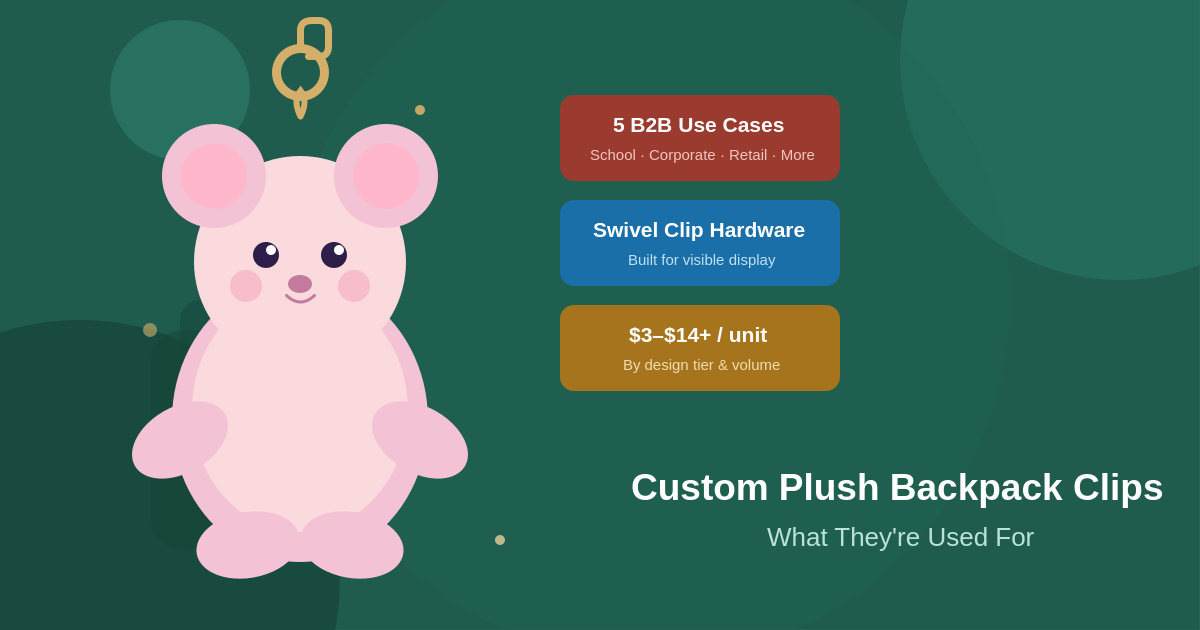
What They’re Used For
Last reviewed: August 2026 | Audience: Promotional product distributors, school/youth program buyers, corporate gifting buyers, retail buyers, e-commerce sellers | Reading time: ~10 min
Quick Answer
Custom plush backpack clips — also called plush bag charms — are used for five core B2B programs: school and youth program identification and spirit gear, corporate and event giveaways, retail and gift shop lifestyle accessories, e-commerce bundle upsells, and IP or character collectible bag charm series.
They belong to the same product family as plush keychains, but with a different spec profile: larger size (5–8″ vs. 3–4″), built for visible display, typically attached with a swivel clip or lobster clasp rather than a small split ring.
The most common failure point: the cord or strap connecting the plush body to the clip — not the clip hardware itself, and not the plush body.
What this article covers:
• The five B2B use cases and what each requires from your factory
• How backpack clips differ from plush keychains in spec, hardware, and positioning
• The Two-Zone Safety Model applied to backpack clips — why the cord is the real risk point
• A buyer’s inspection checklist for cord material and clip hardware
• Real market pricing benchmarks and cost tiers
• A factory brief checklist and criteria for choosing a manufacturer
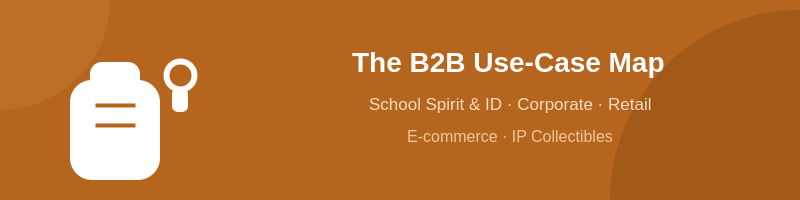
What Custom Plush Backpack Clips Are Used For — the B2B Use-Case Map
A custom plush backpack clip is a larger, display-oriented cousin of the plush keychain: instead of a small character riding quietly on a keyring, it’s a bigger, more visible plush figure clipped to the outside of a bag — meant to be seen at a distance, not just carried.
School and youth program identification and spirit gear. This is the dominant use case in the category. Schools use mascot backpack clips as school-store merchandise, spirit gear for sports teams, and — a use case that shows up repeatedly in buyer discussions — a practical identification tool: a distinctive clip makes a child’s backpack instantly recognizable to parents, teachers, and camp staff in a sea of identical bags. That identification function is a real, practical reason schools and camps buy these in bulk, separate from the branding value.
Corporate and event giveaways. Backpack clips work as a higher-perceived-value alternative to a standard keychain giveaway at trade shows, conferences, and brand activations — the larger size and clip-on display format make them feel like a more substantial gift without moving into full-plush-toy budget territory.
Retail and gift shop lifestyle accessories. Gift shops, museum stores, and theme park retailers stock backpack clips as a step up from keychains — same checkout-counter appeal, larger visual footprint, correspondingly higher price point.
E-commerce bundle upsells. DTC and marketplace sellers use backpack clips as premium bundle add-ons or standalone accessory SKUs, often marketed under the “bag charm” name — a term with meaningfully higher search demand than “backpack clip” in the broader consumer market.
IP and character collectible bag charm series. Character brands and licensors use backpack clips for blind-box and limited-edition collectible programs — the larger format allows more character detail than a compact keychain, which matters for licensed IP where accuracy is scrutinized closely.
Use-Case Requirements Matrix
Use Case | Volume Range | Unit Budget | Priority | Compliance Focus |
|---|---|---|---|---|
School/youth program (spirit + ID) | 300–5,000 | $3–8 | Durability, visual identification | High (daily use by minors) |
Corporate/event giveaway | 1,000–10,000+ | $3.50–8 | Fast turnaround, perceived value | Medium (mixed audience) |
Retail lifestyle accessory | 500–5,000 | $4–10 | Display appeal, SKU infrastructure | Medium (child-accessible retail) |
E-commerce bundle | 500–3,000 | $3–7 | Price efficiency, channel packaging | Medium-High (platform-specific) |
IP collectible series | 500–5,000/character | $4–14+ | Character accuracy at larger scale | Medium (licensing + safety) |
The use case shapes more than budget — it shapes the hardware and cord spec, covered next.
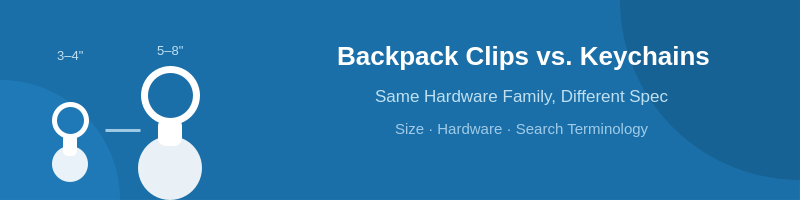
Backpack Clips vs. Keychains — Same Hardware Family, Different Spec
Custom plush backpack clips and plush keychains are frequently treated as interchangeable products, and in casual conversation they often are — but they diverge in three concrete specs that should shape your factory brief differently.
Size and visibility. A plush keychain is typically 3–4 inches, designed to sit quietly in a pocket or on a keyring. A backpack clip runs 5–8 inches, designed to be seen from a distance on the outside of a bag. That size difference changes fabric yardage, stuffing volume, and — critically — how much character detail is achievable and how visible small defects are.
Attachment hardware. Keychains commonly use a small split key ring. Backpack clips are built around a swivel clip or lobster clasp — hardware designed for quick one-handed attachment and removal from a bag strap or loop, not for threading onto a keyring. This is a different hardware category with different failure modes, covered in the next section.
Search and market terminology. Buyers and search engines don’t fully distinguish between the two: “plush bag charm” carries roughly 20× the search volume of “backpack clip” variants in market data we’ve reviewed, even though the physical product described is often the same clip-on format. If you’re sourcing or marketing this product, expect “bag charm,” “backpack clip,” and “clip-on plush” to be used interchangeably by buyers.
Backpack Clip vs. Keychain Comparison
Dimension | Plush Keychain | Plush Backpack Clip (Bag Charm) |
|---|---|---|
Typical size | 3–4 inches | 5–8 inches |
Primary attachment hardware | Split key ring | Swivel clip / lobster clasp |
Positioning | Compact, carried, low-profile | Visible, displayed, higher-profile |
Typical unit price | $0.70–4.20+ | $3–10+ |
Dominant B2B use case | Corporate gift, retail POS, e-commerce | School/youth programs, event giveaways |
Market search term | “plush keychain” | “plush bag charm” (higher volume) / “backpack clip” |
The Two-Zone Safety Model Applied to Backpack Clips — Why the Attachment Cord Is the Real Risk Point
Our compliance research on custom plush keychains established the Two-Zone Safety Model: every clip-on plush product has a Body Zone (the plush shell and stuffing, governed by ASTM F963-23, EN71, and CPSIA) and an Attachment Zone (the hardware and cord connecting the plush to the bag, governed by small-parts and use-and-abuse rules under 16 CFR Part 1501).
For backpack clips specifically, the Attachment Zone risk concentrates in a component that’s easy to overlook: the short cord or strap connecting the plush body to the swivel clip.
From the sourcing side: Most people inspecting a sample plush clip look first at the face — does it resemble the character, is the color accurate, does it look cute. What actually determines whether a batch fails is the small connecting cord at the top of the head. It functions like a single screw inside a machine: it looks like the least important part, but if it isn’t secured properly, failure means the plush detaches outright. The cord takes repeated pulling and swinging as the item hangs on a bag through daily use. If the connection point isn’t reinforced, and no pull-test or repeated-load testing was done before mass production, a sample can look completely normal and still fail — pulling loose at the seam — after a period of real use. The more difficult part: one failed sample is a single defect, but mass production uses the same fixing method across the entire run, so an unverified connection point becomes a batch-wide risk, not an isolated one. Based on 10 years of plush toy manufacturing experience, the products that fail rarely fail at the most complex point — they fail at the detail everyone assumes is too small to matter.
Three questions to ask before approving a bulk order:
— How is the cord or strap fixed to the plush body?
— Is the connection point reinforced (bar-tack stitching or equivalent), or is it a single loop of thread?
— Was pull-test or repeated-load testing performed on the connection point before mass production — not just visual sampling?
This doesn’t replace the Attachment Zone compliance requirements established for keychains — 16 CFR Part 1501’s small-parts rule and 16 CFR §1500.19’s choking hazard labeling still apply if a hardware component can detach during use-and-abuse testing. But for backpack clips, the cord-to-body connection is the specific point where real-world failures concentrate, and it’s rarely covered in a standard spec sheet.

Buyer’s Inspection Checklist — Cord Material and Clip Hardware
Beyond the general fabric, filling, and stitching checks that apply to any plush product, backpack clips have two inspection points specific to the attachment system.
1. Cord material — the difference is visible and tactile, not just theoretical. Placed side by side, a 4mm thickened braided cord and a thin ordinary cord look and feel clearly different. The thickened braided cord has tight, dense weave texture and doesn’t deform when pulled; it stays stable whether attached to keys, a water bottle, or a bag, and holds up through daily commuting and weekend outdoor use — one cord spec covers both scenarios. A thin ordinary cord feels noticeably soft and loose by comparison, and loosens and frizzes with use; a single catch on a subway security check hook or a scrape against a branch during outdoor use is often enough to finish it off.
Three checks for cord quality:
— Weave tightness — a tighter weave holds up longer under repeated tension
— Hand-pinch test — a cord with some structural firmness (not floppy) retains its shape
— Texture check — a cord that doesn’t fuzz or feel rough against skin is the more durable choice
2. Clip hardware — swivel clips and lobster clasps carry different failure risks than a keyring. Confirm the swivel mechanism doesn’t bind or fatigue after repeated open/close cycles, and that the swivel base is riveted (not glued) to its mounting point. A glued swivel base is a common failure point that doesn’t show up until the product has been in use for weeks.
3. Connection point reinforcement. As covered above, this is the single highest-leverage inspection point for backpack clips — confirm bar-tack stitching or equivalent reinforcement at the cord-to-body attachment, and ask whether pull-test data exists for the specific design, not just a general claim that “our clips are durable.”
The rest of the standard plush inspection checklist still applies: fabric pile density, filling odor (a chemical or musty smell signals low-grade filling and adhesive), overall weight (lighter is better for items that hang on a bag), and general seam stitching density.

MOQ and Cost Tiers for Custom Plush Backpack Clips
Backpack clip pricing is harder to benchmark from public sources than keychains, since most competitor pricing lives behind promotional-distributor markup rather than published factory rates. One US promotional products distributor’s published tiered pricing for a 6″ clip-on plush with single-location heat-transfer imprint gives a useful retail-distributor benchmark (Tier 3 — this reflects US distributor pricing with markup and imprint cost included, not factory-direct FOB):
Retail-Distributor Benchmark Pricing (6″ Clip-On Plush, 1-Color Imprint)
Quantity | Unit Price | Notes |
|---|---|---|
500 pcs | $7.95 | Setup charge $233.33 + $50.00 |
1,000 pcs | $5.95 | |
2,500 pcs | $4.71 | |
5,000 pcs | $4.11 | |
7,500 pcs | $3.66 | |
10,000 pcs | $3.378 |
Source: US promotional products distributor published pricing, 6″ backpack clip plush with heat-transfer imprint, poly bag packaging — Tier 3, directional benchmark only.
Factory-direct FOB pricing for the same product typically runs meaningfully below this distributor benchmark once markup, setup fees, and single-market imprint costs are stripped out — comparable to our factory-floor pricing tiers for plush keychains, scaled up for the larger size and heavier hardware:
Tier | Directional Unit Price | Typical Volume | Key Cost Drivers |
|---|---|---|---|
Basic (flat embroidery/print, standard clip) | $3–5 | 500–1,000 units | Size (5–6″), simple 2D design, standard swivel clip |
Mid-tier (3D character sculpt, reinforced cord, upgraded clip) | $5–8 | 500–1,000 units | Premium fabric, character accuracy, reinforced attachment point |
Premium (licensed IP, 7–8″ size, specialty materials) | $8–14+ | Small batch, high customization | Design/licensing fees, specialty fabric, multi-round sampling |
Standard production time for this category runs 20–30 working days (15–20 for rush service), based on published distributor lead times — plan factory-direct timelines similarly unless your factory confirms otherwise.
Factory Brief Checklist for Custom Plush Backpack Clip Programs
Pre-Production Factory Brief: Custom Plush Backpack Clips
☐ Use case confirmed: school/youth program / corporate-event giveaway / retail lifestyle accessory / e-commerce bundle / IP collectible series
☐ Body Zone: fabric type, size (5–8″ range specified), filling type, ASTM F963-23 / EN71 testing scope confirmed
☐ Attachment Zone — cord: material specified (braided cord gauge, e.g. 4mm), connection point reinforcement (bar-tack stitching) confirmed, pull-test/repeated-load test data requested
☐ Attachment Zone — clip: hardware type specified (swivel clip / lobster clasp), swivel base mounting method confirmed (riveted, not glued)
☐ Small parts compliance reviewed against 16 CFR Part 1501 if product may reach children under 3; choking hazard warning label applied if applicable (16 CFR §1500.19)
☐ IP/licensing status confirmed in writing before artwork is sent, if design is based on existing character or brand IP
☐ Packaging and labeling confirmed against target channel (school-store barcode/hangtag, retail SKU control, event carton marking)
☐ Physical sample approved — including a hands-on pull test of the cord and clip — before bulk production release

How to Choose a Factory for Custom Plush Backpack Clip Programs
1. Cord and connection-point testing capability. Ask specifically whether the factory pull-tests the cord-to-body connection point as a standard QC step — this is the single most common failure point for this product category, and many factories only inspect the plush body and the clip hardware, not the connection between them.
2. Swivel clip and hardware sourcing quality. Confirm the factory sources swivel clips and lobster clasps that don’t bind or fatigue after repeated use, and that the swivel base is riveted rather than glued to its mount.
3. School/youth program experience. Since school and youth programs are the dominant use case for this product, ask whether the factory has experience with school-store or spirit-wear compliance requirements, including durability expectations for daily use by children.
4. IP/licensing handling. For programs based on licensed or brand-protected characters, confirm the factory requires licensing documentation before production.
5. Sampling speed and lead time track record. Standard production runs 20–30 working days; confirm the factory’s current queue can realistically hold to that window, or to a rush timeline if needed.
6. MOQ flexibility against your actual design. Confirm MOQ against your specific reference design and hardware spec, not a generic backpack clip listing — complexity in character sculpting or premium cord material can raise the effective minimum.
Frequently Asked Questions
What are custom plush backpack clips used for?
Five core B2B use cases: school and youth program identification and spirit gear, corporate and event giveaways, retail lifestyle accessories, e-commerce bundle upsells, and IP or character collectible bag charm series. School and youth programs are the dominant use case — the larger, visible format makes backpacks easy to identify, in addition to its branding and spirit-gear value.
What’s the difference between a plush backpack clip and a plush keychain?
Size and hardware, primarily. Backpack clips run 5–8 inches and use a swivel clip or lobster clasp for quick attachment to a bag; keychains run 3–4 inches and use a small split key ring. Backpack clips are designed to be seen at a distance; keychains are designed for compact, everyday carry. In market search data, “plush bag charm” — a common alternate name for the backpack clip format — carries roughly 20× the search volume of “backpack clip” terms.
Why do plush backpack clips fail even when the sample looked fine?
The most common failure point is the cord or strap connecting the plush body to the clip, not the plush body or the clip hardware itself. If the connection point isn’t reinforced and wasn’t pull-tested before mass production, a sample can look completely normal and still fail after real-world use, because the cord takes repeated pulling and swinging every time the item hangs on a bag. Because mass production replicates the same fixing method across the entire run, an unverified connection point becomes a batch-wide risk.
How can I tell if a backpack clip’s cord material is good quality?
Three checks: weave tightness (a tighter weave holds up longer under tension), a hand-pinch test (some structural firmness indicates better shape retention), and a texture check (a cord that doesn’t fuzz or feel rough is more durable). A 4mm thickened braided cord will visibly and tactilely outperform a thin ordinary cord in side-by-side comparison.
What is the minimum order quantity for custom plush backpack clips?
MOQs commonly start around 500 units. Published retail-distributor pricing for this category runs from roughly $7.95/unit at 500 units down to $3.378/unit at 10,000 units, though this reflects distributor markup and imprint costs rather than factory-direct FOB pricing, which typically runs lower.
Do plush backpack clips need the same safety certification as plush keychains?
Yes — the Body Zone (plush shell and stuffing) is governed by ASTM F963-23, EN71, and CPSIA/CPC requirements the same way any plush toy is. The Attachment Zone (clip hardware) is subject to CPSC’s 16 CFR Part 1501 small-parts rule and 16 CFR §1500.19 choking hazard labeling if a component can detach during use-and-abuse testing — the same framework that applies to plush keychains.
Glossary
Term | Definition |
|---|---|
Bag charm | Common alternate market term for a plush backpack clip; carries significantly higher search volume than “backpack clip” in consumer search data |
Body Zone | The plush shell, stuffing, and surface decoration — governed by ASTM F963-23, EN71, and CPSIA |
Attachment Zone | The cord, clip, and hardware connecting the plush to a bag — subject to small-parts and tension-related compliance requirements |
Swivel clip | Rotating clip hardware used to attach a backpack clip to a bag strap or loop, allowing quick one-handed attachment |
Bar-tack stitching | Reinforced stitching technique used at stress points (such as the cord-to-body connection) to prevent seam failure under repeated pulling |
16 CFR Part 1501 | US CPSC regulation defining the small parts ban; any component that detaches during use-and-abuse testing is treated as a small part |
16 CFR §1500.19 | US regulation requiring choking hazard warning labels on products that are or contain small parts |
MOQ | Minimum Order Quantity — smallest production run a factory will accept per design |
Disclaimer: Pricing figures cited in this article include one published US promotional-distributor pricing benchmark (Tier 3, includes markup and imprint costs) and directional factory-floor cost tiers as of August 2026 — actual costs vary by factory, design complexity, and current market conditions. CPSC small parts and labeling requirements are legal obligations for US market imports — consult a licensed customs broker or compliance specialist before finalizing product certification. Nothing in this article constitutes legal or regulatory advice.
References
1. CPSC.gov — Small Parts Ban and Choking Hazard Labeling (16 CFR Part 1501) (Tier 1)
2. eCFR — 16 CFR §1500.19, Choking Hazard Warning Labeling (Tier 1)
3. ASTM F963-23 Toy Safety Standard (Tier 1)
4. CPSC.gov — Children’s Product Certificate (Tier 1)
5. US promotional products distributor — published tiered pricing, 6″ clip-on plush backpack clip (Tier 3)
6. School mascot backpack clip listing — school store use case reference (Tier 3)
Ready to Source Your Custom Plush Backpack Clips?
Tell us your use case — school/youth program, corporate giveaway, retail accessory, e-commerce bundle, or IP collectible — and we’ll spec the cord, clip hardware, and safety documentation around that program, not a generic bag-charm template.
→ Request a Channel-Ready Backpack Clip Quote: CONTACT – Plush Toy Manufacturer|Customized plush toys
→ Related: Custom Plush Keychains: What They’re Used For | What Are Custom Plush Toys Used For?