
Custom Plush Toys for Retail Branding:
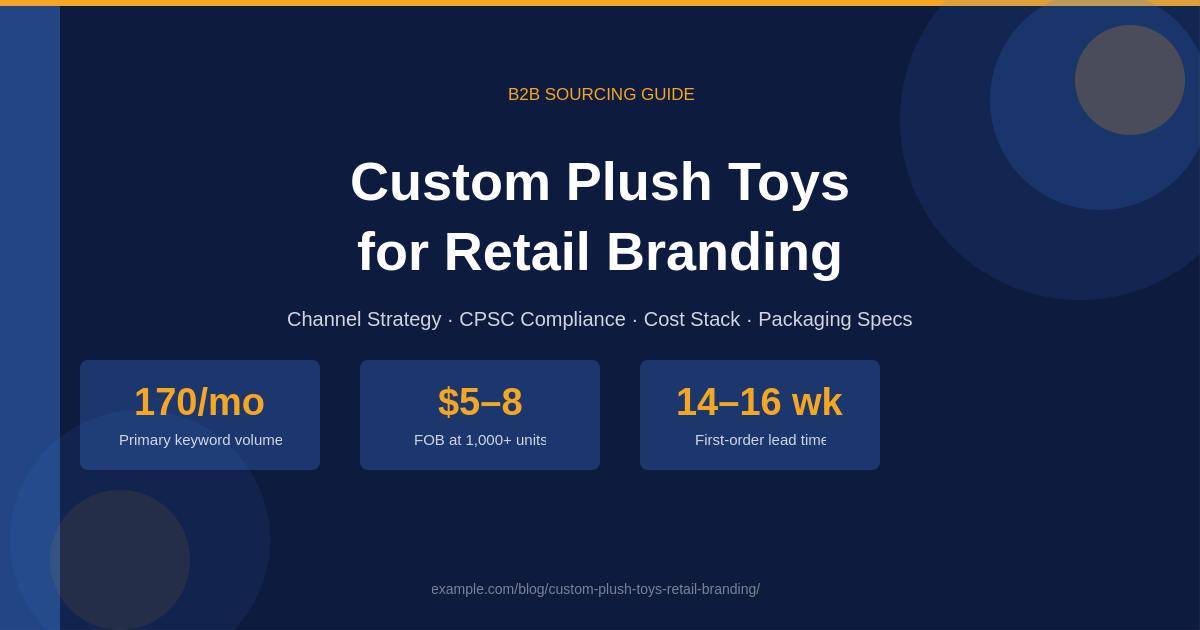
How to Turn a Character into a Revenue-Generating SKU
Quick Answer
Branded plush toys become retail-ready SKUs when they meet four conditions:
1. CPSC eFiling submitted at customs entry (mandatory July 8, 2026)
2. Children’s Product Certificate (CPC) backed by ASTM F963-23 third-party testing
3. GS1 UPC barcode tied to each unique design
4. Retail-ready packaging formatted for the specific distribution channel
Most brands that contact us about a retail plush program have already made one version of the same mistake: they ordered the product the way they would order a trade show giveaway, then discovered at the point of import — or worse, at the retailer’s warehouse — that the product was missing something the retail channel required. No UPC. No CPC. Packaging formatted for a booth display, not a hook rack. The units were technically well-made. They just weren’t retail-ready.
Our factory works with a U.S. retail brand that launches 10 new plush designs every month for their own branded stores. Every single design requires a separate ASTM F963-23 test report and its own Children’s Product Certificate. That compliance cycle takes approximately one week per SKU. Running 10 simultaneously means compliance and production must operate in parallel — not sequentially. The brands that maintain continuous shelf presence are not the ones with the lowest FOB cost. They are the ones with a factory that has built compliance into the production workflow from day one.
This guide covers everything a brand needs to know before briefing a factory on a retail plush program: how to define your business model, which sales channel determines your specs, what the 2026 compliance changes mean in practice, how to express brand identity on a shelf, and how to work out the full cost from FOB to retail margin.
Revenue SKU vs. Brand Tool — Two Business Models That Demand Different Sourcing Strategies
Before you brief a factory on a retail plush program, you need to answer one question: is this plush supposed to generate revenue on its own, or is it a brand investment that happens to take physical form? The answer determines almost everything downstream — MOQ strategy, price point, packaging investment, compliance scope, and how you measure success.
Dimension | Revenue SKU | Brand Tool |
|---|---|---|
Typical use case | Licensed IP character, food/beverage mascot, collectible series | DTC brand mascot, corporate gift, pop-up exclusive |
Pricing logic | MSRP → cost → margin target | Brand exposure value → cost is secondary |
MOQ strategy | 1,000+ units to lower per-unit cost | 300–500 units to test market response |
Compliance | Full: CPC + CPSC eFiling + retail labeling | Partial may suffice for adult-only DTC |
Packaging | Hang tag + UPC + shelf-ready carton | Branded gift box or minimal OPP bag |
Success metric | Sell-through rate >80%, reorder velocity | Brand recall, social sharing, LTV data |
A food brand launching a mascot plush in their own DTC store is building a brand tool. A toy distributor licensing a character to sell at Target is building a revenue SKU. The production process may look identical from the outside, but the sourcing decisions are completely different. A brand tool tolerates a lower sell-through rate because it is generating awareness. A revenue SKU that sells through at 40% is a failure.
More U.S. retail operators — pop culture stores, gift shops, entertainment venues — are now working directly with Chinese manufacturers rather than through distributor chains. Store operators are optimizing for new design speed, reliable IP restocking when a character gains traction, and a supplier capable of handling customs clearance end-to-end. Long-term supply relationships, not one-time low-price orders, are what serious retail buyers are building.

The 4-Channel Retail Plush Model: Why Your Sales Channel Determines Your Specs Before You Order
The most expensive mistake in a retail plush program is ordering product before locking down which channel it will sell through. Each channel has different packaging requirements, compliance obligations, MOQ economics, and success metrics — and those differences need to be reflected in the factory brief, not added as afterthoughts.
Channel | DTC / Brand Store | Amazon / Mkt | Physical Retail | Pop-Up / Event |
|---|---|---|---|---|
Packaging | Gift box or OPP bag | FBA carton + FNSKU | Hang tag + UPC + display carton | Custom display box |
Compliance | CPSC eFiling + CPC | eFiling + CPC + ASIN | eFiling + CPC + state regs | Same as DTC |
MOQ floor | 300–500 units | 500+ units | 1,000+ units | 100–300 units |
Key metric | Repeat purchase, AOV | BSR, Buy Box % | Sell-through rate | Brand conversion |
How to Choose Your Primary Channel Before Briefing the Factory
The common failure pattern is launching on multiple channels simultaneously with a single product configuration. A unit optimized for Amazon FBA (poly bag + FNSKU, compact carton) is not the same configuration as a unit destined for a physical retailer’s hook rack (hang tag with UPC, specific tag dimensions, retail-ready display carton). Ordering one version for both channels results in units that work for neither.
For brands testing the market, DTC is the lowest-risk channel: lowest MOQ, packaging flexibility, no retail buyer approval process. For Amazon, confirm FBA packaging requirements before finalizing carton dimensions. For physical retail, most chain buyers require 1,000+ units minimum per SKU and a sell-through performance review after the first season before committing to a second order.
The most reliable path for brands with strong DTC audiences but retail expansion ambitions: launch DTC at 300–500 units → prove sell-through data → approach retail buyers with a second order at 1,000+ units and retail-ready packaging.
Retail Compliance: What Changes When Your Plush Goes from Giveaway to For Sale
The compliance requirements for a plush toy sold at retail are meaningfully different from those for a promotional giveaway, and the changes that took effect in 2026 have made the gap larger.
CPSC eFiling: What Changed on July 8, 2026
“Beginning July 8, 2026, importers of most regulated consumer products will be required to electronically file (eFile) certificates of compliance with U.S. Customs and Border Protection (CBP), via a Partner Government Agency (PGA) Message Set.” — CPSC.gov, Children’s Product Certificate (Tier 1)
Before July 8, 2026, the system was reactive: an importer tested the product, held the certificate, and produced it only if customs requested it. eFiling changes that to proactive: certificate data must be transmitted electronically into CBP’s ACE system at customs entry, before goods are released.
Seven data elements must be filed at entry for every shipment: product identification (SKU/UPC), the specific safety rules certified to, manufacturing date and location, testing date and laboratory, and contact information for the records custodian (source: 16 CFR 1110 amendment, Federal Register 2025-01-08, Tier 1).
No de minimis exemption. Any product requiring a certificate must have an eFiled certificate regardless of shipment value. A 100-unit test run is subject to the same eFiling requirement as a 10,000-unit production run.
Each unique SKU requires its own compliance file. A brand launching 10 new plush designs per month needs 10 separate test reports, 10 CPCs, and 10 eFiling submissions that month — an ongoing operational function, not a one-time event.
Children’s Product Certificate (CPC): What It Contains
Children’s products — designed for children 12 years of age or younger — require third-party testing and a CPC under Section 14 of the Consumer Product Safety Act (Tier 1: CPSC.gov). Plush toys sold at retail are presumed to be children’s products.
The CPC must contain seven required elements: product identification; citation to each applicable safety rule (ASTM F963-23, CPSIA lead content, phthalates); certifying manufacturer or importer; records custodian contact; date and place of manufacture; date and place of testing; and identification of the CPSC-accepted third-party laboratory.
UPC/EAN Barcodes: The Operational Prerequisite
Every retail channel requires a unique GS1-issued UPC per SKU. Without it, the product cannot be listed in a retailer’s inventory system, cannot generate a POS receipt, and cannot be tracked for replenishment. Third-party barcode resellers cause retailer chargeback issues. For Amazon, each ASIN also requires a GTIN linked to the listing and the CPSC Product Registry.
State-Level Requirements
Pennsylvania, Massachusetts, and Ohio each require additional registration for stuffed toys sold at retail. Maine requires PFAS-free verification. Brands targeting national retail distribution should confirm compliance with all four before fulfillment begins.
Brand Expression on the Retail Shelf: Logo Placement, Character Accuracy, and the 12-Inch Rule
A plush toy on a retail shelf has approximately two seconds to communicate brand identity before a shopper moves on. That communication happens through three variables: where the logo appears, how accurately the character translates from 2D to 3D form, and whether the size registers at shelf from a distance.
Logo Placement Spectrum and Retail Durability
Method | Placement | Retail Durability | Cost at 500 units |
|---|---|---|---|
Embroidery | Body surface, chest, back | Highest — survives washing and handling | +$0.40–0.80/unit |
Hang tag, chest, ear tag | High — does not fade | +$0.15–0.30/unit | |
Heat transfer print | Body surface | Moderate — can crack with handling | +$0.20–0.40/unit |
Screen print on fabric | Body surface | Low-moderate — fades over time | +$0.15–0.25/unit |
Branded hang tag only | Paper at wrist or neck | Tag only; product surface bare | Minimal |
Character Accuracy: The 3D Translation Challenge
The most common source of production disputes in retail plush programs is character accuracy — the gap between how a character looks in 2D artwork and how it looks in 3D stuffed form. This is not primarily a skill issue; it is a geometry issue. A character with a disproportionately large head in 2D artwork needs its proportions actively managed in the physical pattern to prevent tilt.
The standard process: share vector artwork from multiple angles, specify head-to-body ratio as a percentage (“head should be approximately 40% of total height”), and require a physical sample before approving bulk production. Digital renders are useful for color review; they are not a substitute for holding the actual sample.
Color Matching: Why Physical Swatch Approval Is Non-Negotiable
Pantone numbers define a color target. They do not guarantee a color outcome in plush fabric, because actual color depends on dye lot, fiber content, and material weave. A navy PMS color in short-pile velboa will look different from the same PMS code in ultra-soft minky. Standard process: share Pantone references, receive physical fabric swatches by courier, approve the closest match in writing, then release bulk production. This adds 3–5 days but prevents color disputes at delivery.
The 12-Inch Shelf Visibility Rule
A 6-inch plush on a hook rack disappears when the rack is full. An 8–10-inch piece is visible, desk-worthy after purchase, and carries enough surface area to display brand details clearly. A 12-inch piece commands a higher MSRP but requires more shelf space than most retail buyers will allocate for a new brand. For initial retail programs, 8–10 inches is the functional sweet spot: visible on shelf, fits in a shopping bag, and lands at a $14.99–$24.99 MSRP that works across specialty retail and DTC.

Retail-Ready Packaging: The 5-Layer Decision That Affects Your Sell-Through Rate
Packaging is where branded plush programs most visibly succeed or fail on the retail floor. The right packaging communicates brand positioning, meets channel technical requirements, and drives sell-through. The wrong packaging creates returns, chargebacks, or a product that looks like a trade show giveaway on a premium shelf.
The 5-Layer Retail Packaging Decision
1. rimary format — OPP poly bag (mass market / high-volume DTC); hang tag + OPP bag (best cost/impact ratio for most programs); branded gift box (premium; adds $0.80–$2.00/unit); blind box (collect-all mechanic; highest packaging development cost).
2. UPC position and format — GS1-issued barcode on the hang tag or packaging, scannable at POS without removing the product from display. For hook-rack display, barcode faces outward.
3. Hang tag specifications — Retail buyers specify dimensions, hole position, card weight. Standard for hook-rack display: approx. 3.5″ × 2.75″, 16-pt card stock minimum. Request the retailer’s routing guide before finalizing.
4. Retail-ready outer carton — Display-ready master carton with tear-away front panel. Must carry GTIN, item count, weight, and dimensions in EDI-compatible format. Carton spec differs by retailer.
5. Multi-language regulatory label — Fiber content, country of origin, safety warnings. EU/UK distribution additionally requires EN71 and CE marking.
QR Code Hang Tags: Post-Purchase Digital Touchpoint
A QR code on the hang tag converts a one-time shelf purchase into an ongoing brand relationship. A scannable code linking to a character registration page, a collection gallery, or a digital unlock performs consistently for brand merchandise programs — the physical product becomes an entry point into a digital loyalty loop. For retail brands building DTC alongside physical retail, this is the lowest-cost tool for cross-channel customer acquisition available in the packaging budget.
Retail Plush Economics: FOB Cost, Landed Cost, Margin Math, and Collectible Series Premiums
The economics of a retail plush program require working backward from a shelf price, not forward from a factory cost. Understanding the full cost stack before placing an order determines whether the program is viable — or whether it will look good in the brief and fail on the P&L.
The Full Cost Stack: FOB to Retail Shelf
Cost Element | Notes |
|---|---|
FOB unit cost | 100–299 units: $12–20 / 500–999 units: $7–11 / 1,000+ units: $5–8 (Tier 3 directional — confirm with factory quote) |
Ocean freight | Approx. $0.30–0.80/unit at standard carton quantities; varies by weight and port pair |
Import duty (HS 9503.00) | 0% for most plush toys — confirm HTS classification before ordering |
CPSC eFiling + customs brokerage | Fixed per shipment ~$150–300; amortizes across larger order quantities |
Domestic freight + fulfillment | $0.50–1.50/unit DTC pick-and-pack; retail routing adds $0.30–0.80/unit |
Total landed cost (est.) | At 500 units: ~$9–15/unit landed | At 1,000 units: ~$7–11/unit landed |
Retail Margin Math: Working Backward from MSRP
Physical retail channels typically take 50% gross margin from MSRP — the retailer pays the brand approximately $10.00/unit wholesale on a $19.99 MSRP. For the brand to achieve 30% gross margin on that wholesale price, landed cost must be ≤$7.00/unit. At 500 units, a landed cost of $9–15 puts most designs below that threshold. At 1,000+ units, a landed cost of $7–11 makes retail margin viable — which is why most 500-unit programs work as DTC launches (brand captures the full $19.99), not wholesale launches.
For DTC at a $34.99 price point with a $10 landed cost, the gross margin before marketing is approximately 71%. The economic case for branded plush in DTC channels is stronger than most brands realize when they first price it against a $7 FOB.
Collectible Series Premium Economics
The global blind box market was valued at $13.53 billion in 2024 and is projected to reach $25.14 billion by 2034, with a CAGR of 6.14%. Plush figures are the highest-growth collectible format at 11.8% CAGR through 2034 (source: Zion Market Research / DataIntelo, Tier 2). Standard series units are priced at $8–$15; limited-edition artist collaboration series command $25–$150 per unit.
A six-character blind box series at 500 units per character (3,000 units total) achieves the per-unit economics of a 1,000-unit order while spreading design and compliance cost across six SKUs. Each SKU still requires its own CPC and eFiling submission, but the series-level economics are meaningfully more efficient than six separate single-character orders.
Frequently Asked Questions
Do I need a CPC for branded plush sold only to adults through my own website?
If the product is explicitly designed for adults and marketed solely to adults, the CPC requirement technically applies only to products primarily designed for children 12 and under. However, plush figures have a high probability of ending up in the hands of children regardless of stated audience. Most experienced compliance professionals recommend obtaining ASTM F963-23 testing and a CPC for any plush item sold to consumers, to limit liability and ease customs clearance.
Does CPSC eFiling apply to small test orders of 100–200 units?
Yes. There is no de minimis exemption under the July 8, 2026 eFiling mandate. Any plush toy requiring a CPC must have a completed eFiling submission at customs entry, regardless of unit count or shipment value. (Source: CPSC.gov / 16 CFR 1110 amendment, Tier 1.)
What is the minimum order quantity for a retail-ready branded plush program?
The functional minimum is 300–500 units for DTC channels. For Amazon or physical retail, 500–1,000 units is the practical floor. Unit costs at 300 units ($12–20 FOB, directional) make physical retail margins difficult; 1,000+ units ($5–8 FOB) is where retail margin math typically becomes viable.
How do I handle compliance when launching 10 or more new designs in the same month?
Each unique design requires its own test report and CPC — there is no batch certification for different designs. The practical approach is to run compliance and production in parallel: while the factory produces the current month’s designs, compliance documentation for next month’s designs is already in process at the testing laboratory. Ask potential factory partners specifically how they manage multi-SKU monthly launch programs before placing an order.
Can I sell the same plush design on Amazon and in physical retail simultaneously?
Yes, but the product configuration may need to differ. Amazon FBA requires FBA-compatible packaging with FNSKU label. Physical retail requires a hang tag with GS1 UPC in a scannable position, a retail-ready master carton, and compliance with the retailer’s routing guide. A single configuration may not satisfy both channels — confirm requirements before ordering.
What is the lead time for a new retail plush program?
A first-time order typically requires 14–16 weeks: 2 weeks for brief and design approval, 1–2 weeks for physical sample approval, 10–15 business days for compliance testing (runs in parallel with bulk production), 4–5 weeks for bulk production, 2–3 weeks for freight and customs clearance. Confirm the factory’s parallel compliance-and-production workflow before finalizing your launch calendar.
How to Launch a Custom Plush Retail Program in 8 Steps
1. Define your business model. Decide whether the plush is a Revenue SKU (margin target, sell-through KPIs) or a Brand Tool (awareness and loyalty goals). This decision sets your MOQ strategy, MSRP, and compliance investment level.
2. Select your primary sales channel from the 4-Channel Model. Choose from DTC, Amazon/marketplace, physical retail shelf, or brand pop-up before briefing the factory. Each channel requires a different packaging configuration and compliance scope.
3. Determine your compliance scope. Plan for ASTM F963-23 testing, CPC issuance, and CPSC eFiling. Confirm state registration requirements (PA, MA, OH, Maine PFAS) for your distribution territory.
4. Prepare and submit the factory brief. Include: vector artwork from multiple angles; Pantone color references; target size with dimensional priorities; total quantity and units per design; launch date and delivery address; fabric preference; compliance scope statement; packaging specifications.
5. Approve a physical sample and color swatches before bulk production. Receive fabric swatches by courier and approve the closest Pantone match in writing. Do not approve from digital renderings alone.
6. Initiate compliance testing during bulk production. Submit representative production samples (not pre-production prototypes) to a CPSC-accepted third-party laboratory. Obtain the ASTM F963-23 test report and draft the CPC while production is underway.
7. Finalize retail-ready packaging and obtain GS1 UPC. Confirm hang tag dimensions, barcode placement, and master carton specifications against target channel requirements. Register UPC codes through GS1 for retail chain distribution.
8. Submit CPSC eFiling before the shipment departs. Register product data in the CPSC Product Registry. Provide Certificate Identifiers to your customs broker before the cargo sails. Confirm the PGA Message Set transmission before the container arrives at the U.S. port.
Ready to Launch Your Retail Plush Program?
Whether you are bringing a brand mascot to shelf for the first time or scaling an existing character across multiple retail channels, the compliance and production planning decisions made before the factory brief determine whether the program hits its launch window — and its margin targets.
→ Request a quote for your retail plush program: example.com/contact/
→ View custom plush product options: example.com/products/custom-plush/
→ Related: Custom Plush Toys for Trade Shows and Events | Custom Plush Toys for Corporate Gifts
Terminology Reference
Term | Definition |
|---|---|
CPC | Children’s Product Certificate — required for any children’s product subject to a CPSC safety rule |
CPSC eFiling | Mandatory electronic submission of certificate data to CBP at customs entry; effective July 8, 2026 |
ASTM F963-23 | Current U.S. mandatory toy safety standard (effective April 20, 2024) |
FOB | Free On Board — unit cost at the factory port before freight, duty, and domestic logistics |
GS1 UPC | Globally recognized product barcode issued by GS1; required for retail chain distribution |
GTIN | Global Trade Item Number — the numeric identifier behind a UPC or EAN barcode |
MSRP | Manufacturer’s Suggested Retail Price |
Sell-through rate | Percentage of inventory sold within a given period; typically measured per retail season |
FBA | Fulfillment by Amazon — warehouse-and-ship service with specific packaging requirements |
Blind box | Opaque packaging where the specific character variant is unknown until opened |
PGA Message Set | Partner Government Agency Message Set — format for transmitting CPSC certificate data to CBP |
Disclaimer: This article reflects compliance requirements as understood at the date of publication (August 2026). CPSC and CBP requirements are subject to change. Consult a licensed customs broker or qualified compliance professional before making certification and import decisions for your specific products.
References
1. CPSC.gov — Children’s Product Certificate (Tier 1)
2. Federal Register — 16 CFR 1110 amendment (certificates-of-compliance) (Tier 1)
3. CPSC.gov — eFiling portal (Tier 1)
4. ASTM F963-23 Toy Safety Standard (Tier 1)
5. Future Market Insights — Stuffed and Plush Toy Market (2026) (Tier 2)
6. Zion Market Research — Global Blind Boxes Market (Tier 2)
7. DataIntelo — Blind Box Figures Market 2025–2034 (Tier 2)