
Embroidery vs Appliqué vs Printing on Plush Toys: Which Method for Which Detail
The three decoration methods used on plush toys, what each one is genuinely bad at, and why the right answer usually differs for each detail on the same toy.
Updated August 2026 · B2B production guide
Plush decoration is not a choice between embroidery and printing. There are three methods — solid embroidery, appliqué and heat-transfer print — and a well-built toy commonly uses two or three of them in different places.
Direct answer: Embroider small precise details like faces and logos. Use appliqué for large shapes, because embroidering a big area makes the toy stiff and expensive. Print when the artwork has gradients or complex colour that thread cannot reproduce — provided the fabric suits it.
Embroidery vs Appliqué vs Printing — TL;DR: Most guides on this topic are written for apparel, where the toy-specific constraints don’t apply. On plush, pile height, the finished shape being three-dimensional, and the child’s age grade all remove options before aesthetics get a say.
Scope: This article covers decoration methods on plush toys specifically. For fabric and filling selection, see our
guide to plush toy materials →. Costs and feasibility vary with design and fabric — confirm specifics at quotation.
Three Methods, Not Two
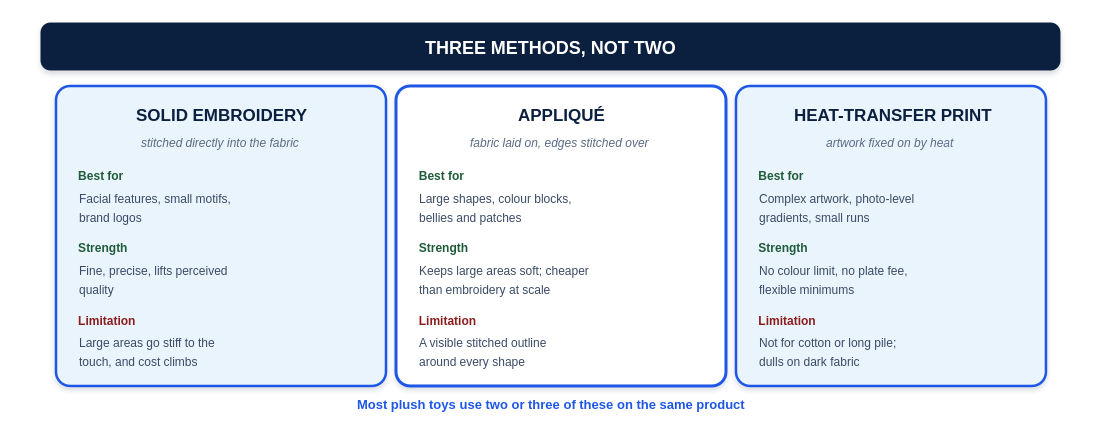
Search this question and you will mostly find articles about t-shirts. Apparel treats it as a binary because appliqué is comparatively rare there. On plush toys appliqué is a mainstream method, and leaving it out of the comparison removes the answer to the most common large-area problem.
Solid embroidery is stitched directly into the fabric and is the most common method for facial expressions, decorative motifs and brand marks. It is fine and precise, and it lifts perceived quality more than any other option. Its limitation is scale: embroider a large area and the finished toy feels stiff in the hand, while the cost climbs with stitch count.
Appliqué solves exactly that problem. A separate piece of fabric is laid over the area and stitched around its edge, so a large shape stays soft and costs less than the equivalent in dense stitching. The trade-off is visual: every appliquéd shape carries a visible stitched outline, which suits some designs and fights others.
Heat-transfer print fixes artwork to the fabric surface with heat. It has no colour limit, no plate fee and flexible minimums, which makes it the practical choice for complex artwork and smaller runs. But it is the most fabric-dependent of the three: it does not work on pure cotton or on long pile, and colours read noticeably darker and duller on dark base fabrics.
Match the Method to the Detail
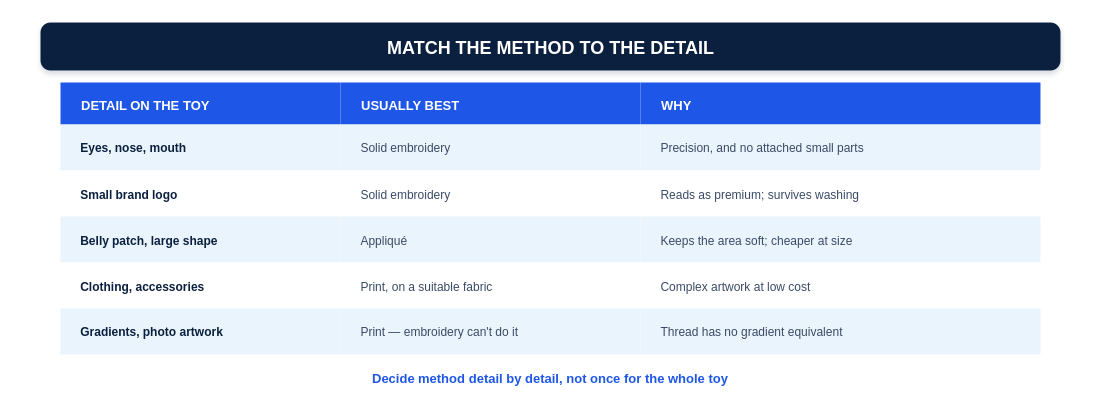
The productive way to approach this is detail by detail rather than once for the whole product. A single toy might carry an embroidered face, an appliquéd belly patch and a printed pattern on its clothing — each chosen for a different reason.
Two rules do most of the work. First, small and precise goes to embroidery; large and soft goes to appliqué. The threshold is roughly where a customer would notice the toy going stiff. Second, anything with a gradient or photographic shading has to be printed, because thread has no gradient equivalent — this is a hard technical limit rather than a preference.
Printed vs Embroidered Faces: The Question Everyone Asks
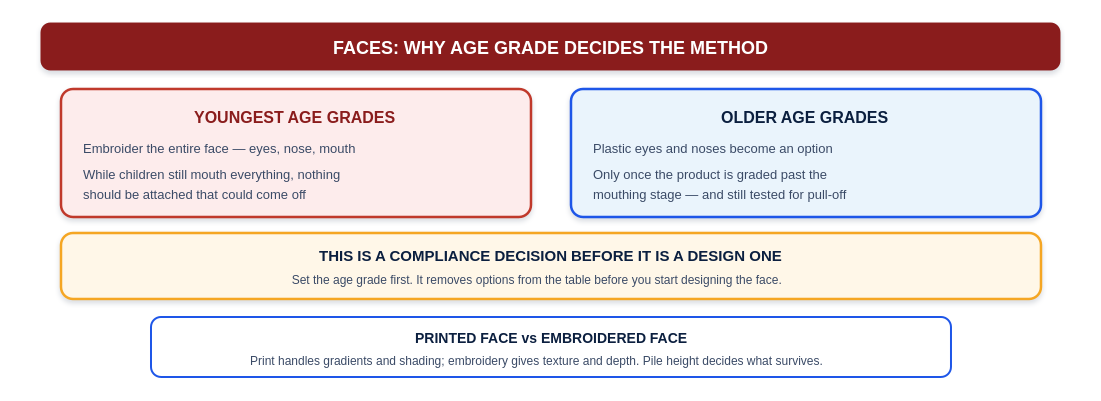
This is the single most-debated decision in plush design, particularly in collector communities where custom character plush — often called nui — trade heavily on how the face reads.
Printing handles gradients, blush, shading and subtle colour transitions that embroidery simply cannot produce. Embroidery gives texture and physical depth, wears better over time, and reads as more premium in the hand. Neither is universally correct, and pile height often decides for you: fine printed or stitched detail disappears into a long-pile fabric regardless of which method you choose.
But for children’s products, the age grade decides before aesthetics do. While children are still at the stage of putting everything in their mouths, the entire face should be embroidered — eyes, nose and mouth. Once a product is graded for older children past that stage, plastic eyes and noses become a legitimate option, though they still need to pass attachment-strength testing.
There is a specific regulatory reason this works, and it is worth understanding rather than treating as a rule of thumb. The US small parts ban applies to products intended for children under three, and a small part is anything that fits entirely inside a test cylinder approximating the throat of a child that age — including pieces that break off during use-and-abuse testing. Critically, the CPSC excludes components made of fabric, yarn, fuzz, elastic or string from being treated as small parts even when they detach during that testing. A plastic eye that pulls off is a small part; embroidery thread that works loose is not.
That exemption is why embroidered faces are the default for the youngest age grades. It is not merely that embroidery is safer in a general sense — it sits outside the category the ban is written around. Products intended for children aged roughly three to eight that do contain small parts remain permitted, but require choking-hazard warning labelling.
This is why age grading belongs at the start of a project rather than the end. See our guide to toy safety standards → for what the small-parts requirements actually involve.
Where Decoration Goes Wrong at Sampling
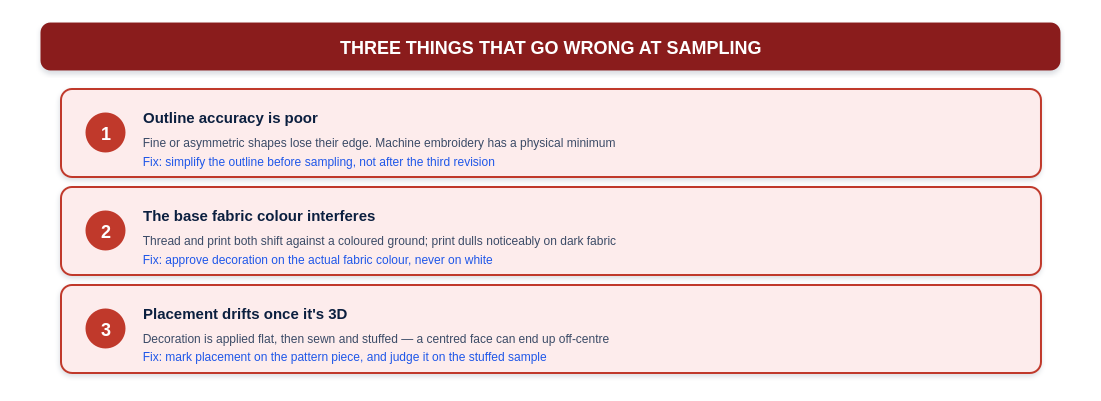
Three problems account for most decoration revisions, and all three are cheaper to prevent than to fix.
Outline accuracy is poor. Fine or asymmetric shapes lose their edges, because machine embroidery has a physical minimum below which detail blurs. Simplify the outline before sampling rather than discovering the limit across three revision rounds.
The base fabric colour interferes. Both thread and print shift against a coloured ground, and heat-transfer print in particular dulls on dark fabric. Always approve decoration on the actual production fabric colour, never on a white swatch or a screen mock-up.
Placement drifts once the toy is three-dimensional. Decoration is applied to flat pattern pieces, which are then sewn and stuffed. A face that sits centred on the flat piece can end up off-centre on the finished toy. Mark placement on the pattern piece itself, and judge it only on a stuffed sample.
That last point is the one apparel guides never mention, because a t-shirt stays flat. On plush, every decoration decision is made in two dimensions and evaluated in three.
A Note on Cost
Rather than quote figures that vary by design, it is more useful to understand what drives them. Embroidery cost scales with stitch count, so a large embroidered area is expensive in a way a large printed area is not. Appliqué sits between the two for large shapes, which is exactly why it exists. Print carries no plate fee and no per-colour charge, making it the most forgiving option for small runs and complex artwork.
The practical implication for a tight budget: keep embroidery for the details that carry the perceived quality — usually the face and the logo — and use appliqué or print for everything large.
Frequently Asked Questions
Should a plush toy face be printed or embroidered? For children’s products at the youngest age grades, embroidered — US small parts rules exclude fabric and yarn components from being treated as small parts, while a detached plastic eye would be one. Beyond that it is a design decision: print for gradients and shading, embroidery for texture, depth and durability. Pile height may decide it for you either way.
Why is embroidery more expensive on large areas? Cost scales with stitch count, so a large area means substantially more stitching. It also makes the finished area stiff, which is a quality problem as much as a cost one. Appliqué is the usual answer for large shapes.
Can you print on any plush fabric? No. Heat-transfer print is fabric-dependent — it does not suit pure cotton or long-pile fabrics, and colours appear darker and duller on dark base fabrics. Confirm the fabric and the decoration method together, not separately.
What is appliqué on a plush toy? A separate fabric piece laid over an area and stitched around its edge. It keeps large shapes soft and costs less than dense embroidery at size, at the cost of a visible outline around the shape.
Does printed decoration fade or crack? Print sits on the fabric surface rather than being stitched into it, so it is more exposed to prolonged sunlight and repeated abrasion than embroidery. For products expected to be handled heavily or washed often, embroidery holds up better.
Can one toy use more than one method? Yes, and most well-built plush toys do — an embroidered face, an appliquéd body shape and printed clothing on the same product is a common and sensible combination.
Terminology Buyers Should Know
Term | What It Means |
Solid embroidery | Dense stitching worked directly into the fabric; the standard method for faces and logos |
Appliqué | A separate fabric piece laid on and stitched around its edge, used for large shapes |
Heat-transfer print | Also called digital print; artwork fixed to the fabric surface with heat |
Nui | From the Japanese for plush toy; common in collector communities discussing printed vs stitched faces |
Pile height | The length of the fabric’s raised fibre — the main constraint on fine decoration |
Plate fee | A setup charge per colour in screen printing; heat-transfer print does not carry one |
A Note on Scope
Feasibility and cost for any decoration method depend on the specific design, fabric and order size, and the guidance here describes general practice rather than a quotation. Machine capabilities also differ between factories, so what one supplier can reproduce another may not. Safety requirements referenced here — particularly around attached components and age grading — vary by market and should be confirmed with a testing laboratory for your target market.
References & Sources
1. U.S. Consumer Product Safety Commission — Small Parts for Toys and Children’s Products
2. eCFR — 16 CFR Part 1501, small parts test method
3. U.S. Consumer Product Safety Commission — Toy Safety Business Guidance
Deciding How to Decorate Your Design?
Send us the artwork and we’ll tell you which details will hold up as embroidery, which are better as appliqué or print, and anything that will need simplifying before sampling — before you pay for a revision round to find out.