
Plush Toy Materials Explained: Fabrics, Fillings, and How to Pair Them
What plush toys are made of, what each material actually costs, and — the part most guides skip — how the fabric and the filling work together to produce a specific hand-feel.
Updated August 2026 · B2B sourcing guide
A plush toy is two material decisions, not one. The outer fabric sets the look and texture; the filling sets the shape, weight and squeeze. Neither decides the hand-feel on its own — the pairing does.
Direct answer: Choose the pairing, not the parts. The same crystal super-soft fabric feels premium over high-resilience PP fill and cheap over under-filled soft fibre. Decide the outcome you want first, then work backwards to both layers together.
Plush Toy Materials — TL;DR: Five common outcome targets each have a fabric-and-filling combination that works. Filling costs range from roughly RMB 6 to 120 per kilogram, and layering different fillings by function is how experienced buyers get premium feel without premium cost throughout.
Scope: This article covers material selection and cost. Prices are indicative ranges from our own sourcing and move with grade, volume and season — confirm at quotation. For the wider production process, see our
guide to how custom plush toys are designed and made →.
Start With the Outcome, Not the Material
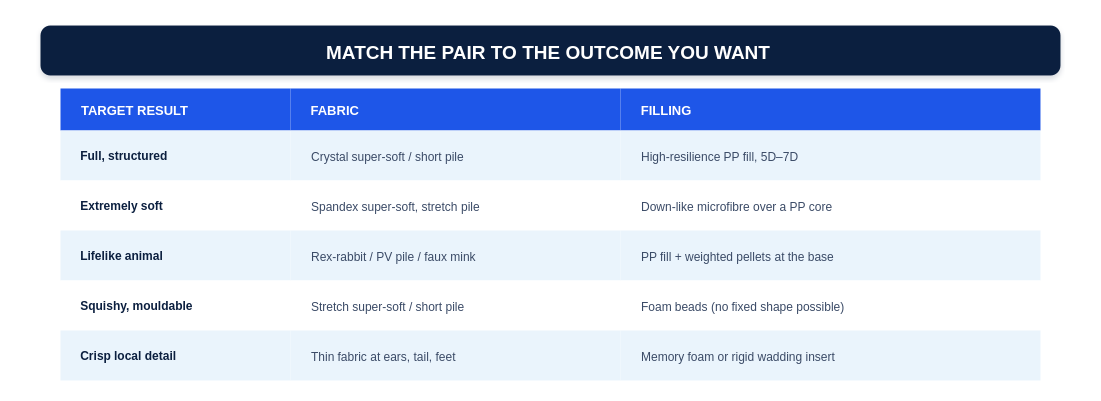
Buyers usually approach material selection as two separate shopping lists: pick a fabric, then pick a filling. That order produces disappointing samples, because the two interact. A stretchy fabric over a soft filling sags. A long-pile fabric buries the fine embroidery you paid for. A firm filling inside a thin shell shows every seam.
The more reliable approach is to name the outcome first. Five targets cover most projects:
Full and structured. The classic character plush that sits up and springs back. Crystal super-soft or standard short pile over high-resilience PP fill. This combination accounts for most plush toys on the market, and for good reason — it is predictable, affordable and photographs well.
Extremely soft. The cloud-like, sink-into-it feel. Spandex super-soft or down-effect fabric over down-like microfibre. Be aware of the trade-off: this filling has weak support, so the toy will not stand, and loft degrades faster than PP fill. In practice a PP core with a down-like surface layer gives a better result than down-like fill throughout.
Lifelike animal. Rex-rabbit pile, PV pile or faux mink over PP fill, with weighted pellets at the base. The PP fill carries the body shape so the animal reads as muscular rather than limp; the base weight lets it sit or lie convincingly. For realistic cats and dogs, filling the head and limbs more firmly than the belly gets closer to real anatomy.
Squishy and mouldable. Stretch super-soft over foam beads. The beads flow, so the toy holds whatever shape you press it into. The limitation is absolute: foam beads cannot hold a designed silhouette, so this only works for beanbag and rounded forms. Beads also break down over time and shed powder.
Crisp local detail. Not a whole-body approach but a targeted one. A thin memory foam insert in an ear makes it stand up; rigid wadding under the feet keeps the base flat. The main body is filled normally — these inserts work alongside it, not instead of it.
Fabric: What Each One Costs and What It Does to Your Embroidery
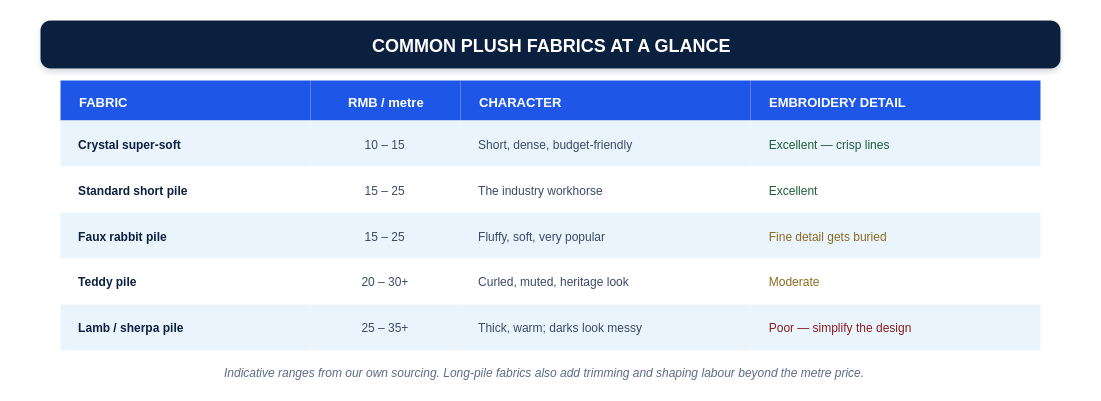
Fabric choice is usually framed around softness. For a B2B buyer, two other factors matter more, because they cost money later.
The first is embroidery clarity. Pile height and embroidery detail are in direct tension: short, dense fabrics hold crisp embroidered lines, while long or curly piles physically bury fine stitching. A design with delicate facial embroidery on a lamb-pile body will come back looking blurred, and no amount of sampling fixes it — the fabric is the constraint. Decide the fabric and the detail level together, or simplify the detail early.
The second is hidden labour. The metre price is not the whole cost. Long-pile fabrics require trimming and shaping work after stuffing that short piles do not, so the gap between a cheap fabric and an expensive one is wider in the finished unit than the fabric price suggests.
Our full range is on the fabric options → page. For the embroidery-versus-print decision specifically, pile height is the main technical constraint to raise with your factory.
Filling: The Cost Spread Is Larger Than Buyers Expect
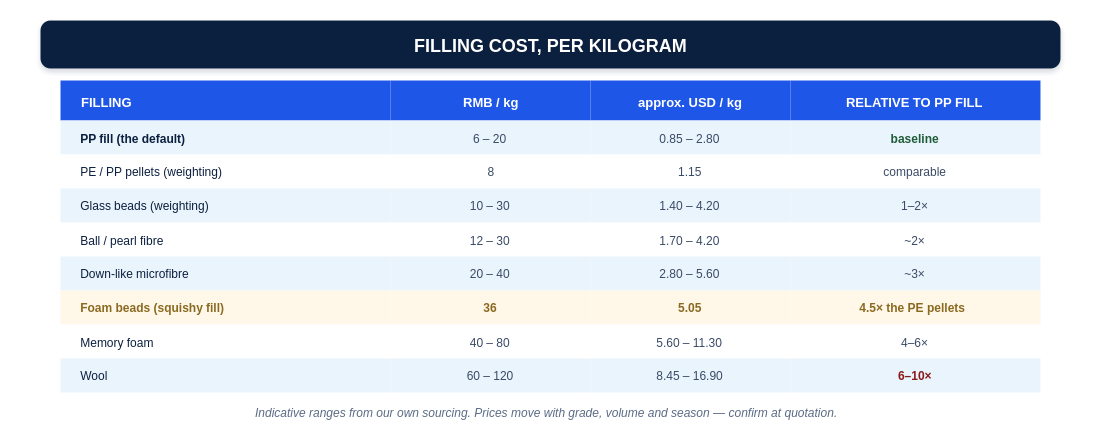
Filling is the part of the toy nobody sees and most buyers under-specify. The cost range is wide — roughly a twenty-fold spread between the cheapest PP fill and wool — which means the filling decision moves your unit cost more than most fabric decisions do.
Two figures in that table are worth flagging because they are counter-intuitive. Foam beads, used for squishy stress-relief plush, cost about four and a half times what PE pellets cost. Buyers often assume all beads are cheap because weighting pellets are cheap; they are different materials for different jobs at very different prices. And memory foam, used for local shaping, sits at four to six times PP fill — which is affordable precisely because you only use a small insert, and expensive if someone proposes filling a whole toy with it.
Fibre grade matters within PP fill too. Denier (D) describes fibre thickness. Around 3D to 7D covers most plush work: higher numbers are coarser and loftier with more support, so 5D–7D suits toys that need to hold structure, while 3D–5D gives a softer result. Hollow fibre is lighter and loftier — useful for large toys where shipping weight matters — while solid fibre feels denser and gives small toys a satisfying substance.
Fill ratio is a specification, not a judgement call. Stuffing a shell to roughly 70–80% of capacity leaves bounce and squeeze. Filling to 100% produces a firm, hard toy. Both are legitimate; what causes problems is leaving it unspecified, because then it varies between operators and between batches.
Layer the Filling Instead of Choosing One
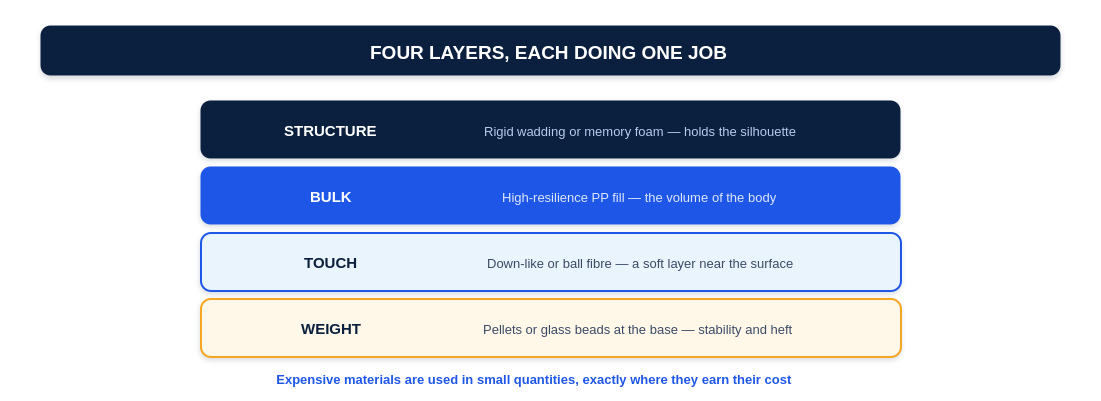
In production, few good plush toys use a single filling throughout. The mature approach is to assign each material to the job it does best, which controls cost and improves the result at the same time.
A structural layer of rigid wadding or memory foam holds the silhouette. A bulk layer of high-resilience PP fill provides the volume. A touch layer of down-like or ball fibre near the surface improves the hand-feel where hands actually make contact. A weight layer of pellets or glass beads at the base adds stability and heft.
The commercial logic is straightforward: the expensive materials are used in small quantities, exactly where a customer will notice them. A toy that is entirely PP fill feels like what it is. A toy that is mostly PP fill with a thin down-like surface layer feels considerably more premium, at a fraction of the cost of filling it with down-like fibre throughout.
A Warning About the Term “PP Cotton”
This is worth a short section because it causes real confusion in quotations.
“PP cotton” is used inconsistently across the industry. Some suppliers use it to mean polypropylene fibre. Others use it interchangeably with polyester fibrefill, on the reasoning that “PP” is shorthand and “cotton” simply describes the fluffy texture rather than the actual fibre. These are different polymers with different wash durability and different resilience behaviour.
This is not an academic distinction. If you specify “PP cotton” and two factories quote against it while meaning different materials, you are not comparing like with like. The practical fix is simple: write the specific polymer name into your specification rather than relying on the abbreviation, and ask any supplier to confirm in writing which fibre their “PP” refers to.
How to Specify Materials So You Get What You Expect
A material specification that prevents disputes covers six things: the exact fabric with pile height, the exact filling with polymer named rather than abbreviated, the fibre grade (denier) and whether hollow or solid, the fill ratio or a firmness reference sample, whether density varies by body part, and whether pellets are used and where.
The most reliable of these is the physical reference sample. Numbers on a specification sheet rarely translate to identical feel between factories, but an agreed physical sample that both sides hold is unambiguous. Written figures should support that sample, not replace it.
One habit worth adopting regardless: always confirm fabric colour from physical swatches rather than a screen. Screens misrepresent pile fabrics badly, and dye lots vary between batches.
Frequently Asked Questions
What are plush toys made of? Two main components: an outer pile fabric such as crystal super-soft, short pile, faux rabbit, teddy or lamb pile, and an interior filling, most commonly a polyester-type fibre fill. Many toys also use weighted pellets, and some use memory foam or rigid inserts for local shaping.
What is the cheapest plush filling? Standard PP fill, at roughly RMB 6–20 per kilogram in our sourcing. It is also the most widely used, because it balances cost, resilience and washability better than the alternatives for most applications.
Which fabric is best for detailed embroidery? Short, dense fabrics such as crystal super-soft or standard short pile. Long and curly piles physically obscure fine embroidered detail, so if your design has delicate facial features, the fabric choice constrains what is achievable.
Can I use a soft filling and still have the toy stand up? Not with soft filling alone — down-like microfibre has weak support and produces a toy that slumps. The workable approach is a PP fill core for structure with a soft surface layer for hand-feel, or firmer fill in the head and base with softer fill elsewhere.
Why does my sample feel different from the last batch? Usually fill ratio or fibre grade, not fabric. If neither was specified in writing, both can drift between production runs. Agreeing a firmness reference sample and a target fill weight prevents it.
Do filling materials affect safety testing? Yes. Filling materials are subject to the same chemical limits as the outer fabric, and weighted pellets must be contained in a sealed inner pouch with reinforced stitching to pass physical testing. Confirm requirements for your market with a testing laboratory.
Terminology Buyers Should Know
Term | What It Means |
Pile | The raised fibre surface of a plush fabric; pile height drives look and embroidery clarity |
PP fill | The default fibre filling. Note the term is used inconsistently — see the terminology warning below |
D (denier) | Fibre thickness. Higher D means coarser, loftier fibre with more support |
Hollow vs solid fibre | Hollow is lighter and loftier; solid feels denser and more substantial |
Foam beads | Free-flowing beads giving a mouldable, non-rebounding squish; cannot hold a fixed shape |
Weighted pellets | PE/PP pellets or glass beads in a sealed inner pouch, used for heft and stability |
Fill ratio | How full the shell is stuffed — roughly 70–80% gives bounce, 100% gives firmness |
A Note on Scope
Prices in this article are indicative ranges drawn from our own sourcing at the time of writing, converted to US dollars at an approximate rate for reference only. Material prices move with grade, order volume, season and supplier, and the figures here are intended to show relative cost relationships rather than to serve as a quotation. Confirm current pricing for your specific project. Safety and compliance requirements for materials are separate from the selection guidance here and depend on your target market and age grade.
Not Sure Which Pairing Fits Your Design?
Send us your artwork and tell us the feel you’re after — structured, cloud-soft, lifelike, or squishy. We’ll recommend a fabric and filling combination, flag anything in the design that the fabric will fight against, and send physical swatches before sampling begins.