
Custom Plush Toy Meaning: A Beginner’s Guide
New to sourcing plush toys? This guide untangles the everyday words — plush, plushie, stuffed animal, soft toy — and explains simply what changes when the word “custom” gets added.
Updated August 2026 · Beginner’s glossary guide
“Custom plush toy” simply means a soft, stuffed toy — made from pile fabric and filling — that’s built from a design belonging to one buyer, rather than picked from an existing catalog.
Direct answer: “Plush” describes the fabric and the product category; “custom” describes who owns the design behind it. Put them together and you get a soft toy built specifically for one brand or buyer.
Custom Plush Toy Meaning — TL;DR: The words plush, plushie, stuffed animal, and soft toy all describe roughly the same category of product, with regional and formality differences; adding “custom” simply means the design is exclusive to one buyer.
Scope: This is a beginner-level terminology guide. If you’re sourcing plush toys for your business and want the full breakdown of MOQ, sampling, and buyer considerations, see our complete guide,
linked at What Is a Custom Plush Toy? →, which goes much deeper than this glossary-style introduction.
Plush, Plushie, Stuffed Animal, Soft Toy — Are They the Same Thing?
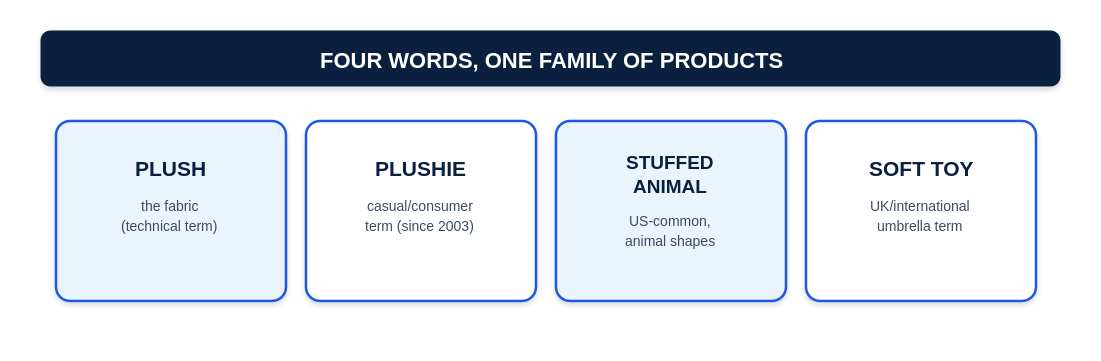
Mostly yes, with some regional and formality differences worth knowing if you’re new to the space:
Plush is technically the name of the fabric — a pile textile softer and longer than velvet. In everyday use, it’s also shorthand for the finished toy.
Plushie is the casual, consumer-facing version of the word. It’s newer than you might think — dictionaries date its use in the “soft toy” sense to around 2003, tied closely to online fan and collector communities.
Stuffed animal is the most common term in the United States, though it technically implies an animal shape — a plush toy shaped like a robot or a plain cube is still a plush toy, just not, strictly speaking, a stuffed animal.
Soft toy is the broader umbrella term used more often in the UK and in international trade documentation — it covers any shape, animal or otherwise.
For most everyday purposes, these words are interchangeable. But if you’re reading a supplier contract or a customs document, “soft toy” is the term most likely to appear as the formal product category.
So What Does “Custom” Add to the Meaning?
Adding “custom” doesn’t change what the product physically is — it changes who owns the design behind it. A custom plush toy is built from a pattern developed specifically for one buyer, rather than selected from a factory’s existing catalog. That’s the short version; the difference shows up in practical terms like minimum order quantity, sampling, and price, which this glossary-level guide won’t cover in depth.
If you’re actually sourcing for your business, our full buyer’s guide → breaks “custom” down into a 3-layer model (physical, commercial, and procurement definitions) and covers OEM vs ODM, MOQ ranges, and a buyer checklist.
Where Does the Word “Plush” Come From?
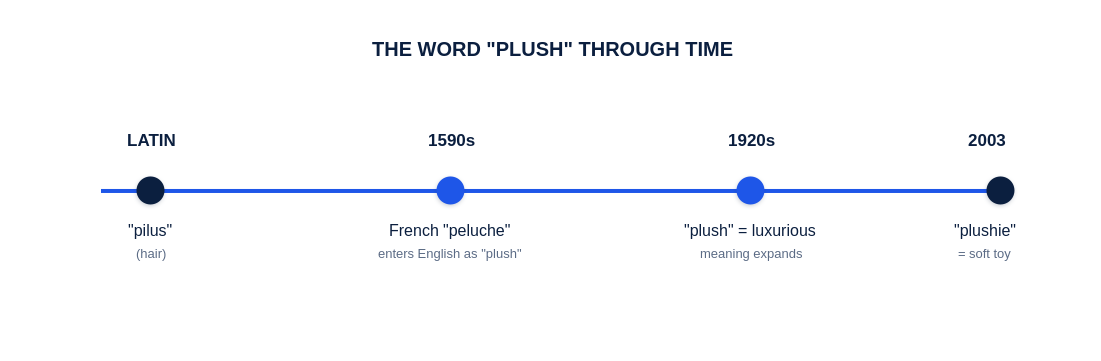
The word has a longer history than most people expect. “Plush” entered English in the 1590s from the French word for a hairy, shaggy fabric, which itself traces back to the Latin word for “hair.” The fabric sense — a pile textile softer and longer than velvet — is the original meaning, and it’s still the technical definition used in textile and manufacturing contexts today.
The word picked up a second meaning in the 1920s, when “plush” started being used to describe anything luxurious — a plush hotel room, a plush apartment — a sense that persists in everyday English independent of the toy industry. The specific use of “plushie” to mean a soft toy is a much more recent development, entering common usage in the early 2000s.
Common Beginner Mix-Ups
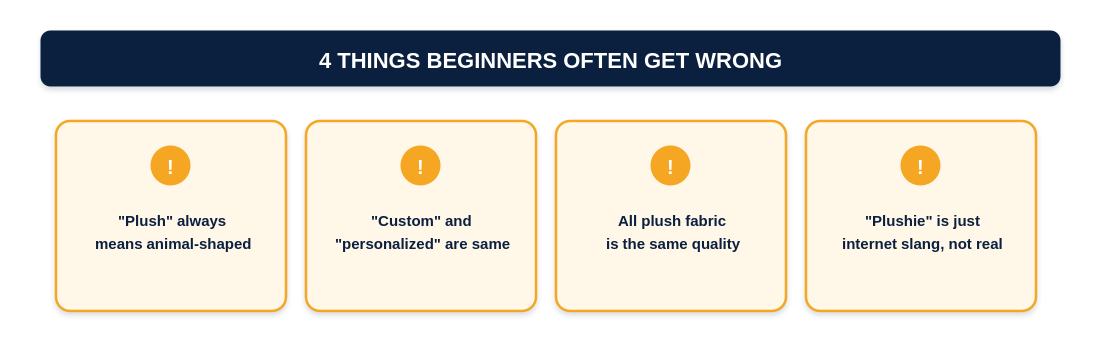
“Plush always means animal-shaped.” Not necessarily — the word describes the fabric and construction, not the subject. A plush toy can be shaped like a robot, a food item, or an abstract mascot.
“Custom and personalized mean the same thing.” Not quite — “personalized” often just means adding a name or logo to an existing stock design, while “custom” implies the pattern and shape itself were developed for one buyer. It’s worth asking a supplier which one they’re actually offering.
“All plush fabric is the same quality.” Pile height, density, and fiber type vary widely and affect both hand-feel and durability — “plush” is a category, not a single quality grade.
“Plushie is just internet slang, not a real word.” It’s informal, but it’s a documented English word with its own dictionary entry and a traceable history — it’s simply newer than “plush” itself.
A Quick Glossary
Term | What It Means |
Plush | The pile fabric itself — the technical/industry term for the material |
Plushie | Informal, consumer-facing word for a plush toy; entered common use around 2003 |
Common U.S. term, technically implies an animal shape (though used loosely) | |
Soft toy | Broader umbrella term, common in the UK and international trade, covers any shape |
Custom | Built from a design/pattern developed specifically for one buyer, not pulled from stock |
Frequently Asked Questions
Is a plushie the same as a stuffed animal? In everyday use, yes — the words are typically interchangeable. “Stuffed animal” technically implies an animal shape, while “plushie” doesn’t.
What’s the difference between plush and velvet? Both are pile fabrics, but plush has a longer, softer nap than velvet — it’s part of why plush is comfortable for toys while velvet is more associated with upholstery and formal fabric.
Does “custom” always mean more expensive? Usually, yes, relative to stock designs — but the extent depends on how much of the pattern is built from scratch versus adapted from an existing base, a distinction covered in our full buyer’s guide.
Is this guide useful if I’m buying for personal use rather than a business? Yes — the terminology section applies either way. The buyer-checklist and MOQ content in our full guide is more relevant if you’re sourcing at business volume.
A Note on Scope
This article is a plain-language introduction to plush toy terminology. It is not a sourcing or compliance guide — for the buyer-side considerations (MOQ, sampling, safety compliance), see our full guide linked above and our dedicated compliance page.
References & Sources
1. Online Etymology Dictionary — Etymology of “plush”
2. Merriam-Webster — Plush: Definition & Etymology
Want the Full Buyer’s Guide?
If you’re sourcing custom plush toys for your business, our complete guide covers materials, MOQ, production models, and what to confirm before sampling.