

Custom Claw Machine Plush Toys:
A Buyer’s Guide for Arcade and Crane Game Operators
Last reviewed: September 2026 | Audience: arcade owners, claw machine operators, vending and prize crane businesses, and event/carnival buyers | Reading time: ~17 min
An arcade owner or claw machine operator gets back one flawless plush sample — perfect shape, soft fabric, exactly the character they pictured — and treats that as proof the bulk order will perform the same way inside a real machine. It won’t necessarily. A single sample only proves a factory can build one good-looking plush by hand. It says nothing about whether the other thousands of units in the batch will hold the same weight and shape tolerance a claw actually needs, whether a single-character order will keep players interested past the first few weeks, whether every unit will actually carry the safety and tracking documentation a US or EU venue is legally required to have, or whether the whole shipment will still look appealing after being vacuum-compressed for freight.
This guide walks through those four questions — Fit, Variety, Compliance, and Logistics — using the real, published technical specifications and production workflow from a factory that manufactures plush specifically for commercial claw machines and crane games, plus general sourcing context on toy safety certification and compressed soft-goods packaging. It’s built to help an arcade or vending operator judge a specific factory’s claims against what actually keeps a claw machine profitable, rather than judging the whole order on one nice sample.

The Four-Part Claw Machine Order Question
Instead of judging a factory by its sample alone, asking these four questions separately identifies what actually determines whether a claw machine plush order performs once it’s loaded into a real machine.
1. Fit Question. Will the bulk batch actually match the size and weight tolerance a claw machine needs — no jamming, no bridging, no claws that can’t get a grip — or does quality drift once volume goes up?
2. Variety Question. Will a mixed, multi-character assortment actually keep machine displays fresh and players coming back, or is the order locked into a single design that goes stale within weeks?
3. Compliance Question. Does every unit actually carry the sewn-in tracking labels and safety certifications a US or EU venue needs to clear customs and pass a safety audit, or is “compliant” just a claim with nothing behind it?
4. Logistics Question. Will the shipment actually arrive looking full and sellable after vacuum-compression freight, or does cutting shipping costs come at the expense of how the prizes look on day one?
A factory that shows off one flawless sample but never gets asked about the other three questions is being judged on a fraction of what actually decides whether the order is profitable.

Why a Great Prototype Doesn’t Answer These Four Questions
Most buyers treat one approved sample as proof the whole order will perform, without asking which of the four questions it actually answers.
A sample is one unit, hand-checked. A machine sees thousands, unsorted. A single prototype tested by hand in a showroom says nothing about whether a full production run holds the same weight and dimension tolerance a claw actually needs to get a fair, repeatable grip.
A single character doesn’t test a revenue program. One great-looking design proves the factory can execute a character well — it says nothing about whether that factory can actually deliver a rotating, pre-mixed assortment that keeps a machine’s display looking fresh.
A sample rarely comes with its own paperwork. A showroom or trade-fair sample is not the same as a sewn-in tracking label with batch codes and certification stamps on every unit in a shipping container — compliance has to be verified at the batch level, not assumed from one unit.
A sample was never vacuum-compressed for freight. The unit a buyer holds and approves typically wasn’t shipped the way the bulk order actually will be — vacuum-compression packaging is a separate variable that only shows up once the real shipment arrives.
Because a great sample can coexist with any of these four problems, checking each one separately — rather than treating one flawless unit as the whole verdict — is what actually protects a claw machine operator’s order.

Fit: Will It Actually Work in Your Machine?
Jamming and bridging are the most common, most expensive failure a claw machine operator runs into — and they trace back almost entirely to shape and weight tolerance, not luck.
Why Off-Spec Plush Jams a Machine
— Irregular shapes are the primary cause. A plush toy with protruding limbs or an inconsistent bulk silhouette is what gets wedged in a drop chute or bridges across the display grid, triggering machine errors and frustrating players before a single claw ever drops.
— Weight matters as much as shape. A toy that’s too light lets a claw “cheat-grab” it too easily, throwing off a machine’s payout ratio; a toy that’s inconsistent in weight across a batch makes it impossible to calibrate claw strength predictably.
— The industry’s own trade body focuses on conduct and safety compliance, not dimensional specs. The American Amusement Machine Association (AAMA), the recognized US trade association for coin-operated amusement equipment, asks its members to commit to meeting applicable safety standards and codes — but it doesn’t publish its own claw-machine dimensional specifications. That means fit tolerance is something a buyer has to verify directly with a manufacturer, not something a general industry standard guarantees.
— Testing in an actual chute, not just a showroom, is the real check. Whether a factory tests drop velocity and grip behavior in a real crane chute before bulk production — rather than just confirming a sample looks right by hand — is a fair, specific question that separates a factory that engineers for machine compatibility from one that just sews toys.

A calibrated weight and an anti-wedge silhouette are what let a claw actually get a predictable, repeatable grip.
None of this is visible from a single sample — it only becomes clear when a buyer asks specifically how shape and weight consistency are controlled once a batch scales to thousands of units.

Variety: Will It Actually Keep Making Money?
A claw machine’s revenue depends on players wanting to keep inserting coins — and a display that never changes is one of the fastest ways to kill that interest.
Why a Single-Design Order Is a Revenue Risk
— A stale display is a real, ongoing cost, not just a merchandising preference. Local players who see the same single character in a machine for weeks stop finding it worth a try, and a machine’s coin-drop rate follows that disinterest down.
— A single large order of one design also concentrates inventory risk. Committing an entire bulk order to one character means there’s no way to rotate the display without buying an entirely new batch — the deadstock problem shows up the moment interest in that one design fades.
— A pre-mixed, multi-character program is the direct fix, and it’s a real question to ask a factory: can a single production run be split across several different characters, colors, or seasonal variants and packed pre-mixed into the shipping cartons, rather than delivered as one uniform batch.
— Weight parity across a mixed batch matters for fairness, not just variety. If different designs in the same mix carry noticeably different weights, players learn to target the “easy” ones, which skews a machine’s payout ratio away from what the operator configured.
Asking whether a factory can split one order across multiple designs — and whether it keeps the weight consistent across all of them — is what actually protects an operator’s long-term coin-drop revenue, not just the look of the first shipment.

Compliance: Is It Actually Legally Sellable in Your Market?
Running a prize machine without properly documented, compliant toys is a real legal and financial exposure for the operator, not just the factory that made them.
What Real Compliance Actually Requires
— The US and EU have separate, non-substitutable requirements. The US market requires compliance under CPSIA and ASTM F963 (the federal toy safety standard); the EU market requires CE marking. A toy compliant in one market isn’t automatically cleared for the other, and an operator running machines in both needs both.
— A tracking label is not the same as a compliance claim. A sewn-in fabric label carrying batch codes, material composition data, and the specific certification stamps is what actually lets a shipment clear customs and lets an operator produce documentation during a venue safety audit — a verbal or catalog claim of “compliant” isn’t the same thing.
— Verification should happen at the batch level. Because certifications and tracking data are tied to specific production batches, asking whether every unit in a shipment — not just a sample — carries this documentation is the real question, not whether the factory says it “can” do compliant production.
For an operator running machines across multiple countries, confirming which specific certifications travel with a given shipment is what actually prevents a customs hold or a failed venue audit — not a general assurance that the factory “does compliance.”

How This Factory Actually Builds Claw Machine Plush
For claw machine and crane game orders specifically, this factory engineers around the four questions above from the start — because a machine operator asking them is the norm, not the exception.
Who This Kind of Order Usually Comes From
| Operator Type | The Real Risk | How It’s Addressed |
|---|---|---|
| Arcade owners & entertainment centers | A single-style display that local players get bored of within weeks, crashing replay rates | Pre-mixed, multi-character assorted cartons to keep machine displays fresh without deadstock |
| Dedicated claw machine stores | Slippery plush fabrics that prevent the claw from building grip, frustrating players into walking away | High-traction crystal super-soft velvet that maximizes claw friction for a predictable payout ratio |
| Vending & prize crane operators | Off-size plush jamming drop chutes, or ultra-light items that let a claw cheat-grab them | Calibrated 120g-150g weight profiles built into a strict 7-9 inch anti-wedge template |
| Carnivals, fairs & outdoor events | Oversized cargo boxes that spike transit costs, plus uncertified toys that fail legal safety audits | 50% volume vacuum compression packaging for compact storage, with sewn-in CE, CPSIA, and ASTM tags |
| Brands & promotional campaigns | Distorted character faces and peeling logo prints that violate IP guidelines and harm brand reputation | Exact Pantone color dye-matching paired with tight ≤0.5mm industrial appliqué embroidery |
Standard Crane Machine Plush: The Representative Spec
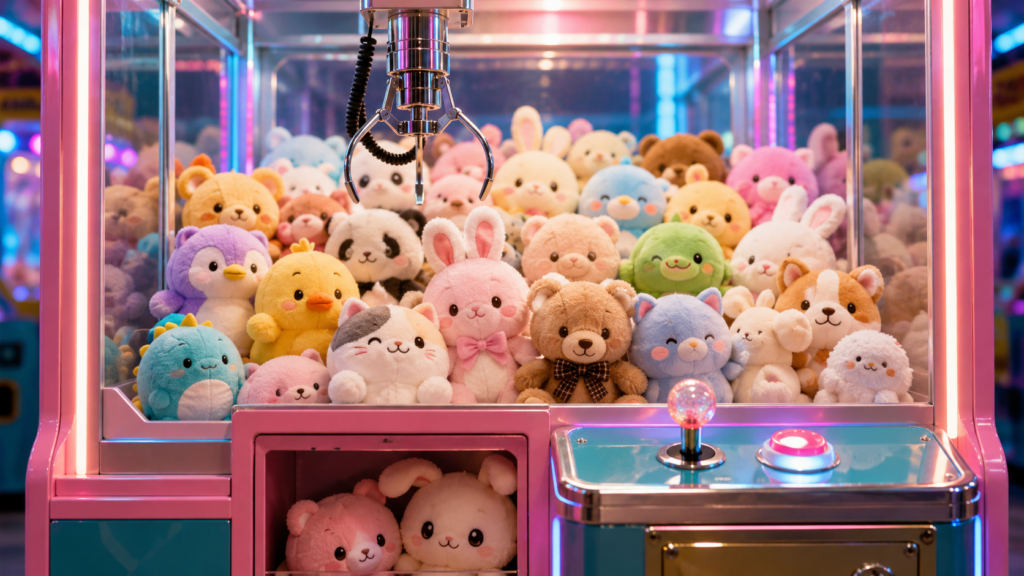
Claw machine plush is offered across several formats — standard, mini, jumbo, keychains, animal styles, seasonal styles, custom branded prizes, and pre-mixed assortments — each engineered for a different machine type. The 7-9 inch standard size, the most common for a typical medium crane machine, illustrates the level of engineering involved:
| Machine Integration Factor | Factory Manufacturing Benchmark (Standard 7-9in) |
|---|---|
| Optimized dimensions | A strict 18cm-23cm (7-9 inch) height profile, configured for standard medium-sized crane machine gantry claws with zero drop-chute sticking |
| Weight & gravity calibration | A calibrated 120g-150g range per unit, stuffed with 100% virgin 7D three-dimensional hollow polyester fiber to avoid center-of-gravity tilting or claw slippage |
| Fabric & grip texture | Heavy-duty, high-friction crystal super-soft velvet, chosen for optimal surface drag against steel claw tines for a predictable payout ratio |
| Label & tracking compliance | A sewn-in legal tracking label with batch codes, material data, and verified CE, ASTM F963, and CPSIA stamps for customs clearance |
| Bulk packaging & mix ratio | Multi-layer corrugated export cartons with interior moisture barriers, supporting up to 6 styles pre-mixed per box to keep machine clearing rates high |
The Crane-Ready Production Blueprint
1. Machine compatibility and gravity review (1-2 days). Before any sewing begins, the specific crane machine’s gantry specs, claw size, and drop-chute dimensions are reviewed, and the toy’s shape profile and center of gravity are configured around them — the goal is zero chute-jamming and zero bridging by design, not by luck.
2. Rapid prototyping and low-MOQ sign-off (5-7 days). A flat vector design or character sketch becomes a physical plush sample within about a week, with flexible adjustment rounds based on feedback — backed by a flexible MOQ of just 500 pieces, so an operator can test local player interest without heavy inventory commitment.
3. High-tensile assorted batch production (15-20 days). Bulk production runs on heavy-duty, high-friction minky velvet or crystal soft fleece built to withstand aggressive claw scratching, and a single production run can be split across 5 to 10 different characters pre-mixed directly into the shipping boxes.
4. Dual needle detection and legal tagging (integrated into production). Every plush passes through automated conveyor-belt needle detectors twice, catching metal fragments down to ≤1.0mm, and each unit is sewn with a compliant fabric tag carrying its tracking batch code and verified CE, ASTM F963, and CPSIA stamps.
5. Vacuum compression and bulk doorstep freight. Because the toys are stuffed exclusively with 100% virgin 7D hollow fiberfill, bulk cargo boxes can be vacuum-compressed to shrink shipping volume by up to 60%, cutting air or ocean freight costs, with delivery handled through full DDP doorstep logistics covering import customs and taxes.
Added together, phases one through three alone run roughly 21 to 29 days from the first machine-compatibility review to a finished bulk batch ready to ship — a range worth confirming against your own launch or event date, since logistics transit time on top of that isn’t a fixed number and depends on destination and shipping method.
Why Vacuum-Compressed Toys Don’t Arrive Flat
A fair concern with vacuum-compression freight: if a factory uses cheap, recycled scrap cotton fill, the compression process can permanently damage the inner fibers, leaving toys looking flat and lifeless when unboxed. Stuffing exclusively with 100% virgin 7D three-dimensional hollow polyester fiber avoids this — the material has real shape memory, so once the inner bags are opened at the destination, the toys snap back to a full, plump shape within about 60 seconds, ready to load into a machine. On master cartons specifically, this packaging typically reduces air/sea shipping volume by up to 50%.

Real shape memory from 100% virgin 7D hollow fiber is what lets a vacuum-compressed shipment arrive looking full, not flat.
The Assorted Mix Program
To address the Variety question directly: within a standard bulk production run, manufacturing can be split across 5 to 10 entirely different character designs, color variations, or seasonal outfits, packed pre-mixed directly into the shipping cartons. This lets an operator slash inventory overhead on any single design while keeping machine displays constantly rotating — rather than committing an entire order to one character that will eventually go stale.