
Custom Plush Toy Buying Guide:What to Consider Before You Place a Bulk Order
Last reviewed: August 2026 | Audience: Brand owners, promotional product buyers, corporate gifting buyers, retail buyers, e-commerce sellers, event/trade show organizers placing a first or repeat bulk custom plush order | Reading time: ~12 min
Quick Answer
A bulk custom plush order is a small manufacturing project, not a catalog reorder — every element (shape, fabric, fill, decoration, packaging) has to be specified and approved before production starts, and most factories set a minimum order quantity (MOQ) to make that setup cost economical.
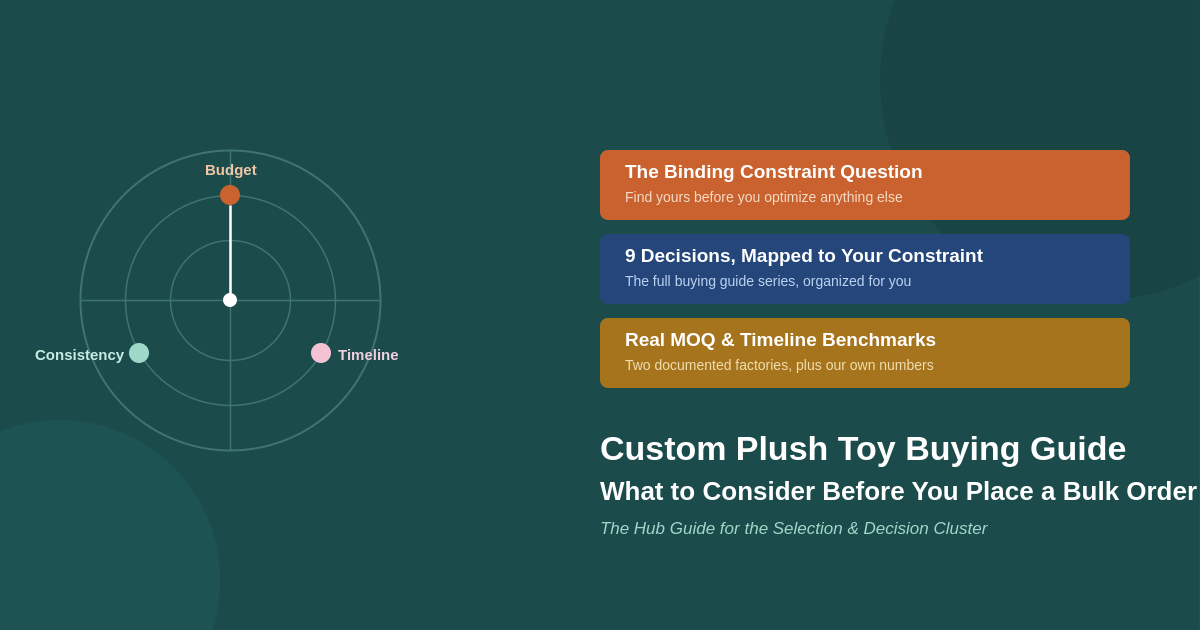
Before you optimize any single decision — size, MOQ tier, fabric, timeline — find your binding constraint first: is this order limited by budget, by a fixed deadline, or by the need for consistent quality across a large or recurring program?
That one answer determines which of the decisions in this guide (and the rest of this buying guide series) matter most for you, and in what order to tackle them.
What this article covers:
• What makes a bulk custom order fundamentally different from a one-off custom item
• The Binding Constraint Question — find yours before you read anything else
• The nine decisions you’ll make before production starts, mapped to your constraint
• Real benchmark numbers — MOQ, sampling timeline, and cost across two documented factories plus our own
• The sampling checkpoint every buyer should apply, regardless of profile
• Common first-order mistakes, and the one number-focused mistake that doesn’t show up until the goods arrive
• How to choose a factory for your first bulk custom plush order
What Makes a Bulk Custom Plush Order Different From a One-Off Custom Item
Ordering a custom plush toy in bulk is not the same activity as commissioning a single personalized stuffed animal, even though both start with “here’s my design.” A one-off custom item — the kind an individual might order as a keepsake or a one-of-a-kind gift — is typically handled as a single production run with no meaningful setup-cost problem to solve. A bulk order is different because it is, in every practical sense, a small manufacturing project: pattern creation, fabric sourcing, cutting templates, sample approval, and quality inspection all have to happen before a single sellable unit exists, and those fixed setup costs only make sense to absorb across a minimum number of units.
That’s the reason minimum order quantities exist at all. They aren’t an arbitrary gate — they reflect the real fact that a factory cutting a brand-new pattern and sourcing brand-new fabric for 20 units loses money doing it, while the same setup spread across 500 units is economical for both sides. Buyers coming from a print-on-demand or dropshipping mindset, where “order one to test” is normal, are often surprised that plush manufacturing doesn’t work that way — a single custom-designed plush is a different kind of request entirely from a bulk production run, and most manufacturers that specialize in bulk custom work will tell you so directly rather than trying to accommodate a single-unit order at bulk pricing.
Our factory’s real minimum is 500 units per design. Orders below that aren’t turned away, but the per-unit price increases to reflect the setup cost being spread across fewer pieces — the same underlying economics as a formal MOQ, just handled as a pricing adjustment rather than a hard cutoff. This is worth understanding as a general pattern before you request quotes: expect *some* form of MOQ-linked pricing behavior from any bulk custom plush manufacturer, even when it isn’t phrased as a strict minimum.

The Binding Constraint Question — Find Yours Before You Read the Rest of This Guide
Every buying guide in this space — including the strongest ones we reviewed while researching this article — presents the same information in the same order for every reader: design, then sampling, then MOQ and pricing, then compliance, then packaging. That’s a reasonable checklist, but it treats a startup testing a first product idea, an event organizer with a fixed trade show date, and a retail brand launching a five-character collection as if they have identical priorities. They don’t.
Before you work through any of the individual decisions in this buying guide series — size, MOQ tier, custom vs. semi-custom scope, fill firmness, timeline, collection structure, and so on — answer one question: what is actually the binding constraint on this specific order? In our experience, it’s almost always one of three:
— Budget-constrained. You’re a startup, a small e-commerce seller, or you’re testing a new product idea, and the MOQ and unit cost are the ceiling everything else has to fit under. Landed cost — including freight — often matters as much as unit price.
— Timeline-constrained. You have a fixed date — a trade show, a product launch, a corporate gifting deadline — and no amount of budget flexibility changes the fact that the goods must exist by a certain day. Speed sometimes has to win over full customization.
— Consistency-constrained. You’re a retail brand, an IP/licensing buyer, or you’re planning a multi-character collection or recurring reorders, and what matters most is that quality, color, and construction stay identical across a large batch — or across separate orders placed months apart.
A real example of budget-and-freight-constrained decision-making: one of our clients, based in India, wanted to minimize ocean freight cost on a large order. Rather than shipping fully finished, fully stuffed plush toys — which are bulky and expensive to ship by volume — they had us produce the custom-designed outer shells only, then had the toys filled locally in India after import. The finished design was still fully custom; what changed was where the highest-volume, lowest-value step (filling) happened, because freight cost was the actual binding constraint, not design flexibility or unit price.
That example is worth sitting with, because it illustrates the real point of this framework: the “right” answer to almost every decision in this guide changes depending on which constraint is actually binding. A timeline-constrained buyer facing that same freight-cost problem would probably just pay for air freight and fully finished units, because speed matters more to them than the savings. Neither buyer is wrong — they’re solving for different constraints.

The Nine Decisions You’ll Make Before Production Starts — Mapped to Your Constraint
Once you know your binding constraint, you can prioritize which of the following decisions to work through carefully and which to move through quickly. This buying guide is the hub for a full series — each row below links to a dedicated deep-dive.
Decision | What It Determines | Matters Most If You’re… |
|---|---|---|
Unit cost, whether custom-dyed fabric is even accessible to you | Budget-constrained | |
Material cost, shipping weight/cost, sewing complexity | Budget- or timeline-constrained (freight) | |
Design origination cost and timeline | Budget- or timeline-constrained | |
How fast you can realistically launch | Timeline-constrained | |
Whether your delivery date is even achievable | Timeline-constrained | |
Feel/positioning consistency across units | Consistency-constrained | |
Per-unit cost and sampling revision risk | Budget-constrained | |
Whether you need repeatable specs across future SKUs | Consistency-constrained | |
Whether your factory can quote and build accurately at all | All three — this one isn’t optional |
The last row is deliberate: a complete tech pack is the one decision every buyer has to get right, regardless of constraint, because an incomplete or vague one produces guesswork no matter which of the other trade-offs you make correctly.
Real Benchmark Numbers — MOQ, Sampling Timeline, and Cost Across Two Documented Factories Plus Our Own
Numbers vary by factory, so treat the table below as a directional benchmark, not a universal standard. It combines two independently documented competitor processes with our own factory’s real figures, side by side — a comparison none of the sources individually provide.
Metric | Factory A (documented) | Factory B (documented) | Our Factory |
|---|---|---|---|
MOQ | 100–500 units, varies by complexity | 100 units min; ~500 is the “sweet spot” | 500 units firm minimum |
Below-MOQ policy | Not specified | Accepted at higher per-unit price | Accepted at higher per-unit price |
Sample/prototype timeline | 2–4 weeks | 10–15 days for first version | Confirm directly — varies by complexity |
Typical revision rounds | 1–2 rounds normal | Up to 3 free; ~50% approved 1st round | Confirm directly |
Bulk production lead time | 30–75 days after approval | 25–35 days normal | Confirm directly |
Sample fee refund | Not specified | Refundable at 1,000–2,000 units | Confirm directly |
What this tells you: our own factory’s MOQ (500 units, firm) sits at the higher end of what’s documented elsewhere — one competitor explicitly offers a lower 100-unit tier for buyers testing an idea, which we don’t. That’s a genuine difference worth knowing before you request a quote, not something we’re going to paper over: if your binding constraint is budget and your target quantity is well under 500 units, ask directly whether the below-MOQ pricing adjustment still works for your volume, rather than assuming every plush factory prices small orders the same way.
The Sampling Checkpoint That Applies to Every Buyer, Regardless of Profile
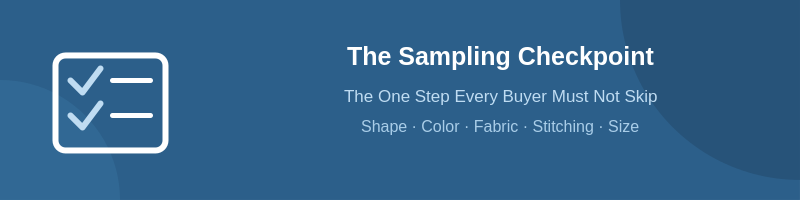
No matter which constraint is binding for your order, one step is non-negotiable: approving a physical sample before bulk production starts. This is where our guide agrees completely with every credible source we reviewed — skipping or rushing this step is the single most common way a bulk order goes wrong.
When your sample arrives, check it against these five points:
— Shape and proportions — does it match your reference art from front, side, and back?
— Color — does it match your reference under normal light, not just under a phone screen or studio photo?
— Fabric and feel — is the material what you expected, not just what was described?
— Stitching and finish — are seams tight and consistent, with no loose threads or rough edges?
— Size — does it match the height and proportions you specified?
Revision norms vary — one documented factory treats one to two rounds as typical, another offers up to three free rounds and reports that roughly half of samples are approved on the very first version, with most finalized by the second. Neither number is universal, so confirm your own factory’s revision policy in writing before development starts.
Approve your sample in writing, and keep the physical approved sample if you can — it becomes the quality benchmark your bulk production run is measured against, and it’s the reference point if a dispute comes up later.
Common First-Order Mistakes — and the One That Doesn’t Show Up Until the Goods Arrive
The most frequently documented first-order mistakes across the sources we reviewed cluster around a handful of patterns: underestimating lead times, providing incomplete or low-resolution design references, skipping the physical sampling step to save time or money, overlooking compliance testing requirements, and — the most common one — focusing on unit price while ignoring the full landed cost picture (sampling fees, tooling, freight, duties, and testing).
That last one deserves its own emphasis, because it’s the mistake our own production team sees most often too.
From our production floor: some customers evaluate a quote purely on price, without accounting for the fact that on a genuinely high-quality plush toy, every single step of the process — pattern precision, stitching density, fill consistency, finishing — represents real cost. Skip the quality control built into those steps to chase a lower quote, and the result very often falls well short of what you expected. There’s a saying in China for this: “一分钱一分货” — roughly, “what you pay is what you get.” It applies here as directly as anywhere.
A few red flags are worth watching for regardless of which factory you’re evaluating: a price that balloons with surprise charges after you’ve committed, reluctance to produce or show a physical sample, replies that slow down or stop once you start asking detailed questions, and pressure to commit to a much larger volume than you asked about with no clear explanation. None of these are automatically disqualifying on their own, but more than one together is a real signal to slow down before you commit.
How to Choose a Factory for Your First Bulk Custom Plush Order
Which questions matter most still depends on your binding constraint from H2-2 — use whichever set applies to you.
If you’re budget-constrained: Ask for below-MOQ pricing in writing before you assume it exists. Ask whether custom-dyed fabric colors are accessible at your target quantity, or whether you’ll be matched to existing swatches instead (this is common below roughly 2,000 units and isn’t a red flag — it’s a real cost threshold). Get an itemized quote, not a single bundled number, so you can see what sampling, tooling, and testing actually cost separately from the unit price.
If you’re timeline-constrained: Ask for a real production timeline broken into stages — design confirmation, sampling, bulk production, shipping — not a single “8 to 12 weeks” estimate. Ask what happens to your timeline if a revision round is needed. Ask directly whether an in-stock blank or semi-custom path could meet your date if a fully custom timeline can’t.
If you’re consistency-constrained: Ask how the factory controls dye-lot and material consistency across a large batch, and — if you’ll be reordering later — across separate production runs placed months apart. Ask to see evidence of past multi-SKU or collection work, not just single-product samples.
Regardless of your constraint, look for a factory that reviews your brief and flags ambiguity before quoting rather than after, that won’t skip the sampling step, and that gives you a real answer about MOQ and pricing rather than a vague “it depends” with no numbers attached.
Frequently Asked Questions
What’s the difference between ordering a custom plush toy and ordering a bulk custom plush toy?
A single custom plush is typically a one-off production run. A bulk order is a small manufacturing project — pattern creation, fabric sourcing, sampling, and quality inspection all happen before any sellable unit exists, which is why bulk manufacturers set a minimum order quantity (MOQ) to make that setup cost economical.
What is a typical MOQ for custom plush toys?
It varies by factory — documented examples range from a 100-unit entry tier up to a firm 500-unit minimum. Some factories accept orders below their stated MOQ at a higher per-unit price rather than declining them outright. Always confirm the specific policy with your factory rather than assuming a number.
How do I know which decision to focus on first when planning a bulk custom plush order?
Identify your binding constraint first: is this order limited mainly by budget, by a fixed deadline, or by the need for consistent quality across a large or recurring program? That answer determines which of the decisions in this guide — size, MOQ tier, timeline, collection structure, and the rest — deserve the most attention for your specific order.
How long does a bulk custom plush toy order take from start to finish?
This varies by factory and design complexity, but documented ranges suggest roughly 8–14 weeks total from initial brief to finished goods, including sampling, revisions, bulk production, and shipping. Confirm a stage-by-stage timeline with your factory rather than relying on a single overall estimate.
What’s the most common mistake first-time bulk plush buyers make?
Focusing on unit price alone, without accounting for the full landed cost (sampling fees, tooling, freight, duties, testing) or for the fact that quality control at every production step has a real cost. The second most common mistake is skipping or rushing the physical sample approval step.
Can I reduce my MOQ by combining multiple designs into one order?
Some buyers do this to meet a factory’s MOQ threshold more efficiently, though it depends on whether the factory calculates MOQ per design or per order. Ask directly rather than assuming — this varies by factory.
Glossary
Term | Definition |
|---|---|
The Binding Constraint Question | This article’s framework: identify whether your order is primarily limited by budget, timeline, or consistency-at-scale before prioritizing any other sourcing decision |
MOQ (Minimum Order Quantity) | The smallest number of units a factory will produce for one design, reflecting the fixed setup cost (pattern-making, fabric sourcing, tooling) that has to be spread across the order |
Landed cost | The total cost of a product delivered to its destination, including unit price, sampling fees, tooling, freight, duties, and testing — not unit price alone |
Sample / Prototype | The first physical, factory-built version of a design, used to approve shape, color, material, and construction before bulk production begins |
Disclaimer: This article describes bulk custom plush toy buying practices and benchmark figures as commonly documented and practiced as of August 2026; specific MOQs, timelines, and policies vary by factory — confirm your specific factory’s approach in writing before committing to an order. Nothing in this article constitutes a guarantee of any particular factory’s process, pricing, or turnaround time.
References
Ready to Place Your First Bulk Order?
Tell us your binding constraint — budget, timeline, or consistency — and we’ll walk you through exactly which of the decisions in this guide matter most for your order, starting with an honest quote at your real target quantity.
→ Request a Bulk Order Quote: CONTACT – Plush Toy Manufacturer|Customized plush toys
→ Related: What Is a Tech Pack in Plush Toy Manufacturing? | What Is a Plush Toy Prototype (Sculpt)?