
Plush Fabric Types: A Production Guide to Pile, Nap and Cost
The plush fabrics used in bulk soft toy manufacturing, what they cost, and the production factors — nap direction, dye lots, fabric consumption — that decide the real cost per toy.
Updated August 2026 · B2B sourcing guide
Plush fabric is a pile textile — a knitted base with a raised fibre surface. Which one you choose sets your hand-feel, your embroidery detail ceiling, and your fabric consumption, in that order of visibility and reverse order of cost impact.
Direct answer: Most bulk plush production runs on a small working set: crystal super-soft, standard short pile, faux rabbit pile, teddy pile, lamb pile, and PV long pile. Speciality fabrics exist above that tier and change perceived value more efficiently than added embroidery does.
Plush Fabric Types — TL;DR: Price per metre is the least reliable way to compare fabrics. Nap direction, fabric consumption and post-stuffing trimming labour move the finished unit cost more than the metre price does.
Scope: This article covers fabric selection for bulk manufacturing. For fillings and how fabric and filling pair together, see our
guide to plush toy materials →. Prices are indicative ranges from our own sourcing and move with grade, volume and season — confirm at quotation.
The Working Set: What Most Orders Actually Use
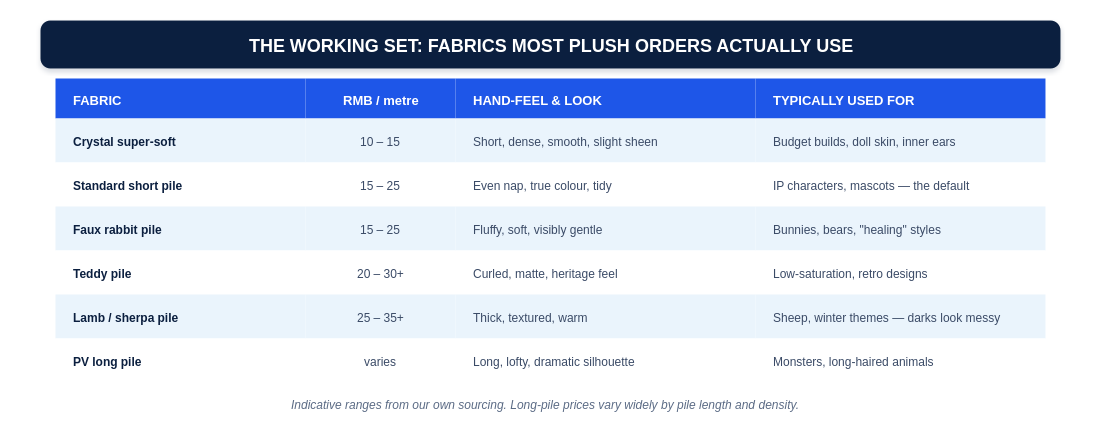
Fabric guides written for hobbyists tend to list cotton, felt, fleece and faux fur, because those are what a fabric shop stocks by the yard. Bulk manufacturing works from a different set, and the distinctions that matter are between pile types rather than between fibre families.
Crystal super-soft is the budget workhorse: short, dense, smooth, with good colour rendering. It holds embroidery detail cleanly and is often used for doll skin and inner ears even on toys made mainly from something else.
Standard short pile is the default for character work — even nap, accurate colour, tidy outlines. If a project has no specific reason to use something else, it usually ends up here.
Faux rabbit pile is fluffier and visibly gentle, popular for bunnies, bears and softer character styles. The trade-off appears as soon as you want fine facial detail.
Teddy pile has a curled, matte, slightly vintage character that suits low-saturation palettes and heritage designs.
Lamb or sherpa pile is thick and textured, natural for sheep and winter themes. Worth knowing: it looks visually messy in dark colours, so it is generally used in pale shades.
PV long pile gives dramatic loft and silhouette for monsters and long-haired animals, at the cost of significant post-stuffing trimming work.
Nap Direction: Why the Metre Price Misleads
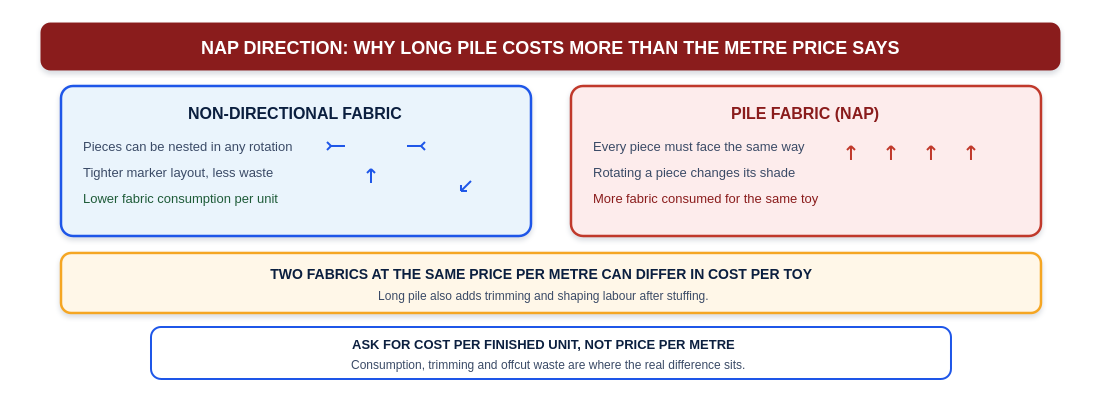
This is the production factor buyers most often miss, and it explains why two fabrics quoted at the same price per metre can produce meaningfully different unit costs.
Pile fabric has a nap — the fibres lie in one direction. Rotate a cut piece and the same fabric reads as a different shade, because the pile catches light differently. That means every pattern piece in a plush toy must be cut facing the same way, which constrains how tightly the pieces can be nested in the marker layout. Non-directional fabric can be nested in any rotation, wasting far less.
The consequence is straightforward: pile fabrics consume more fabric per toy than their metre price implies, and longer piles compound the effect. Long pile also adds trimming and shaping labour after stuffing that short pile does not need.
The practical fix is to stop comparing fabrics on metre price and ask instead for the cost per finished unit. A factory quoting properly will have accounted for consumption and offcut waste; if a supplier can only quote you a metre price, they haven’t done the layout.
Speciality Piles: When the Fabric Is the Selling Point
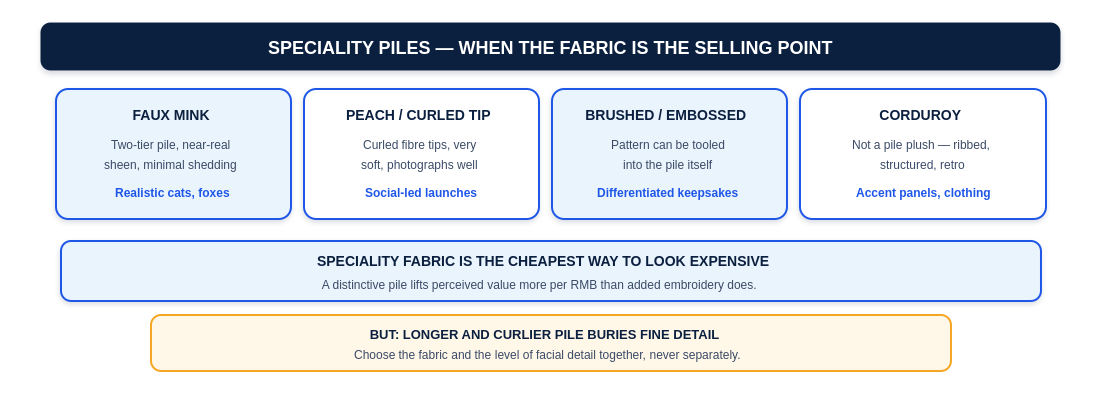
Above the working set sits a tier of fabrics chosen for differentiation rather than function.
Faux mink piles use a two-tier fibre structure that reads convincingly as real fur with minimal shedding, which is why they dominate realistic cat and fox designs. Peach-skin and curled-tip piles are extremely soft and photograph unusually well, making them common in social-media-led launches. Brushed and embossed piles allow a pattern to be tooled into the pile surface itself, which is genuinely difficult for a competitor to copy quickly. Corduroy is not a plush pile at all — it is ribbed and structured — but it works well as an accent panel or for doll clothing where you want the fabric to hold a shape.
The commercial logic is worth stating plainly: a distinctive fabric usually lifts perceived value more per RMB spent than adding embroidery does. Embroidery cost scales with stitch count; fabric upgrade cost scales with consumption, which is more predictable.
The constraint is the same one that runs through this whole category. Longer and curlier piles bury fine detail. Choose the fabric and the level of facial detail together, never in separate conversations.
Four Problems That Only Appear in Bulk
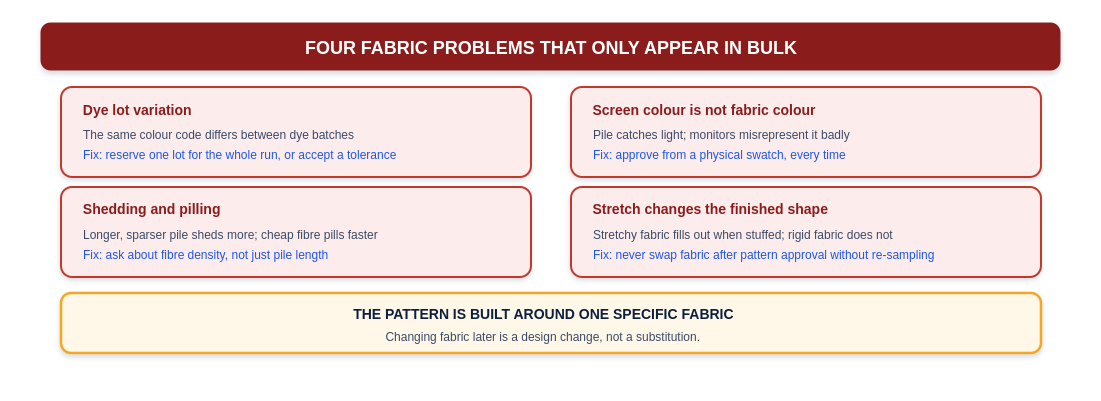
A sample uses one cut of one dye lot, handled by one person. Bulk production does not, and four fabric issues surface only at that scale.
Dye lot variation. The same colour code differs between dyeing batches. On a large run split across lots, that difference becomes visible when units sit side by side. Either reserve a single lot for the whole run or agree a tolerance in writing beforehand.
Screen colour is not fabric colour. Pile surfaces catch light in a way monitors cannot represent, and this is worse for plush than for flat fabric. Approve colour from a physical swatch every time, without exception.
Shedding and pilling. Longer and sparser piles shed more; lower-grade fibre pills faster under handling. Pile length alone doesn’t tell you this — ask about fibre density, which is what actually differs between a good and a poor version of the same fabric type.
Stretch changes the finished shape. Stretchy fabric fills out when stuffed, so two flat pieces can read as rounded; rigid fabric does not expand and shows the pattern exactly as drafted. This is why swapping fabric after pattern approval is a design change requiring re-sampling, not a simple substitution.
Choosing by Constraint, Not by Feel
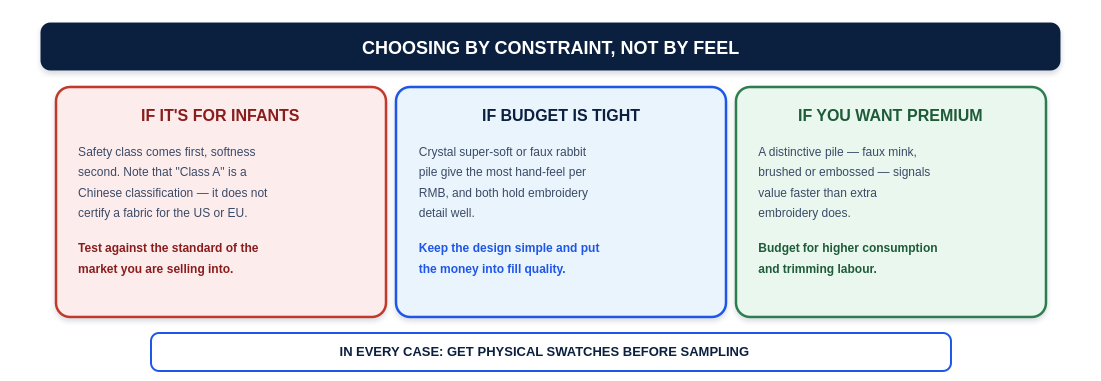
The most common mistake in fabric selection is starting from softness. Softness is easy to assess and rarely the binding constraint. Three situations show what to lead with instead.
For infant products, safety classification comes before hand-feel, and this is where exporters most often go wrong. Short, dense piles are the safer default simply because they shed less — but the classification question needs care.
Chinese factories commonly talk about “Class A” fabric. That refers to a Chinese national textile standard, under which Class A covers products for infants up to 36 months and sets limits on formaldehyde, pH, colourfastness, odour and azo dyes. It is a meaningful grade, and it is the right question to ask if you are selling into China.
What it is not is an export passport. The United States and the European Union have no equivalent “Class A” category. US children’s products are governed by lead and phthalate limits and, for toys, by ASTM F963; EU toys fall under the EN71 series, including EN71-3 for migration of certain elements. A fabric certified to the Chinese grade has not been tested against either. If a supplier answers a compliance question with “it’s Class A material,” that is a domestic-market answer to an export question.
The workable approach is to state your destination market and age grade up front, and have testing done against that market’s standard rather than inferring compliance from a fabric grade.
On a tight budget, crystal super-soft and faux rabbit pile give the most hand-feel per RMB, and both hold embroidery cleanly. Keep the design simple and put the saved money into filling quality, which affects how the toy feels in the hand more than most buyers expect.
For a premium position, a distinctive pile signals value faster than extra embroidery. Budget for the higher fabric consumption and the trimming labour that speciality piles bring with them.
In all three cases the same rule applies: get physical swatches before sampling begins. See our common fabric options → for the range we stock.
Frequently Asked Questions
What fabric is used for plush toys? Most bulk plush is made from knitted polyester pile fabrics — crystal super-soft, short pile, faux rabbit, teddy and lamb piles being the common working set. Cotton and felt appear mainly as accents rather than as the main body fabric.
What fabric are teddy bears made of? Traditionally mohair, but modern production almost always uses synthetic pile — teddy pile for a heritage look, or standard short pile for a cleaner, brighter finish. The choice mostly determines whether the bear reads as vintage or contemporary.
What is the softest plush fabric? Peach-skin and curled-tip piles are among the softest, and faux rabbit pile is soft with better durability. But the softest option is rarely the right one — softer, longer piles shed more and bury embroidered detail.
Why is my fabric a different colour from the sample? Almost always dye lot variation, or colour approved from a screen rather than a physical swatch. Both are preventable if raised before production.
Does fabric choice affect safety testing? Yes. Fabrics are subject to chemical limits, and shedding behaviour matters for younger age grades. Be careful with fabric grades quoted by suppliers: China’s Class A textile grade applies to the Chinese market and is not equivalent to US or EU toy requirements. Test against the standard of the market you are selling into.
Can I change fabric after the sample is approved? Not without re-sampling. The pattern is drafted around one fabric’s stretch and thickness, so a substitution changes the finished shape even when the colour and pile look identical.
Terminology Buyers Should Know
Term | What It Means |
Pile | The raised fibre surface of a plush fabric. Pile height is the single biggest driver of look, cost and detail feasibility |
Nap / nap direction | The direction the pile lies. Pile fabrics look different when rotated, so all pieces must be cut facing the same way |
Marker layout | The arrangement of pattern pieces on the fabric before cutting; nap restricts how tightly pieces can be nested |
Dye lot | A single dyeing batch. The same colour code can differ visibly between lots |
Knit vs woven | Knit fabrics stretch and resist fraying; woven fabrics hold shape but fray at cut edges |
Shedding | Loose fibre coming off the pile surface, more common with longer and sparser piles |
Fabric consumption | Metres of fabric needed per finished toy — the number that actually determines material cost |
A Note on Scope
Prices here are indicative ranges from our own sourcing at the time of writing and are intended to show relative cost relationships rather than serve as a quotation. Fabric naming is not standardised across the industry — the same commercial name can refer to slightly different constructions between suppliers, which is another reason to work from physical swatches rather than names alone. Safety and compliance requirements for textiles vary by market and age grade and should be confirmed with a qualified testing laboratory. In particular, a fabric grade issued under one country’s standard does not establish compliance in another.
References & Sources
1. U.S. Consumer Product Safety Commission — Toy Safety Business Guidance
2. European Commission — Toy Safety
3. Intertek — GB 18401-2010, China’s general safety code for textile products
Need Help Choosing?
Tell us the look you’re after and the age grade you’re designing for, and we’ll recommend a fabric, flag anything in your artwork the pile will fight against, and send physical swatches before sampling starts.