
OEM vs ODM Plush Toys Explained: Which Model Fits Your Project
The difference between OEM and ODM plush toys, the third option most guides leave out, and the questions that reveal which one you’re actually being quoted.
Updated August 2026 · B2B sourcing guide
OEM means you bring the design and the factory builds it. ODM means the factory brings the design and you brand it. But ODM itself splits into two very different arrangements, and that split matters more than the OEM/ODM distinction.
Direct answer: Ask who owns the pattern when the order is finished. In OEM it’s you. In non-exclusive ODM it’s the factory, and rivals can order the identical toy. In exclusive (bought-out) ODM you purchase the design outright and the factory can no longer use it.
OEM vs ODM Plush Toys — TL;DR: There are three models, not two. Exclusivity and originality are separate decisions, and bought-out ODM lets you buy exclusivity without paying for original development.
Scope: This article covers production models and design ownership. For what “custom” means generally and for MOQ ranges, see our complete guide,
linked at What Is a Custom Plush Toy? →. Commercial terms vary by factory and project — the arrangements described here reflect how we work and common industry practice, but confirm specifics with any supplier before committing.
Three Models, Not Two
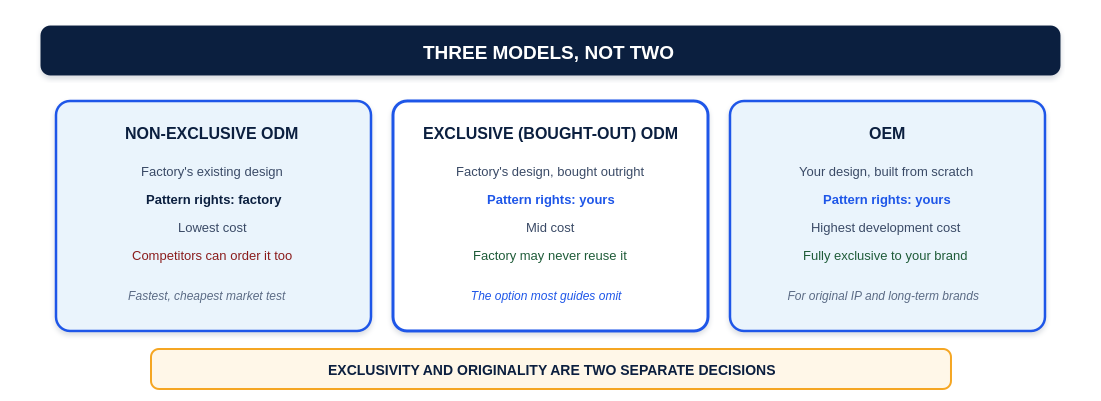
Nearly every guide on this subject presents a binary: OEM is expensive and exclusive, ODM is cheap and shared. That framing forces a false choice, because it treats exclusivity and originality as the same decision. They aren’t.
Non-exclusive ODM. You select an existing factory design and add your branding. The pattern rights stay with the factory, unit cost is lowest, and — this is the part buyers underestimate — a competitor can order the same toy from the same factory.
Exclusive, or bought-out, ODM. You start from a factory design but purchase it outright. The pattern becomes yours, the factory may no longer use it, and you skip the cost and time of developing an original character from scratch. Cost sits between the other two models.
OEM. You supply an original design and the factory builds it. Highest development cost and longest lead time, fully exclusive, and the right model when the character itself is the brand asset.
Framed this way, the decision becomes clearer. If you need exclusivity but don’t need originality, bought-out ODM gets you there without OEM’s development bill.
Side by Side
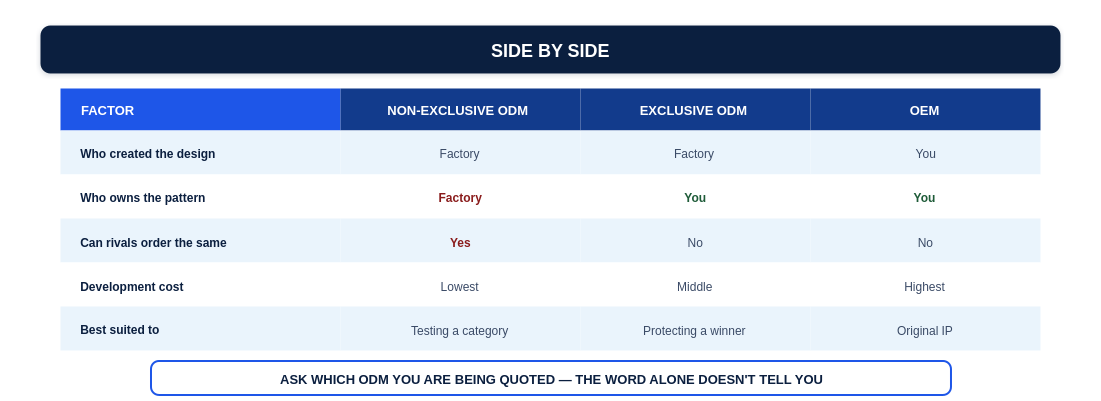
The comparison that actually matters isn’t cost — it’s what you hold at the end. Two of these three models leave you owning a pattern; one doesn’t. That single row changes what your options look like a year later.
It’s worth noting that “ODM” on a quotation tells you almost nothing on its own. The same word covers both the arrangement where you own nothing and the arrangement where you own everything, at meaningfully different prices. Asking which one you’re being quoted is not a difficult or awkward question, and any competent supplier will have a clear answer.
What Happens to the Pattern
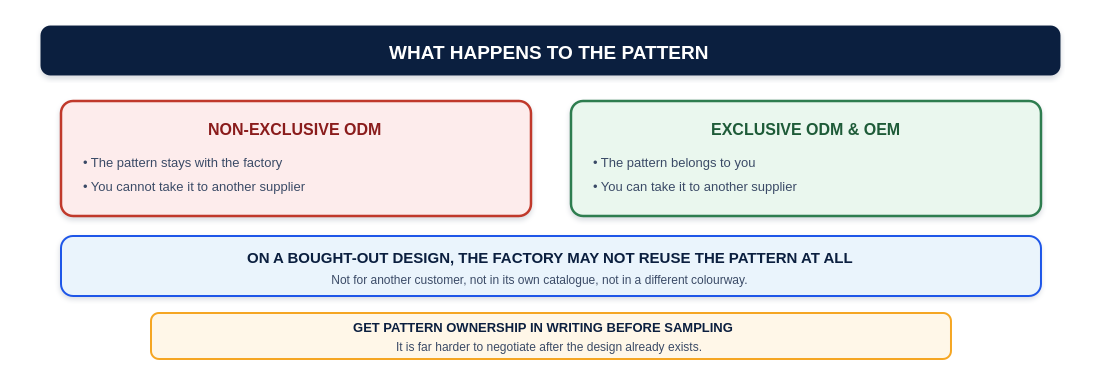
In plush manufacturing, the pattern is the asset. It’s the technical template that translates flat artwork into a stitched three-dimensional shape, and developing a good one is most of what you pay for in a custom project. Who holds it determines whether you have a product or merely an order.
Our own terms are straightforward on this point. On OEM projects and on bought-out ODM, the pattern belongs to the customer and can be taken to another supplier. On a bought-out design we do not reuse the pattern in any form afterwards — not for another customer, not in our own catalogue, not in a different colourway. On non-exclusive ODM the pattern remains ours, which is precisely why that option costs less.
The practical advice: settle pattern ownership in writing before sampling begins. Once a design exists and you’re invested in it, your negotiating position is considerably weaker than it was at the quotation stage.
Pattern development is also where most project risk sits. Our guide to how custom plush toys are designed and made → covers what that process involves.
Five Questions That Reveal Which Model You’re Buying
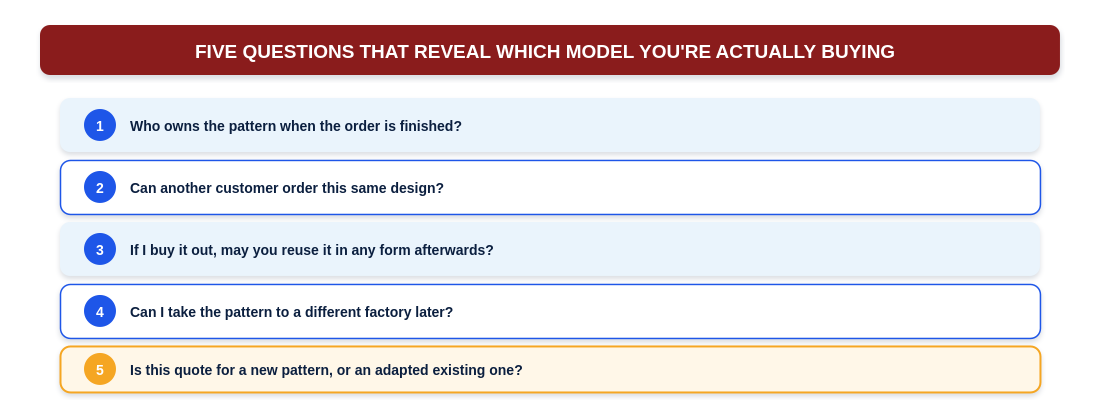
Because the terminology is used loosely across the industry, the reliable way to find out what you’re purchasing is to ask about the mechanics rather than the label. These five questions do that, and the answers should be specific rather than reassuring.
Question five is worth dwelling on. A quotation described as OEM but priced like ODM often means the factory intends to adapt an existing pattern rather than build a new one. That may be a perfectly good outcome — adapting a proven base is faster and cheaper — but you should know that’s what you’re getting, because it changes both what you own and how exclusive the result is.
A Staged Path That Lowers Risk
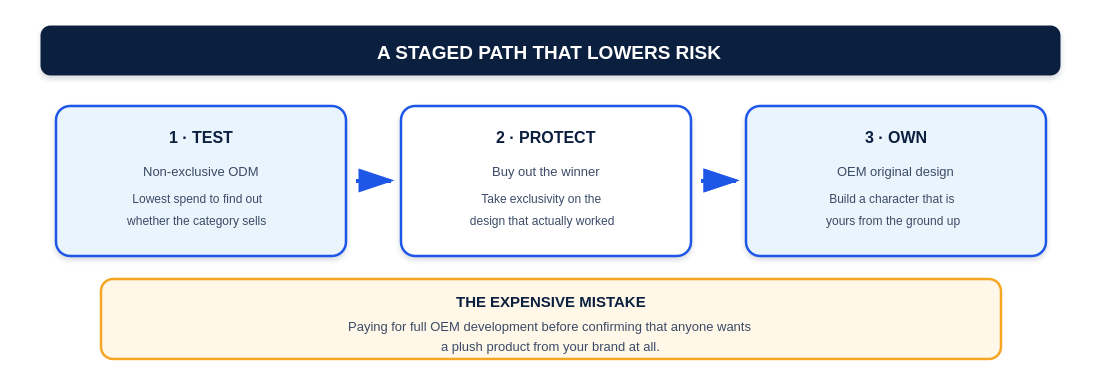
For brands entering the plush category for the first time, the three models work well as a sequence rather than a single choice.
Start with non-exclusive ODM to find out whether the category sells at all — lowest spend, fastest to market, and if the answer is no, you’ve learned it cheaply. If a design performs, buy it out to lock competitors out of the specific product that worked. Then, once the category is proven and you’re building a brand around a character rather than a product, move to OEM and develop something original that’s yours from the ground up.
The expensive mistake runs the other way: paying for full OEM development before confirming that anyone wants a plush product from your brand at all. Original character development is the right investment once demand is established, and a costly one before that.
Where Private Label Fits
One clarification, since these terms are often used as if they were alternatives. Private label describes a branding arrangement — your name on the product, the factory invisible to the end customer. It is independent of OEM and ODM, which describe who created the design. A private label product can be built under any of the three models above; the labels answer different questions.
Frequently Asked Questions
Is OEM always more expensive than ODM? Development cost is higher because a pattern is built from scratch. Whether the total is higher depends on volume and on whether the product sells — a cheaper unit price on stock that doesn’t move isn’t a saving.
Can a competitor really order the same toy I did? Under non-exclusive ODM, yes — the base design belongs to the factory. That’s the trade-off for the lower price, and it’s the main reason to consider buying the design out if the product performs.
What does “buying out” a design actually include? At minimum it should mean the pattern becomes yours and the factory stops using it entirely. Confirm the scope in writing, including whether any restriction applies by region or time — in our case a bought-out design is simply no longer available to us in any form.
Can I move my pattern to another factory? If you own it, yes. On OEM and bought-out ODM projects with us, the pattern belongs to the customer and can be taken elsewhere. On non-exclusive ODM it cannot, because it isn’t yours.
Can I start with ODM and switch to OEM later? Yes, and it’s a common path. A factory that has already produced for you understands your requirements and target market, which usually shortens the early sampling rounds on a subsequent OEM project.
Does the model affect safety testing? It can. An original OEM design generally needs testing in its own right. An ODM base design may have existing reports, but any material or component change you request can affect whether those still apply — confirm with your testing laboratory rather than assuming.
Terminology Buyers Should Know
Term | What It Means |
OEM | Original Equipment Manufacturer — you supply the design, the factory builds it |
ODM | Original Design Manufacturer — the factory supplies the base design, you brand it |
Non-exclusive ODM | The factory keeps the pattern rights; other buyers can order the same design |
Exclusive / bought-out ODM | You purchase the design outright; the factory may no longer use it |
Pattern | The technical template that turns artwork into a 3D stitched shape — the real asset in a plush project |
Private label | A branding layer: your name on the product, the factory invisible. Independent of OEM/ODM |
A Note on Scope
Commercial arrangements in plush manufacturing are not standardised, and the terms OEM and ODM are used differently across the industry. The three-model framework here reflects how we structure projects and what we see as common practice; other suppliers may define things differently, which is exactly why the five questions above are worth asking rather than assuming. Nothing here is legal advice — have any exclusivity or IP terms reviewed before signing. Safety and compliance obligations are separate from the production model and depend on your target market.
Not Sure Which Model Fits?
Tell us what stage you’re at — testing a category, protecting something that’s already selling, or building an original character — and we’ll tell you honestly which of the three makes sense, including when the cheaper option is the right one.