
What Is a Weighted Stuffed Animal?
Also called a weighted plush toy. A plain-language guide to what makes one weighted, how the weight is achieved, where it sits among sensory toys, what the evidence supports, and the safety lines B2B buyers need to know.
Updated August 2026 · Beginner’s glossary guide
A weighted stuffed animal is a soft toy filled so that it has deliberate, noticeable heft — designed to be held or draped rather than simply hugged. It is also commonly called a weighted plush toy or weighted plushie.
Direct answer: An ordinary stuffed animal is filled to be light and lofty. A weighted one adds a denser fill — usually plastic pellets or glass micro beads — to give the toy real weight in the hand.
What Is a Weighted Stuffed Animal? — TL;DR: The weight is the product. That makes fill choice, weight distribution, seam strength and age grading engineering decisions rather than afterthoughts — and it puts the category under closer safety scrutiny than standard plush.
Scope: This article explains what weighted plush toys are and what buyers should confirm before ordering. It is not medical advice and makes no therapeutic claims. Weighted products carry real safety considerations, particularly around young children — regulatory requirements differ by market and should be confirmed with a testing lab. For general production considerations, see our complete guide,
linked at What Is a Custom Plush Toy? →.
What Is a Weighted Stuffed Animal, Exactly?
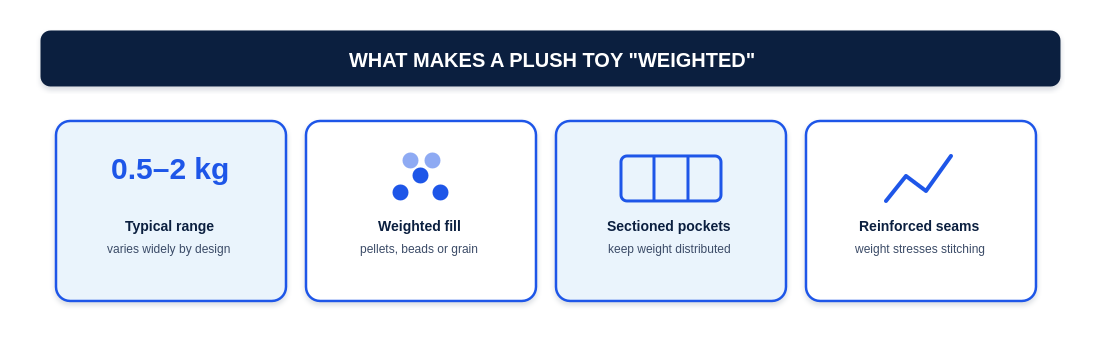
A weighted stuffed animal looks like an ordinary soft toy but is built to a different brief. Instead of being filled purely for loft and softness, part of the fill is replaced with a denser material so the finished toy carries deliberate weight. Products commonly fall somewhere between roughly half a kilogram and two kilograms, though the range varies widely with size, format and intended user.
That weight changes the engineering. Fill has to be held in sectioned pockets so it doesn’t migrate to one end, seams carry load that a standard plush never sees, and the closure and stitching specification matters far more than it would on a conventional toy.
How Is the Weight Actually Achieved?
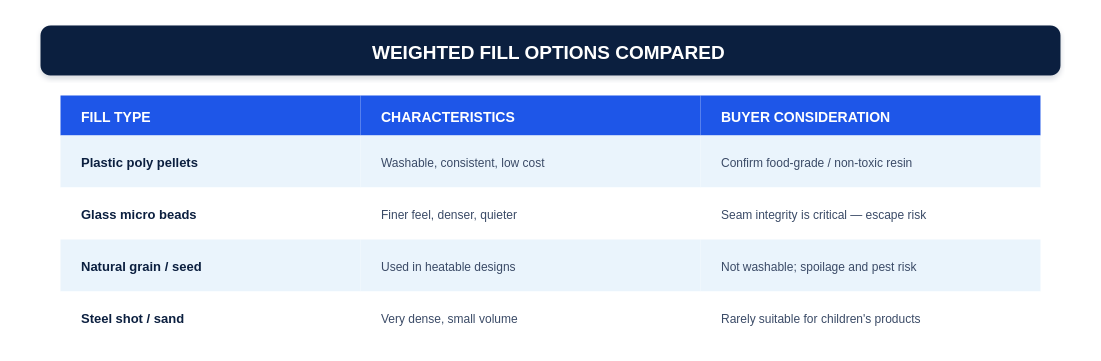
Fill choice drives cost, feel, washability and safety profile all at once. It’s usually the first decision to lock down, because it constrains everything downstream:
Plastic poly pellets are the most common option for washable products. Glass micro beads give a finer, denser feel but make seam integrity critical — if a seam fails, the fill escapes, which is a serious hazard around small children. Natural grain and seed fills appear in heatable designs but can’t be washed and carry spoilage and pest considerations. Dense fills like steel shot are rarely appropriate for children’s products at all.
Where Weighted Fits Among Sensory Plush Toys
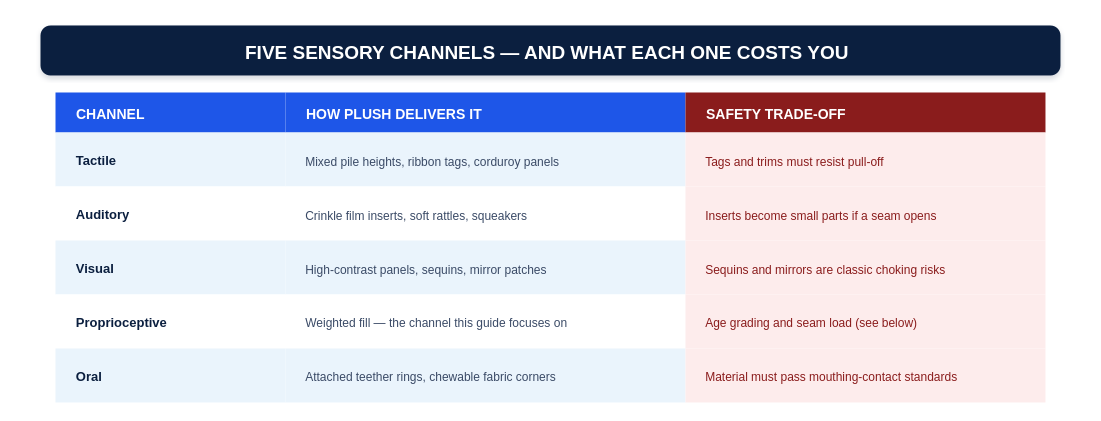
A weighted stuffed animal is one type of sensory plush toy — a broader category of soft toys built to deliver deliberate sensory input rather than just to look appealing. Weight targets one specific channel: proprioception, the body’s sense of position and pressure. The other four channels matter commercially, because most sensory products combine several, and each addition changes the safety profile.
Tactile: varied textures — mixed pile heights, ribbon tags, corduroy or minky panels — invite touch and exploration.
Auditory: crinkle film sewn into ears or limbs, soft rattles, and squeakers add quiet sound feedback.
Visual: high-contrast panels, sequins that flip between two colours, or small mirror patches.
Proprioceptive: weighted fill — the channel this guide focuses on.
Oral: attached teether rings or chewable fabric corners for products aimed at infants and toddlers.
The table above pairs each channel with the safety consideration it introduces, and the pattern is worth internalising: in sensory plush, the selling point and the hazard are often the same component. Crinkle inserts, sequins, mirrors and teether rings are all features buyers ask for, and all of them raise small-parts or mouthing-contact questions under toy safety standards. Adding sensory features doesn’t only add cost — it raises the testing burden on every unit you produce.
What Does the Evidence Actually Say?
This deserves a straight answer, because the marketing around this category often outruns what’s actually established.
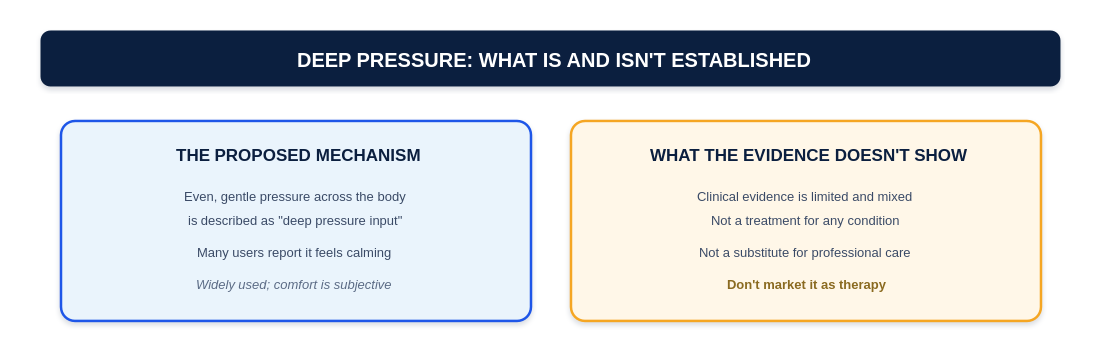
The proposed mechanism is deep pressure input — the idea that even, gentle pressure across the body feels calming. Many people genuinely report that weighted products feel soothing, and the format is widely used and widely liked. That much is real and worth saying.
What isn’t established is that weighted plush toys treat anything. Clinical evidence for weighted products is limited and results have been mixed, including in studies looking at sleep outcomes. They are not a treatment for anxiety, autism, ADHD or any other condition, and they are not a substitute for professional care.
For a B2B buyer, this is a commercial point as much as an ethical one. Comfort is a legitimate and appealing product claim. Therapy is a claim you would need evidence to defend — and one that invites regulatory and marketplace scrutiny you don’t want on a consumer product line.
Age Grading: Where the Hard Lines Are
The weighted category has drawn significant regulatory attention, and buyers entering it should understand the landscape before designing a product.
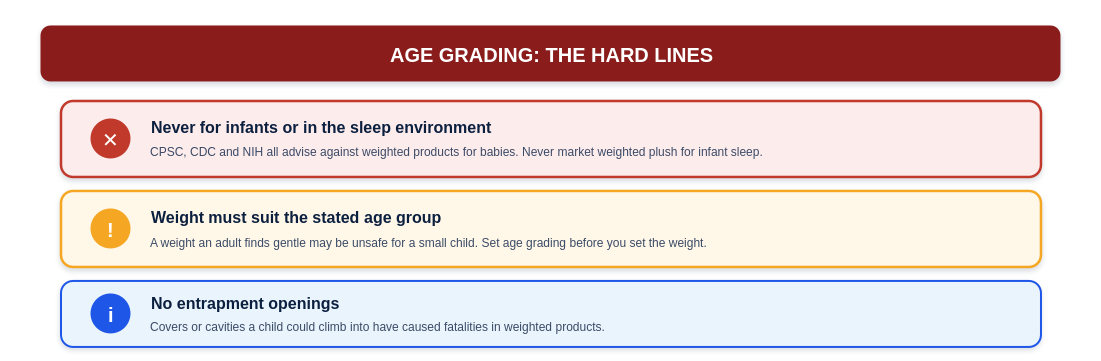
The U.S. Consumer Product Safety Commission advises caregivers not to use weighted blankets or weighted swaddles for infants, guidance echoed by the CDC and NIH, and the agency has reported investigating fatalities associated with weighted infant sleep products. In 2024 several major retailers removed weighted infant sleep products from sale. Separately, in 2022 more than 200,000 children’s weighted blankets were recalled in the U.S. after two young children died of asphyxiation having become entrapped inside a blanket cover.
Weighted plush toys are a different product from weighted blankets and sleep sacks. But the underlying hazards — pressure on a small chest, restricted movement, entrapment in an opening — are the reason the whole category is scrutinised, and they inform how a responsible product should be designed and labelled. Set the age grade before you set the weight, never position a weighted product for infant sleep, and avoid any cover or cavity a child could climb into.
Why Buyers Should Be Careful With Health Claims
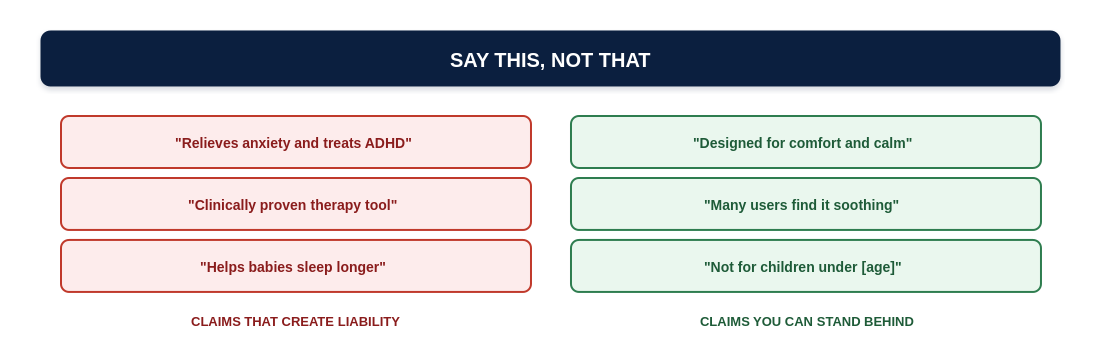
If you’re commissioning a weighted plush line for your own brand, the copy on your listing is your liability, not the factory’s. Claims about treating conditions can attract regulator attention, get listings removed under marketplace health-claim policies, and become evidence against you if a product is ever implicated in an incident.
The practical rule: describe what the product is and how it’s built, not what it will do to someone’s body or mind. “Weighted for a comforting, grounded feel” is defensible. “Clinically proven to reduce anxiety” is not, unless you hold the evidence to prove it.
A Production Example
One weighted design we’ve produced for a wellness brand client illustrates how much the format drives the engineering. It was a weighted sloth-style hugger in a matcha-green plush, built to be worn as well as held: two large clip closures let the wearer adjust the circumference so the same product can hang around the neck, wrap around an arm, or simply be held in the lap.
That adjustability was the hard part. A weighted toy that stays in the lap only has to hold its fill in place. One designed to be worn has to keep the weight distributed evenly across a changing shape, and the clips have to carry load through repeated opening and closing without loosening or stressing the surrounding fabric. Getting the balance right took several sampling rounds on fill distribution and closure reinforcement — details that never appear in the product photos but determine whether the toy still hangs correctly a year later.
What to Confirm Before Ordering
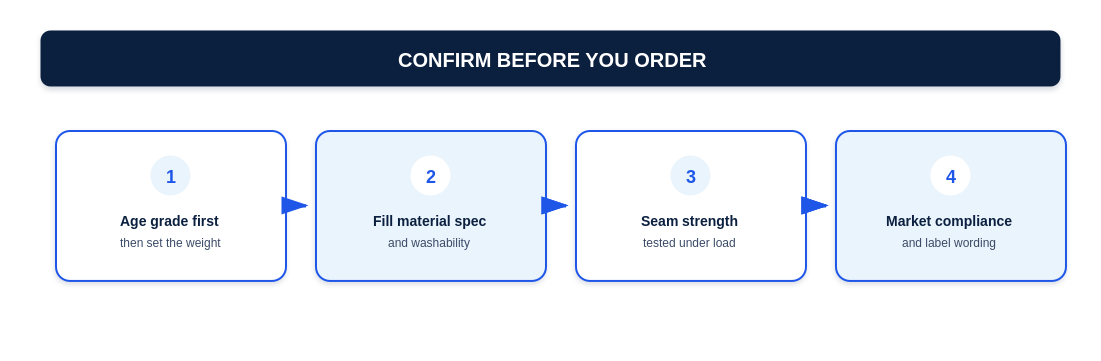
Age grade first, then weight: decide who the product is for before deciding how heavy it is. A weight an adult finds gentle can be inappropriate for a small child.
Fill material and washability: confirm the exact fill, its safety documentation, and whether the finished product can actually be washed the way your listing will say it can.
Seam strength under load: ask how seams are tested with the weighted fill in place, not just on an equivalent unweighted sample.
Market compliance and label wording: confirm which market’s standards apply, and get the age warning and care wording agreed before packaging is printed.
Frequently Asked Questions
How much do weighted stuffed animals weigh? Most fall roughly between half a kilogram and two kilograms, though it varies widely by size and intended user. The right weight depends on who the product is for, which is why age grading should be settled first.
Do weighted stuffed animals help with anxiety? Many users report finding them comforting, and deep pressure is the commonly proposed explanation. However, the clinical evidence is limited and mixed, and they are not a treatment for anxiety or a replacement for professional support.
Are weighted stuffed animals safe for babies? No — weighted products should not be used with infants or placed in an infant’s sleep environment. U.S. safety authorities advise against weighted blankets and swaddles for babies, and weighted plush should never be marketed for infant sleep.
Can weighted stuffed animals be washed? It depends entirely on the fill. Plastic pellets are generally washable; natural grain fills used in heatable designs are not. Confirm this at the specification stage, since it determines your care labelling.
What’s inside a weighted stuffed animal? Usually a combination of standard polyester fill for shape and a denser weighted fill — most often plastic poly pellets or glass micro beads — held in sectioned internal pockets.
Terminology Buyers Should Know
Term | What It Means |
Weighted stuffed animal | A soft toy with weighted fill added so it has noticeable heft when held; also called a weighted plush toy |
Sensory plush toy | The broader category of soft toys built to deliver deliberate sensory input |
Deep pressure input | The proposed mechanism: even, gentle pressure across the body |
Poly pellets | Small plastic pellets, the most common weighted fill for washable products |
Glass micro beads | Fine, dense fill giving a smoother feel; demands strong seam construction |
Age grading | The stated minimum age a product is designed and tested for |
Entrapment | A hazard where a child can climb into an opening or cover and become trapped |
A Note on Scope
This article is general product and sourcing information. It is not medical advice, and nothing here should be read as a claim that weighted plush toys diagnose, treat or prevent any condition. It also does not substitute for current regulatory guidance: requirements for weighted and children’s products differ by market and change over time. Confirm the applicable standards for your target market with a qualified testing laboratory before production, and consult a healthcare professional for questions about individual suitability.
References & Sources
1. U.S. Consumer Product Safety Commission — Statement on weighted infant swaddles and blankets
2. American Academy of Pediatrics — AAP News on weighted sleep products
3. NPR — Reporting on the 2022 children’s weighted blanket recall
Planning a Weighted or Sensory Plush Product?
If you’re developing a weighted or sensory plush line, our team can walk you through fill options, weight distribution, seam reinforcement, sensory feature construction and the age-grading decisions that should come before sampling.