
Plush Toy Certifications and Audits: What Applies to the Product, the Factory, and the Platform
Which documents you actually need, who produces each one, when to raise them, and why a factory audit and a product certificate are not substitutes for each other.
Updated August 2026 · B2B buyer’s orientation
“Certification” covers three separate things in this industry: certification of the product, audit of the factory, and document review by the sales platform. They answer different questions, and having one does not give you the others.
Direct answer: For a US children’s product you need a test report from a CPSC-accepted laboratory, a Children’s Product Certificate that you issue on the basis of that report, and compliant tracking and warning labels. A factory audit is separate, is about the facility rather than your toy, and is only required by some buyers.
Certifications and Audits — TL;DR: Product testing takes weeks. Factory audits take months. Confusing the two, or raising the second one late, is the most common way compliance delays a shipment.
Scope: This is buyer orientation, not legal or compliance advice. Requirements differ by market, product and age grade and change over time — confirm what applies to your product with a qualified testing laboratory. For what the standards themselves contain, see our
guide to toy safety standards →, which covers ASTM F963, EN71 and CPSIA in detail. This article is about the paperwork rather than the standards.
Three Different Things People Call “Certification”
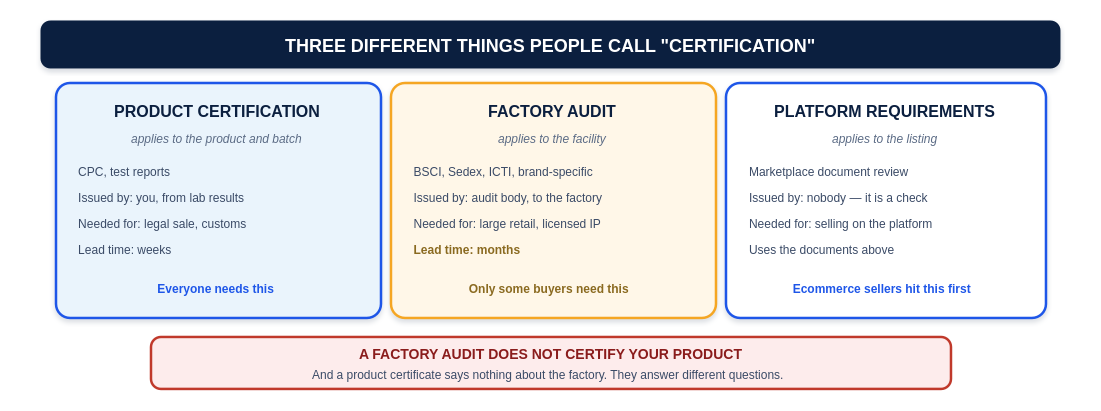
Most confusion in this area comes from one word covering three unrelated processes.
Product certification attaches to a product and a production batch. It consists of test reports and, in the US, a Children’s Product Certificate. Everyone selling a children’s product needs this, and it typically takes weeks.
A factory audit assesses the facility — working conditions, social compliance, management systems. Schemes such as BSCI, Sedex and ICTI are common, and large retailers and licensors frequently require one before they will accept goods from a supplier. It says nothing about whether your specific toy passed any test, and it takes months rather than weeks.
Platform requirements are a document review, not a certificate. A marketplace asks you to upload the paperwork you already hold before your listing goes live. Ecommerce sellers usually encounter this first, and often assume it is a separate certification when it is simply a check on the documents above.
The practical consequence is worth stating plainly: a factory audit does not certify your product, and a product certificate says nothing about the factory. Suppliers sometimes answer “are you certified?” with whichever of the two they hold, which is why the more useful question is which specific document you are being offered.
The Document Set
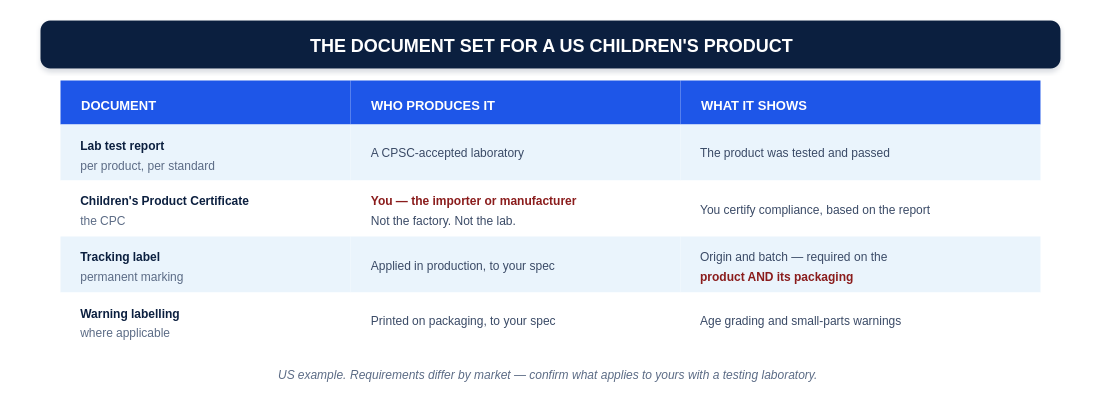
For a US children’s product, four things need to exist, and knowing who produces each one prevents the most common misunderstandings.
The test report comes from a CPSC-accepted laboratory. This matters: reports from other labs, however reputable, do not satisfy the requirement for US children’s products. The Children’s Product Certificate is issued by the importer or manufacturer — not by the factory and not by the lab — on the basis of that report. Tracking labels are applied in production to your specification, and must appear on the product and on its packaging rather than one or the other. Warning labelling, where a product contains small parts and is graded accordingly, is printed on the packaging.
Packaging carries two of these four, which is why packaging artwork cannot be finalised until the market and age grade are settled. Our packaging guide → covers that timing in more detail.
When to Raise Each One
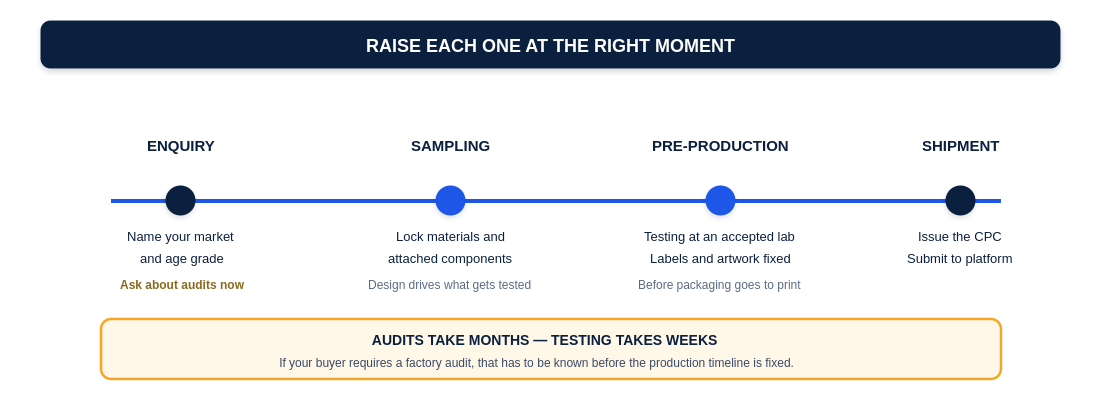
Compliance rarely fails because a requirement was unknown. It fails because it was raised too late in the project to act on.
At enquiry stage, name your destination market and age grade — these determine everything downstream — and ask about factory audits if there is any chance your buyer will require one. At sampling, materials and attached components get locked, and those decisions determine what has to be tested. Before production, testing is carried out and labels and artwork are fixed, which has to happen before packaging goes to print. At shipment, you issue the CPC and submit documents to whatever platform or retailer requires them.
The asymmetry to remember is the timeline. Product testing runs in weeks. A factory audit runs in months, from application through scheduling to a completed report. Raised at the right moment, an audit is an administrative task. Raised after an order is placed, it delays the shipment.
Where We Stand, and Why We Are Telling You
Since this article is published by a manufacturer, it would be easy to imply more than is true. Two things worth stating plainly:
We are not a testing body. We cannot issue your Children’s Product Certificate, because that document belongs to the importer or manufacturer of record. What we do is build to the agreed specification, supply samples and material information to whichever laboratory you appoint, and revise the design where a test result requires it.
We do not currently hold factory audit certifications such as BSCI or Sedex. If your buyer requires one, tell us at the enquiry stage — audits typically take several months to arrange and complete, so it needs to be raised before your production timeline is fixed, not after. Most of the projects we work on, for ecommerce brands, gift companies and independent labels, do not require a factory audit at all. Some do, and it is better for both sides to establish that early.
A supplier who answers every compliance question with a yes is not necessarily the safer choice. Knowing precisely what a factory does and does not hold is what lets you plan around it.
Five Misunderstandings That Cost Time
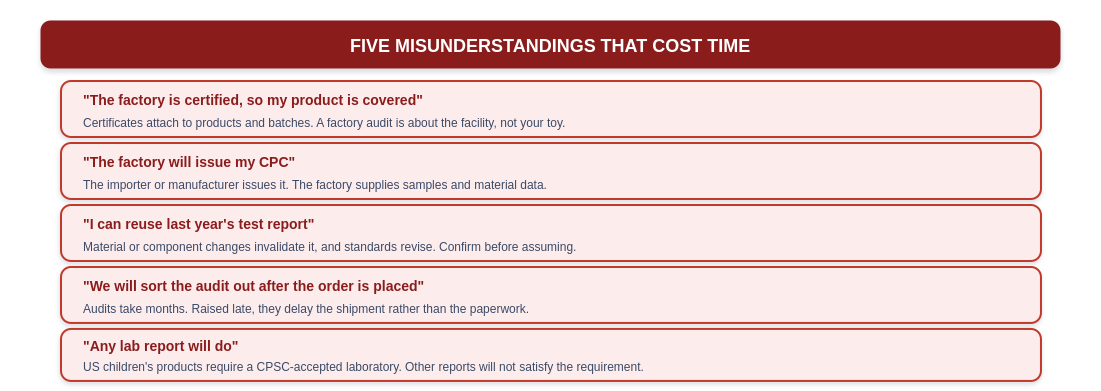
These come up repeatedly, and each one has the same effect: work that could have happened in parallel ends up happening in sequence, after the deadline is already set.
“The factory is certified, so my product is covered.” Certificates attach to products and batches. Whatever a factory holds, your product still needs its own testing.
“The factory will issue my CPC.” It will not, because it cannot. The importer or manufacturer of record issues it.
“I can reuse last year’s test report.” Sometimes, but material or component changes can invalidate it and standards revise over time. Confirm rather than assume.
“We will sort the audit out after the order is placed.” Audits take months. This is the single most expensive version of raising something late.
“Any lab report will do.” For US children’s products it must be a CPSC-accepted laboratory. A report from elsewhere does not meet the requirement, however thorough the testing was.
Frequently Asked Questions
What certification do plush toys need to sell on Amazon? For US children’s products, a Children’s Product Certificate and test reports from a CPSC-accepted laboratory, covering the applicable requirements. The platform reviews documents you already hold rather than issuing a certification of its own.
Who issues the Children’s Product Certificate? The importer or manufacturer of record. Not the factory, and not the testing laboratory — the lab produces the report the certificate is based on.
Is a factory audit the same as product certification? No. An audit assesses the facility; certification applies to the product and batch. Large retailers and licensors often require both, and holding one says nothing about the other.
How long does compliance take? Product testing generally runs in weeks. Factory audits generally run in months. Plan the second one much earlier than the first.
Do I need a factory audit? It depends on your buyer, not on the law. Large retail chains and licensed IP programmes commonly require one; direct-to-consumer brands and smaller ecommerce sellers usually do not. Ask your buyer before assuming either way.
Can I use test reports the factory already has? Only if they genuinely cover your product as built. Reports for a different design, different materials or a different standard version do not transfer. Ask what exactly was tested and when.
Terminology Buyers Should Know
Term | What It Means |
CPC | Children’s Product Certificate — issued by the importer or manufacturer, based on lab results |
CPSC-accepted laboratory | A lab formally accepted by the CPSC to test US children’s products; other labs do not satisfy the requirement |
Tracking label | Permanent identifying marks required on a US children’s product and its packaging |
Factory audit | An assessment of a facility — social compliance, working conditions, systems — not of any product |
BSCI / Sedex / ICTI | Common social-compliance audit schemes requested by large retailers and licensors |
Platform compliance | A marketplace’s own document review before a listing goes live |
A Note on Scope
This article describes how certification, auditing and platform review generally fit together, using the US framework as the main worked example. Requirements differ substantially by market, product type and age grade, and both standards and platform policies change over time. Nothing here is legal or compliance advice, and it does not describe the requirements of any specific retailer, licensor or marketplace. Confirm what applies to your product with a qualified testing laboratory, and with your buyer, before committing to a production timeline.
References & Sources
1. U.S. Consumer Product Safety Commission — Toy Safety Business Guidance
2. U.S. Consumer Product Safety Commission — Children’s Product Certificate guidance
3. U.S. Consumer Product Safety Commission — Tracking label business guidance
Planning a Project That Needs Documentation?
Tell us your destination market, age grade and sales channel at the enquiry stage. We’ll tell you what testing your design will need, what we can supply toward it, and — where a factory audit is involved — whether that is realistic within your timeline.